The Next 100 Miler!

Next weekend I’m running the 100-Mile Haliburton Forest Trail Race. Yes, to answer your question, I’m excited. Also, pretty freaking scared.

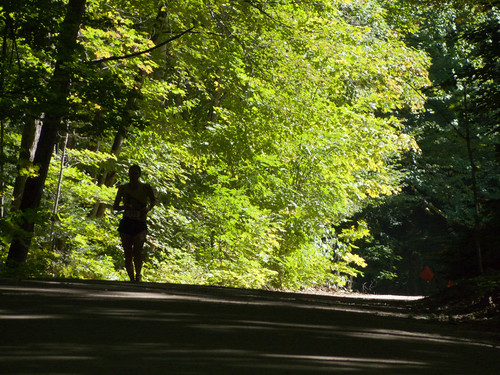
My brother, The Photographer, will be there as usual. Here are some pictures he’s taken in past years.

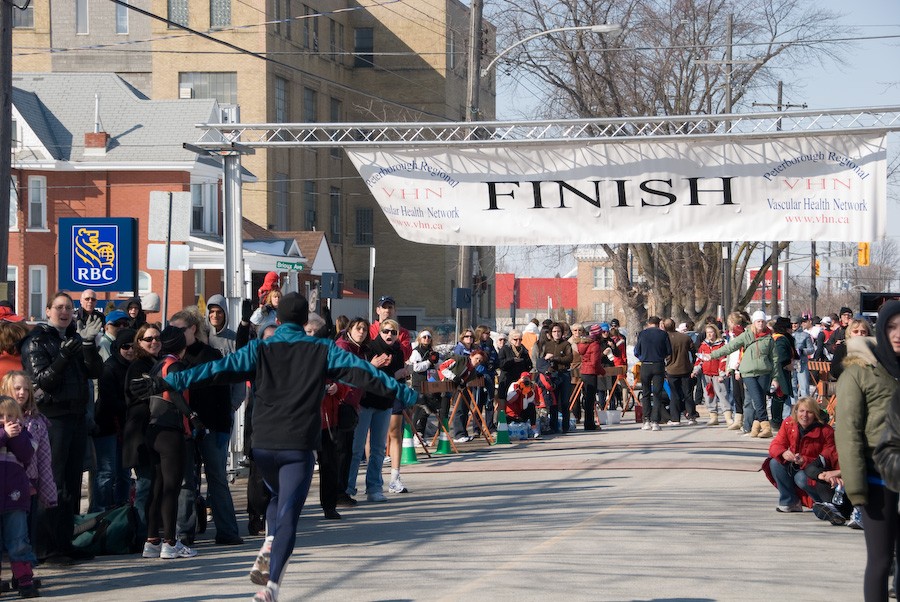
The starting line

That’s the starting line. The race begins at 6 am. Many runners wear headlamps, and most of us will see the sun rise twice before we stop running.

Think of me when you get up on Saturday morning. By the time you eat breakfast, I’ll hopefully have run 15 miles.

Uphill

Think of me again at lunch, by which time, I’ll be somewhere around mile 32.

Haliburton Forest race (6)

By dinnertime, I’ll be closing in on 60 miles.

Running

By the time you go to bed, I might be at mile 72.

Haliburton Forest race (2)

When you get up early Sunday morning to take a pee, I’ll hopefully be close to the finish line.

100 miles (3)

Or maybe not.  You never know.  Running through a forest for 24 hours straight is kinda like running through a Grimm’s fairy tale. It’s incredibly beautiful, but there’s danger too.  And there’s no guarantee of a happy ending.

Photo hat tip: andyscamera

This is What a Dream Comes True Looks Like:

first copy of Ultra

Yesssss!

My first novel. In my hands. For realsies.

It was the hardest thing I ever did.  Writing the thing was only half the battle. Getting it published was even harder.

But this feeling, this moment, makes it all worthwhile.

To those of you who are struggling to get your writing into print, please, don’t give up! It can be done. Hard work pays off.

Dave poster 2

And I must give a huge shout-out to my nieces and nephews – who inspired this story, lent their names to some of the characters, helped me with the jokes and dialogue, and even shared early versions of the book with their classmates.  You all deserve a finisher’s medal:

Aaron, Alex, Ali, Ben, Benjamin, Brody, Caelan, Caitlin, Caleb, Christopher, Daniel, Darcie, Grace S., Grace W., Jackson, Julia, Julian, Kara, Kelsey, Kiernan, Leonardo, Lucy-Claire, Luke, Monty, Madelaine, Maggie, Mateos, Nate, Oliver, Olivia, Parisinia, Quinn, Ray, Riley, River, Rowan, Rylee, Sacha, Skyler, Sofia, Sydney, Tahnee, Tobias, Zoe.

Re-writing is your Friend

SCAN0006

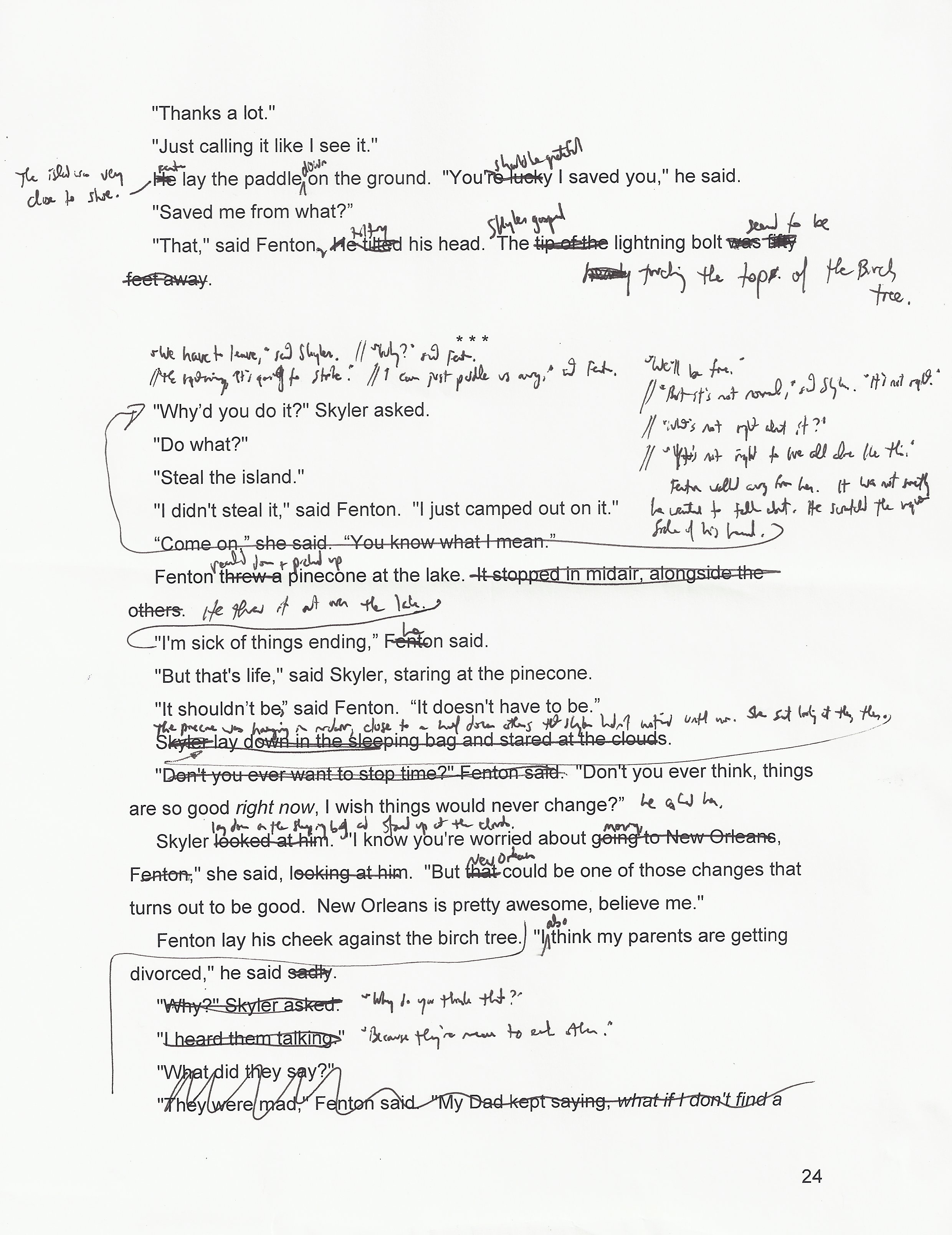
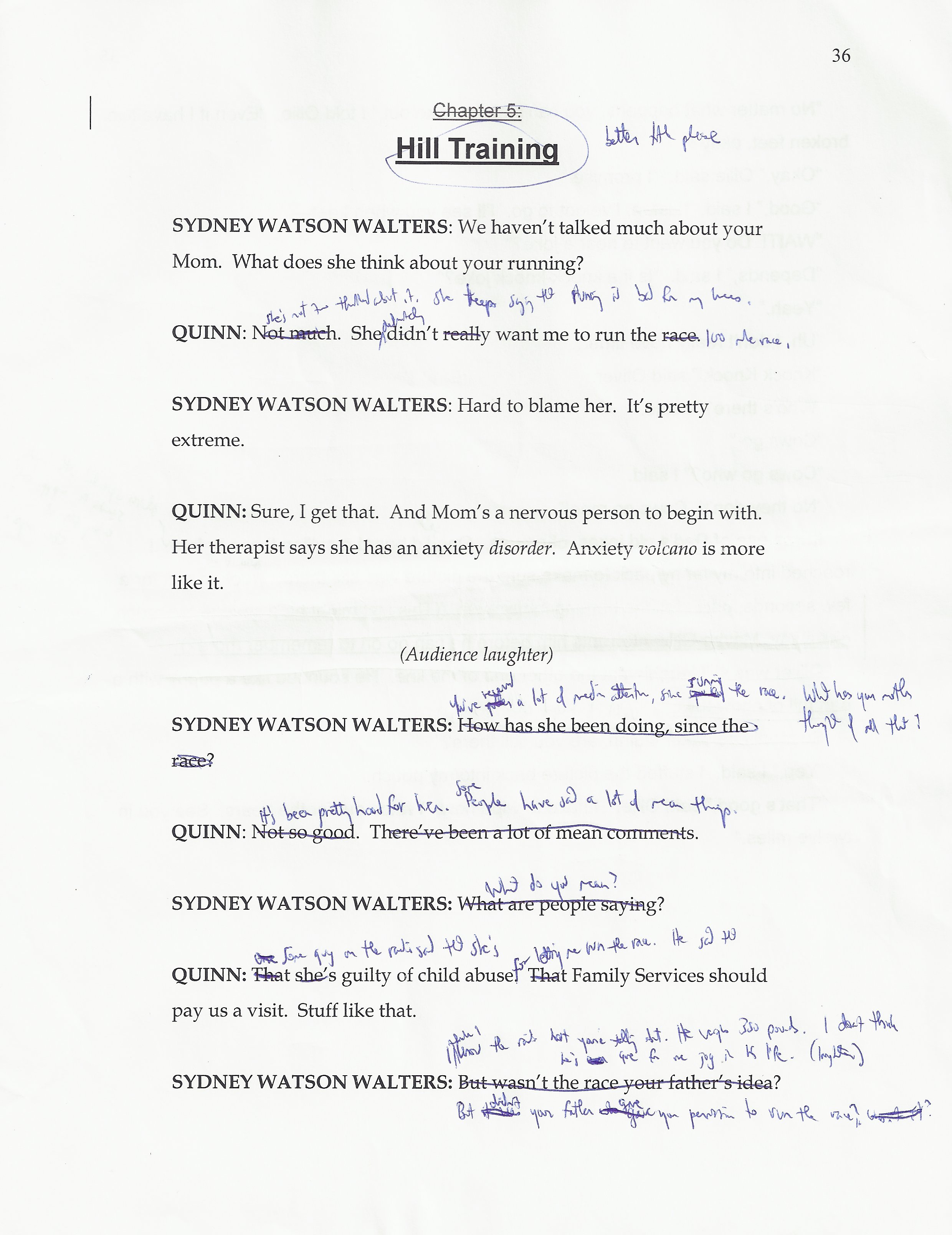
People often ask me how many times I re-wrote my first novel, Ultra.  Trust me when I say, YOU DON’T WANT TO KNOW.

Image

I wrote the first version waaaaaay back, in the summer of 2008.  It was 20,000 words long, and it swallowed two months of my life.  Back then, it was titled “Quinn and the 100 Mile Race.”

I finished the second draft a month later.  By Christmas I’d rewritten it a third time, and then I sent it out.

I sent it to an agent and also a publisher.  The publisher said some nice things about it.  She said the narration was lovely and warm; perhaps too lovely and warm.  She explained that the warm tone made it hard to believe that the central character was living on top of a calamity.  Which was why she was going to take a pass.

The agent didn’t reply.

I wasn’t too upset about it.  I’ve written lots of stuff over the years that never got published.   That’s the writer’s life.  I stuffed the manuscript in a drawer and forgot about it.

Two years later, I picked it up again.  I re-wrote it for…let’s see…the fourth time.

After 5 months of work, I pitched it 50 agents.  49 of them said, “Thanks but no thanks.”

The fiftieth agent (the brilliant Scott Waxman who represents some of the finest sports writers, including the legendary John L. Parker) called me on the phone.  When I saw the 212 area code on the display, I knew something was up.  Scott told me that he liked my story.  He said, however, that he wasn’t quite ready to offer representation just yet.  There were a few things I ought to think about – if, that is, I was “willing to re-write the manuscript.”   

I thought about the improvements that Scott suggested.  I thought about them for all of ten seconds.

Once again, I started re-writing.  When I finished that re-write I did another.

And then another.

And then another.

SCAN0007

After six months of re-writing, Scott Waxman accepted my novel.  I received an “Offer to Represent” in the mail.

Cue the champagne corks!  Cue the s’mores!

A couple of months later, the novel sold to Scholastic Canada.

MORE champagne!  MORE s’mores!

In the year or so since I signed with Scholastic, I’ve done three more rewrites.  The first took 3 months, the second took one month, the third took a week.

That makes eleven re-writes in all.

I know that sounds like a lot of work, but listen: with every single re-write the book got better!

Lesson learned:

Writing a book, and running 100 miles, are similar in two distinct ways.

(1) Both involve a TON of pain.

and (2) The finish line is incredibly sweet.

Real Life Superheroes, Part 2

Take a look at the runners in these pictures.  Can you tell what makes them all special?

First, there’s America’s Dick Beardsley (on the left):

Dick+Beardsley+and+Inge+Simonsen+finish+the+London+Marathon+together.+Horace+Culter+of+the+Greater+London+council+one+of+the+men+who+made+this+race+possible+watches+on+in+the+background

Up next, Spain’s Fernandez Anaya (in green):

o-FERNANDEZ-ANAYA-570

And finally, Ohio track star Meghan Vogel (blonde hair, on the right):

Meghan Vogel

Any guesses?  Yes, they’re all runners, and yes, they’re crazy fit.  They probably run 100+ miles a week and eat nothing but salads and nuts.  But these incredibly healthy human specimens have something much more interesting – and much more valuable – in common.

You’ve got fifteen seconds to figure it out.  Tick tick tick tick tick…TIME’S UP!

ANSWER: All of these runners are real-life superheroes.  They’re not only fast.  They’re also super kind.

Take Meghan Vogel.  She was competing in her third race of the day.  Ahead of her, a runner crumpled to the ground in the heat.  But instead of dashing past her, she lifted her up, helped her to the finish line, and literally pushed her across the finish line.

Fernandez Anaya (the guy in the green shirt) was equally generous.  He was running second in his race, a ways behind the race leader, Abel Mutai.  As he entered the finishing straight, Fernandez noticed Mutai pull up about 10 metres before the finish line.  Mutai thought he’d crossed the finish line, BUT HE HADN’T!  He still had 30 feet left to go!

Instead of racing past Mutai for the win, Fernandez slowed down and gestured at him to keep running.  He literally helped the OTHER guy win.

Which brings me to the black and white photo of Dick Beardsley at the top.  Dick was running the very first London marathon in 1981.  He and Norway’s Inge Simonsen spent the race battling for first place.  In the finishing stretch, instead of trying to prove who was better than the other, the athletes clasped hands and crossed the finish line together.

How awesome is that?  They acknowledged they were evenly matched, and split the first place prize two ways.

Someone should show these videos to Lance Armstrong.

Out-of-Body Experience

A friend says to me, “hey Dave, want to know the fast track to aging?

What’s that?” I say.

Running!” he says.

Sadly, there’s some truth in the joke.  For every mile you run, you burn 100 calories.  Once you’ve trimmed the fat off the usual places, it starts coming off your face and upper body.  Makes you look a little, er, grizzled.  

I don’t care, I’m addicted.  I’ve got a 100-miler coming up next month, so I’m cramming in as many long runs as possible. Twenty, thirty, forty miles at a time.

I love the long runs.  After a couple of hours of plodding down a trail, I generally slip into a trance.  The breath goes in, the breath goes out.  My feet smack the pavement 180 times a minute.  Running becomes a meditation.  I do not smile or wave at the people I pass.  Instead, I focus on keeping my body tilted slightly forward, and snapping my feet right back into the air the moment they hit the pavement.  (That’s the trick to being fast, by the way – let your feet touch the ground for as short a time as possible.)

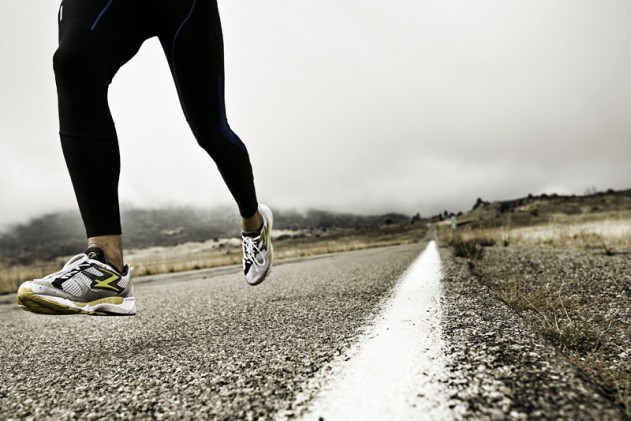
I’ve got pictures of me running, and it always astonishes me to look at them. Usually, both of my feet are in midair.  Given that I’ve been running every day for the last 17 years, I have to wonder: how much of my life have I spent completely disconnected from the earth?
road-running-631x421

Once, during a marathon, I had an out-of-body experience.  I was running up a nasty hill.  I’d covered 22 miles, and I was getting tired.  “Blinding wall of pain” is a little strong, but I was getting into that territory.

Suddenly, all pain vanished. I couldn’t feel my legs. It seemed to me that I was sitting inside my ribcage, peeking out between my bones at the scenery floating by. I wasn’t doing the running anymore. Someone else was. I was just sitting comfortably in that ribcage, like a kid in a grocery cart.

Then suddenly, I was looking down on myself from above. I saw a short-haired dude in Mizuno sneakers and Drifit shorts, struggling up a ten degree hill. I didn’t see this person as a runner though – I saw him as an extension of the earth. I thought to myself: what silly perseverance! What pointless ambition! And then I stared to laugh.

Of course, the moment I laughed, the vision disappeared. My normal consciousness – and the pain – returned.

Peterborough Half marathon finish - Dave

I finished that marathon in 3:04:25.  Did pretty well in my age category too. My age category, by the way, is 35-49. Of course, I don’t look a day over 60.

Thunder Running

Reasons not to run on the Bruce Trail during a thunderstorm:

  1. A tree could fall on you and you could die.
  2. You could get swallowed by the mud and die.
  3. Lightning could strike you and you could die.
  4. You could slip off the 500-foot scarp face and die.

Reasons to run on the Bruce Trail during a thunderstorm:

  1. It’s super fun.

mud running

At a certain point, when you’re soaking wet and freezing cold and lathered in mud, and the forest is as dark as night, and the rain is lashing you like a blizzard of molars, and you’ve still got 15 kilometers left to go before you get back to the car, well, at a certain point, you’ve just got to throw up your hands and laugh, don’t you?  After all, you checked the weather online.  You saw the probability of precipitation (75%) and the expected accumulation (20 – 40 mm), and you saw those clouds amassing on the horizon like an army of unwashed hoodies.  You knew what you were in for and you just laughed, didn’t you?  Well, now it’s time to laugh again.

As for all that mud, well, that can’t be a surprise either.  You do you know what happens to dirt trails when you add water to them, don’t you?  You did play in a sandbox as a child, right?  When water is added to dirt, that dirt turns into mud.  You know this.  If you add enough water, you get something worse than mud.  You get a slippery, shoe-sucking, toffee-like substance called glop. 

But it’s not all bad, is it?  There’s nothing like hypothermia and mud inhalation and blood loss and the threat of plunging into a crevasse cave fathoms deep to fire up the old endorphins, is there?  Especially when you arrive back at your car after three hours of slogging through rushing creek-beds, and stare at yourself in the rear-view mirror only to see a hollow-eyed, scabby-elbowed, tick-bitten runner; hair singed from stray lightning bolts, face besmirched with mosquito guts, and you swear you’ve never seen anything quite so idiotic!

An Ultra-Challenge for July

Of all the months, July is THE BEST.  July is like hitting a bunch of green lights in a row.  It’s better than the smell of crayons.  It’s the Justin Timberlake of months.

I usually take the whole month off, rent a cabin surrounded by hills and trails, and just run.  Last year, near Collingwood, I logged 347 miles on the Bruce Trail.  The July before that, I covered 316 miles in the Haliburton Forest. The July before that I managed, well, only 272 miles, but that’s because I was running up and down mountains in France.

Running up "The Canigou" - near Perpignan, France

Running up “The Canigou” – near Perpignan, France

This July, I’ve set an even BIGGER challenge.  In addition to running 12 miles per day, I’m determined to write my second novel.

WHAT???  In a month?  Who does he think he is – Stephen King?

Actually, I don’t have to write it from scratch.  I wrote a first draft a couple of years ago, but then I set it aside, so I could work on my other book, which is, you know, actually getting published.

This July is the first chance I’ve had to go back to work on that other writing project.  It’s a big, messy, 60,000-word turd right now, but I’m excited about polishing it into a diamond.

So every day this July, in addition to burning 1000 calories on the trail, I’m hoping to produce 2000 words.  Words that glitter like spun glass, words that gleam like dragonflies in sunshine, words that shimmer like cobwebbed trees in summery skies

Okay, I’ll stop now.

This July, I’m also planning to: eat 30 salads, drink 30 cups of coffee, watch 30 sunsets, take 30 naps, and watch zero television shows.

Wish me luck!

My First Book Interview

My novel is going to the printer TODAY.  Synchronize your watches – it’ll be hitting the bookstores in ten weeks.  

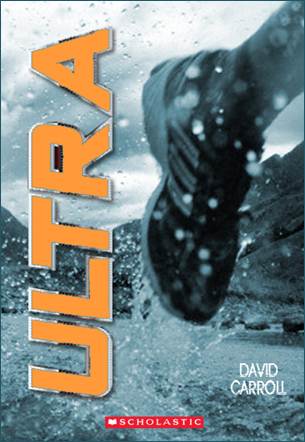
Ultra cover

I had my first book interview today.  Strange experience.  I work for the media, so for years, I’ve been the one asking the questions, not answering them.  Role reversal!

Still, it was fun to talk about these characters who’ve been making a racket inside my head for the last three years.

Here are the first five questions I was asked as an author:

Q: What is the best part of being an author?

I love that the gear is so cheap!  If I wanted to be a professional snowboarder, I’d have to spend hundreds of dollars on equipment.  The board, the boots, the bindings, the jacket…  Pricey!  But all an author needs is a pen and some paper.  What does that cost – maybe $5?

Also, I never get hurt, writing books.  That’s a definite plus for me.  If I was a hockey player in the NHL, I’d probably get hit a lot.  I’m a bit of a wimp when it comes to getting hit, so that wouldn’t be much fun.  As an author, the worst thing that can happen is I get a paper cut.

The best thing about being an author, however, is that the job is dead easy.  The alphabet only has 26 letters.  So all I have to do is arrange those letters in such a way that they tell a good story.  How hard could that be?

Q: What inspired you to write Ultra?

Five years ago, I did an insane thing.  I entered a hundred-mile footrace.  For 24 hours – all day and all night – I ran through a forest.  Some runners saw bears along the route, and all through the night I heard wolves howling in the distance.  It was a terrifying and exhausting experience.  But when I crossed the finish line, my life had changed.  I’d always thought it was impossible to run 100 miles in a day, but now that I’d done it, the whole world seemed different.  I’d changed the goalposts of what I believed was possible.  So I decided to try something else that I’d always thought was impossible – writing and publishing a novel.  And voila!

Q: What was the hardest part of writing this book?

Deciding whether or not the main character, Quinn, should win the race.  For the longest time, I had him crossing the finish line first.  But then I decided that he shouldn’t win; that something else – something dramatic – should happen instead.  So I rewrote the ending.  But then I gave the book to family members to read, and they complained about the ending.  So I rewrote it again, and then again.

I went back and forth, rewriting that ending for a year.  I can’t even remember anymore whether Quinn wins or loses the race.  But I will say this.  Most 100-mile races don’t give prizes to the winners.  Usually the winner just gets a pat on the back, a warm blanket, and a bowl of vegetable soup.  Almost nobody runs a 100-mile race in order to win.  They do it for other, much stranger reasons.

Q: In what ways are you like Quinn, the protagonist in your book?

I share Quinn’s determination.  Once I get an idea into my head, I’ll stick with it, no matter how much it hurts.  That’s why I can run 100 miles in one go.  Also, I love being outside, and I’m okay with being alone sometimes.  I’m a bit of an introvert, and I think Quinn is too.

And finally, like Quinn, I have a really solid friend.  And an amazing family that supports me – even when I do crazy things.

Q: What was your favourite book growing up?

“Swallows and Amazons” by Arthur Ransome.  It’s about a group of kids who climb mountains and race sailboats and survive shipwrecks and explore the high English moors.  Their parents are nowhere in sight, and the kids are always outdoors, facing the elements.  My dad read that book aloud for my whole family when I was a kid.  He’d read one chapter each night before bedtime, and the next morning me and my brother would race for the book so we could read on ahead.

“Swallows and Amazons” was the first in a long series, and Dad read us every single one over the course of a long, magical summer.  And that’s saying something, since there are twelve books in the series, and each one is 350 pages long.  Looking back, I think that experience cemented my love of reading.  Dad reading those books out loud.

Another Burden to BEAR

Patricia Sommers was having a great race.  Until she ran into the bear.

Sommers was running her first 100-miler, in the Haliburton Forest, back in 2000.  She was keeping a good pace, the weather was good, and her husband was waiting for her at the 75-mile turnaround.

One mile shy of that aid station, Sommers heard a noise.  It was eleven at night, and she could hear a large animal crashing down a hill towards her, on the left hand side of the trail.  “I hoped it was a moose, but it wasn’t,” she explained. “It burst onto the path 100 meters ahead of me.”

Sommers shone her headlamp at the animal.  It was an adult black bear.  It rose up on its hind legs and roared.

Black bear

I’ve run into a number of bears on the trail.  It’s gets your heart pumping, that’s for sure.   Given that these animals are large, with claws the size of steak knives, I’ll found myself wondering: am I crazy to be running in a forest?

The answer, according to Bart Hillhorst, is no.  Hillhorst is a Forestry Technician with Ontario’s Ministry of Natural Resources.  He deals with a lot of problem bears.  “There’s always a danger with animals of this size,” he explains, “but in general, black bears are programmed to be scared of humans.  Ninety percent of the black bear’s diet is vegetation – grass, berries, nuts.  The other ten percent is meat, but that’s mostly larvae and ants.  The reality is, bears don’t like dealing with people.  It’s not in their personality.”

Statistics back this up.  Since the early 1900’s, fewer than 70 deaths in North America have been attributed to black bears.

“When you see a bear on the trail, your first reaction is to be scared,” Hillhorst says.  “That’s perfectly natural, but fear is the wrong thing to show a bear.  You want to be calm.  You want to look at the bear and figure out her situation.  What’s the bear doing?  Is it aware you’re there?  Is it feeding on something?  Are there cubs nearby?  Then you can figure out your best response.”

“Once you know what the conditions are, then it’s just a matter of risk tolerance,” explains Dr. Stephen Herrero, Professor Emeritus of Environmental Science at the University of Calgary.  “There is risk associated with bears, so you have to decide if you’re comfortable with that.  I’m a runner myself, and I love running in nature.  But there are some places in North America where I wouldn’t dare run right now.”

If you do decide to lace up in bear country, you can take steps to increase your safety.

1) “Run at a more leisurely pace than you otherwise might.  Bears hate surprises, that’s a major cause of aggressive behaviour, especially with Grizzlies.

2) Keep an eye out for bear tracks, spoor, fresh diggings, torn up logs and scratched trees.  If you see any of those, find another place to run.

3) Above all, make lots of noise, particularly when you’re running in dense forest, or rounding blind corners.

Carrying a can of bear repellent doesn’t hurt either.  Just be sure you know how to use it.

“When you’re staring at that bear, and your heart is racing, and the wind is blowing, how good do you think your aim is going to be?” Hillhorst says.  “Bear spray is good because it gives you confidence, but practice using it a couple of times before you head out.”

Sweaty to Office Ready

A few Februaries ago, while standing on a streetcar, politely absorbing the cloud of germs radiating from the human flu cases all around me, I glanced out the window and had a revelation.

A happy-looking runner bounded up the sidewalk. A vapour trail of snow whorled behind her.

*Jan 19 - 00:05*Brilliant, I thought!  Why hadn’t I thought of it before?  Instead of suffering for hours on public transit, I could be running to work, and losing weight at the same time!

Ever since that revelation, I’ve been running to and from work every day.  I’m saving money on transit, I’m saving time, and my oxygen-rich blood has led to improved performance at work.

Still, I’ll be the first to admit that the running commute can be fraught with peril. Over the years I’ve been caught half-in and half-out of my spandex tights in the photocopy room.  I’ve been referred to as “Chicken Legs Carroll” at a staff meeting.  And I’ve been accused of “stinking up” workstations 2G208 through 2G212.

More on that latter item in a moment, but first, I’d like to address the most significant challenge facing the commuting runner: wardrobe planning.  Any casual runner is capable of keeping a spare shirt or two at the office.  But what about us addicts who run both to and from work, each and every day of the week?  To do this successfully, some planning is in order.

Once a week, I pack a duffel bag full of clean clothes and shlep it downtown. Three pairs of pants, three dress shirts, and four tee-shirts generally do the trick. I also leave a few items at work permanently – sports jacket, belts, a filing cabinet full of clean socks.

clothes pic

My filing cabinet holds all manner of fine toggery

It’s not a fail-safe plan.  Countless are the times I’ve grabbed a clean shirt, shoes, underwear and socks from my filing cabinet, and headed for the showers only to discover that I have no pants.

What the….WHERE ARE MY PANTS!?!

Ever sat through a board meeting in dri-fit shorts?

But maintaining a satellite wardrobe is only the half the battle.  It’s also critically important to be pre-emptive with one’s sweaty laundry.

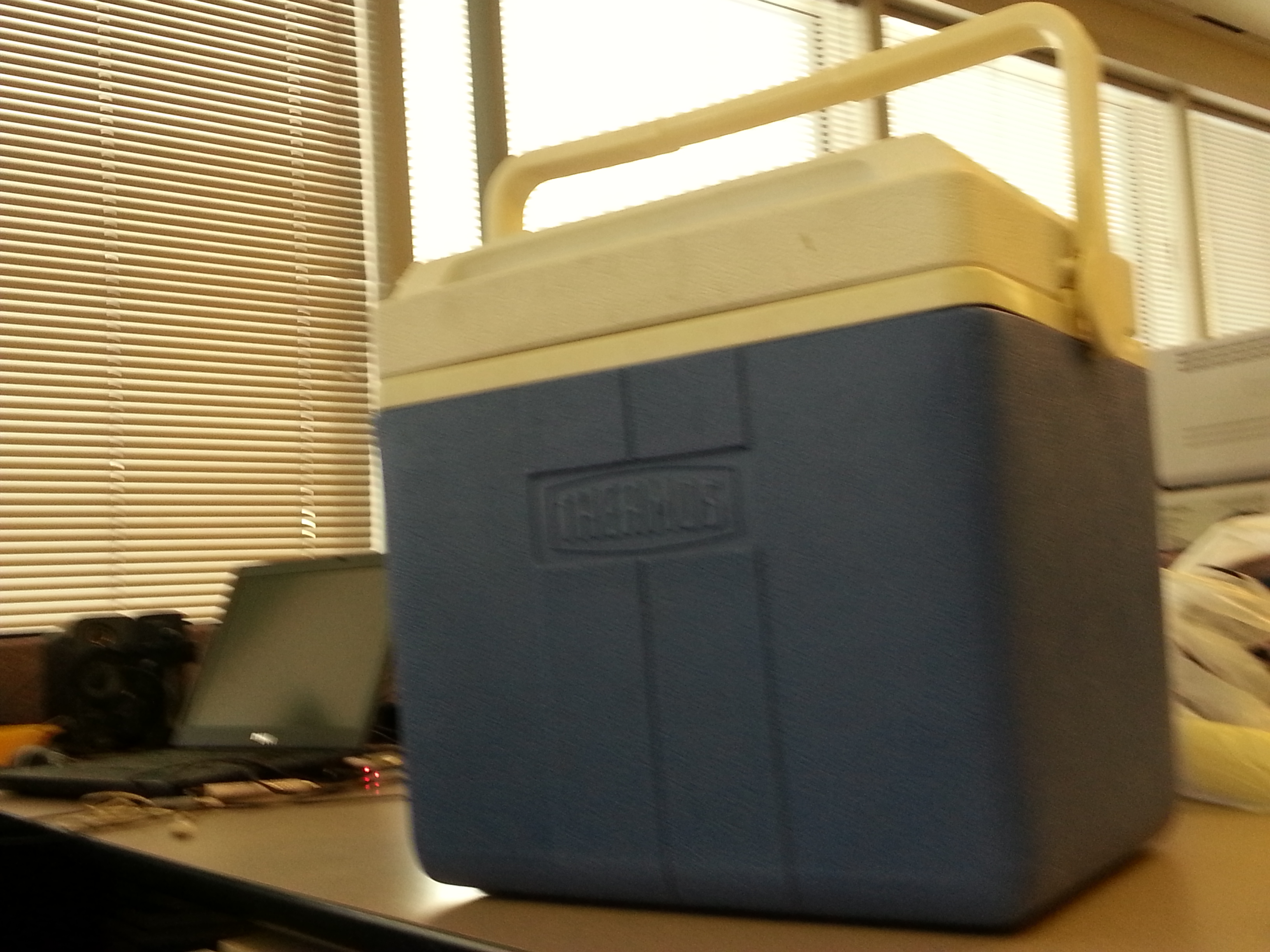
cooler pic

Hide-a-stench

For this, I look no further than my trusty Coleman cooler.  With its airtight seal, that baby can store up to 3 days worth of biological waste without emitting any foul smog.

Despite these precautions, I still get the occasional complaint from my neighbor at workstation 2G212.  I’m doing everything I can, but frankly, I think it’s time for our industry leaders to lend a hand.  If companies really want to attract health-conscious and carbon-neutral employees, they need to get ahead of the fitness curve.  I’m not talking about bike racks and shower rooms.  These days, those are the mere baseline.  I’m talking about lunch-hour massages, Gatorade and Clif shot energy gels in the vending machines, and most importantly, same-day dry cleaning service.

And would it really kill our bosses to keep an ironing board in the photocopy room?  I mean, c’mon!

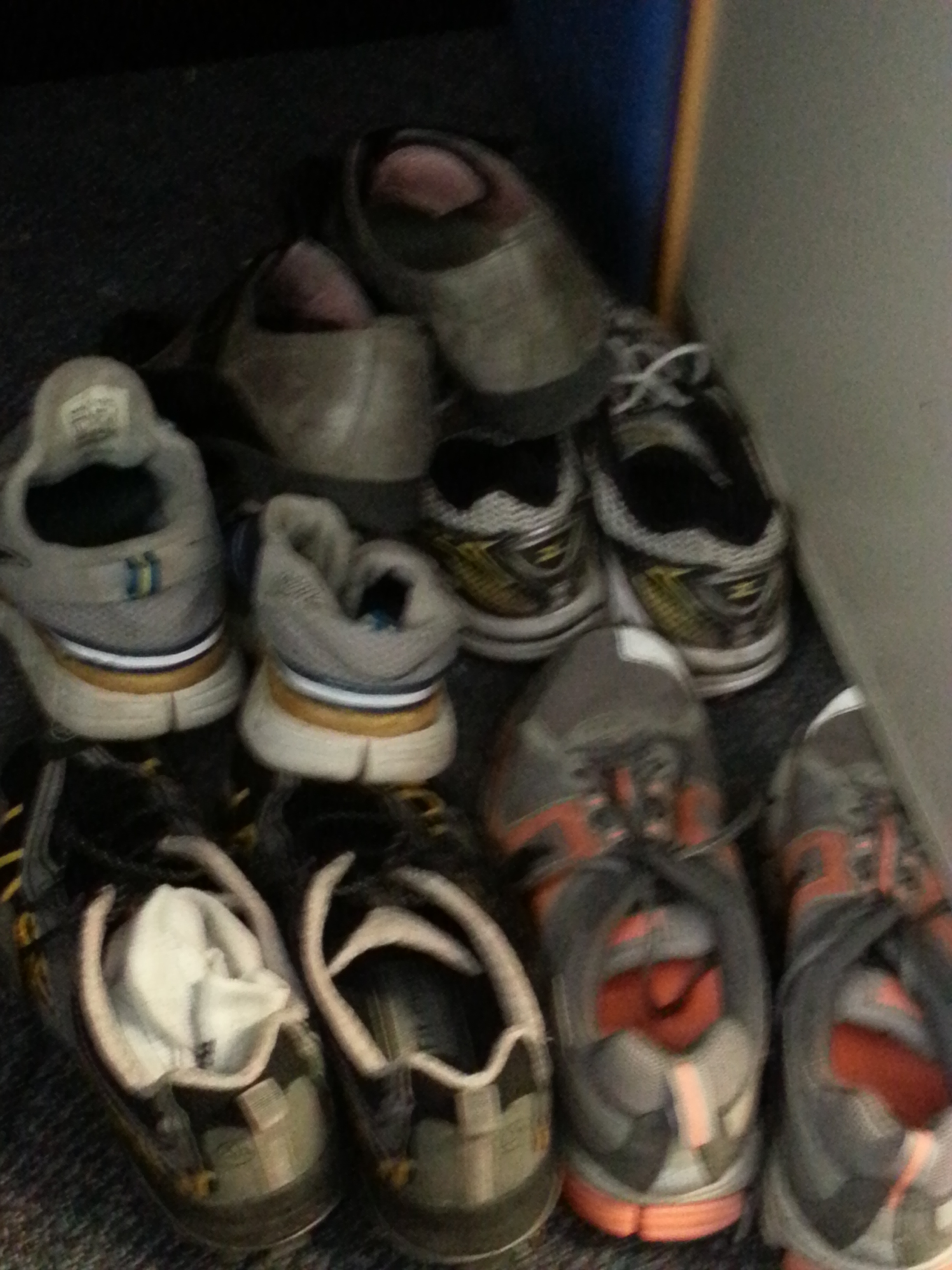
The evidence beneath my desk

The evidence beneath my desk

You’ll find a good article with tips on how to run-commute here.