“We Can Always Do Anything”

It’s time for another INSPIRATIONAL THURSDAY!

And I’ll start it off with a question.  Is it really possible for a 13 year-old to run a 100-mile race?

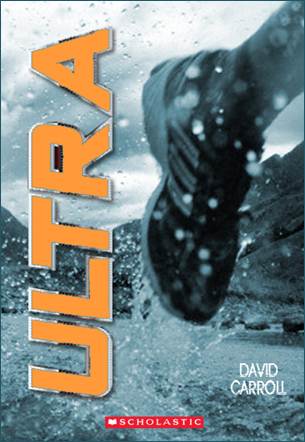
Ultra coverI get that question all the time, since that’s what my book is about: a kid who runs the longest of ultra-marathons in an attempt to outrun a tragic family secret.

Is such a thing actually possible?

HECK YEAH!

Of course, I don’t actually know any 13 year-olds who have successfully completed a 100-mile race.   But it wouldn’t surprise me in the least if they had.  Kids are capable of ANYTHING.  There are kids out there who’ve run multiple marathons, and kids who have swum across great lakes.

And then there’s Conner and Cayden Long, who take the word inspiration to a whole new level:

“We can always do anything.”  Love that.

Bad Sun, but not Badwater

Hot day for running today.  35 degrees in my neck of the woods.

Heat, as a rule, is a bad thing for runners.  Increase your core temperature by a mere 8 degrees, and you’ll likely die of multiple organ failure.

I thought about this while I ran today’s 20-kilometer loop, sweat pouring off of my body like I was Chris Farley’s masseur.

I also thought about the fact that the heat from the sun takes precisely 8 minutes and 16 seconds to travel from the surface of the sun to the surface of my face.  You probably already knew that.  But did you know that the energy that warms your face also had to spend between 10,000 and 1 million years traveling from the core of the sun through a soup of hydrogen 320,000 miles deep, before it reached the sun’s surface?

That means, that pesky sunshine that’s heating up your body to dangerous levels spent up to a million years (plus 8 minutes and 16 seconds) trying to get to you.  So be grateful.

Unless you’re running the 135-mile Badwater ultra-marathon in California’s Death Valley, where temperatures are likely to hit 50 degrees celcius.  Then you can complain all you want.

You’ll notice in that video that most people run on the white line at the edge of the highway.  That’s because it’s the coolest part of the road – and therefore the least likely to melt their shoes.

Looks like fun!

Gifts from our Journals

Write in a journal long enough, and you’ll eventually earn some interest on your deposits.

I’ve been scribbling in journals since 1994.  And seeing as I burn through a 200-page notebook in the same time it takes me to sand down a pair of running shoes (every two months or so), I must have close to 120 old ones lying around.

From time to time, I’ll pick one up and read it.  Just to remind myself what I was thinking at a particular time.

Every now and again I’ll come across a nice turn of phrase, maybe even something I can use in a future story.  For instance, I just found the line “she had sunburned cheeks, the colour of squashed plums.”  It’s a bit florid, but you never know, I may use it someday.

Occasionally I’ll come across something that I’m not 100% certain that I wrote.  For instance:

“Family is like a staple in your heart.  It hurts like hell.  But it holds us together.”

Usually when I steal a line from someone else, I’ll attribute the source.  But in that case, I didn’t credit anyone.  Does that mean I wrote those great lines myself?

Possible, but not likely.  I was sorely tempted to use those lines in my soon-to-be-published book, but in the end, I didn’t trust that it was mine, so I left it out.

Sometimes, while sniffing through old journals, I’ll come across  an unexpected surprise.  I have no idea why I was thinking about fables in 2009, but here’s what I wrote in September of that year:

One day Cricket was tired.  Turtle was passing by, and so she let Cricket climb onto her back.  Turtle swam through the water, which made Cricket very excited.  The waves!  The sunshine!  The sense of adventure! 

In gratitude, Cricket bent his legs, and sang a song for Turtle.  Turtle pulled up onto the shore, and sat there awhile, listening to the beautiful music.  Turtle fell in love with Cricket’s song, and the pair stayed together for many years.  They were very happy, what with Cricket singing songs, and Turtle ferrying the two of them back and forth across the river.

One day, Turtle dug a hole and lay an egg.  When the egg hatched, a funny-looking creature popped out.  It sang songs like a cricket, and had long legs which it used to jump.  But it loved to swim through the water with webbed hands and feet.

And that is how Frog came into the world.

Again, I didn’t attribute it to anyone.  Does that mean I actually wrote it myself?  Or did I hear it told aloud at a storytelling event, or from a child, and rush home to share it with my journal?

I can’t be sure.  I don’t remember.  So if anyone recognizes this story, please let me know.

The Re-write Blues

Rewriting a novel is like arriving at your new apartment right after the movers have dropped off all your stuff. Everything you need is in that huge mountain of boxes, only you have no idea where.

packing boxes

Yikes.

Making matters worse, your apartment is full of odd-shaped rooms. Where will the sectional look best? What about the treadmill?

You want to move the credenza into the living room, but you sense it’s too wide, and you’ll just end up dragging it back to the bedroom.

And that’s only one of a hundred items. It’s very easy to feel defeated.

There’s only one way to get started: grab a box and start unpacking. What that box is finished, grab another. And then another. And then another.

Eventually, you’ll figure out where everything belongs. And your rooms will fill up and begin looking like home.

Trust the process.  Trust yourself.

An Ultra-Challenge for July

Of all the months, July is THE BEST.  July is like hitting a bunch of green lights in a row.  It’s better than the smell of crayons.  It’s the Justin Timberlake of months.

I usually take the whole month off, rent a cabin surrounded by hills and trails, and just run.  Last year, near Collingwood, I logged 347 miles on the Bruce Trail.  The July before that, I covered 316 miles in the Haliburton Forest. The July before that I managed, well, only 272 miles, but that’s because I was running up and down mountains in France.

Running up "The Canigou" - near Perpignan, France

Running up “The Canigou” – near Perpignan, France

This July, I’ve set an even BIGGER challenge.  In addition to running 12 miles per day, I’m determined to write my second novel.

WHAT???  In a month?  Who does he think he is – Stephen King?

Actually, I don’t have to write it from scratch.  I wrote a first draft a couple of years ago, but then I set it aside, so I could work on my other book, which is, you know, actually getting published.

This July is the first chance I’ve had to go back to work on that other writing project.  It’s a big, messy, 60,000-word turd right now, but I’m excited about polishing it into a diamond.

So every day this July, in addition to burning 1000 calories on the trail, I’m hoping to produce 2000 words.  Words that glitter like spun glass, words that gleam like dragonflies in sunshine, words that shimmer like cobwebbed trees in summery skies

Okay, I’ll stop now.

This July, I’m also planning to: eat 30 salads, drink 30 cups of coffee, watch 30 sunsets, take 30 naps, and watch zero television shows.

Wish me luck!

My First Book Interview

My novel is going to the printer TODAY.  Synchronize your watches – it’ll be hitting the bookstores in ten weeks.  

Ultra cover

I had my first book interview today.  Strange experience.  I work for the media, so for years, I’ve been the one asking the questions, not answering them.  Role reversal!

Still, it was fun to talk about these characters who’ve been making a racket inside my head for the last three years.

Here are the first five questions I was asked as an author:

Q: What is the best part of being an author?

I love that the gear is so cheap!  If I wanted to be a professional snowboarder, I’d have to spend hundreds of dollars on equipment.  The board, the boots, the bindings, the jacket…  Pricey!  But all an author needs is a pen and some paper.  What does that cost – maybe $5?

Also, I never get hurt, writing books.  That’s a definite plus for me.  If I was a hockey player in the NHL, I’d probably get hit a lot.  I’m a bit of a wimp when it comes to getting hit, so that wouldn’t be much fun.  As an author, the worst thing that can happen is I get a paper cut.

The best thing about being an author, however, is that the job is dead easy.  The alphabet only has 26 letters.  So all I have to do is arrange those letters in such a way that they tell a good story.  How hard could that be?

Q: What inspired you to write Ultra?

Five years ago, I did an insane thing.  I entered a hundred-mile footrace.  For 24 hours – all day and all night – I ran through a forest.  Some runners saw bears along the route, and all through the night I heard wolves howling in the distance.  It was a terrifying and exhausting experience.  But when I crossed the finish line, my life had changed.  I’d always thought it was impossible to run 100 miles in a day, but now that I’d done it, the whole world seemed different.  I’d changed the goalposts of what I believed was possible.  So I decided to try something else that I’d always thought was impossible – writing and publishing a novel.  And voila!

Q: What was the hardest part of writing this book?

Deciding whether or not the main character, Quinn, should win the race.  For the longest time, I had him crossing the finish line first.  But then I decided that he shouldn’t win; that something else – something dramatic – should happen instead.  So I rewrote the ending.  But then I gave the book to family members to read, and they complained about the ending.  So I rewrote it again, and then again.

I went back and forth, rewriting that ending for a year.  I can’t even remember anymore whether Quinn wins or loses the race.  But I will say this.  Most 100-mile races don’t give prizes to the winners.  Usually the winner just gets a pat on the back, a warm blanket, and a bowl of vegetable soup.  Almost nobody runs a 100-mile race in order to win.  They do it for other, much stranger reasons.

Q: In what ways are you like Quinn, the protagonist in your book?

I share Quinn’s determination.  Once I get an idea into my head, I’ll stick with it, no matter how much it hurts.  That’s why I can run 100 miles in one go.  Also, I love being outside, and I’m okay with being alone sometimes.  I’m a bit of an introvert, and I think Quinn is too.

And finally, like Quinn, I have a really solid friend.  And an amazing family that supports me – even when I do crazy things.

Q: What was your favourite book growing up?

“Swallows and Amazons” by Arthur Ransome.  It’s about a group of kids who climb mountains and race sailboats and survive shipwrecks and explore the high English moors.  Their parents are nowhere in sight, and the kids are always outdoors, facing the elements.  My dad read that book aloud for my whole family when I was a kid.  He’d read one chapter each night before bedtime, and the next morning me and my brother would race for the book so we could read on ahead.

“Swallows and Amazons” was the first in a long series, and Dad read us every single one over the course of a long, magical summer.  And that’s saying something, since there are twelve books in the series, and each one is 350 pages long.  Looking back, I think that experience cemented my love of reading.  Dad reading those books out loud.
Amazing Human Tricks

Admit it – you can do a weird trick with your body. Maybe you can wiggle your ears, or crack your knuckles. Maybe you can change your eye colour at will.

We all have weird party tricks we can do with our bodies. A couple of years back, when I was producing a live comedy show, I met a guy who could fit his whole body through a tennis racquet:

The question arises – what good could it possibly do to squeeze your body through a tennis racquet while simultaneously juggling rubber balls?

Answer: it does you no good whatsoever. But hey, it’s fun! And you get to appear on live comedy shows.

My own personal trick is rather peculiar. I can talk backwards. Listen:

https://writerunrepeat.com/wp-content/uploads/2013/06/dave-talks-backwards-2.mp3

Actually, they never did invite me back.

But listen – in that radio show appearance, I only flipped the words in each sentence around, and repeated them back in the opposite order. Since then, I’ve learned that some people can actually speak backwards phonetically. That is to say, they can flip all the individual letters in each word around, and then pronounce them back-to-front.

Kind of like this girl:

Another Burden to BEAR

Patricia Sommers was having a great race.  Until she ran into the bear.

Sommers was running her first 100-miler, in the Haliburton Forest, back in 2000.  She was keeping a good pace, the weather was good, and her husband was waiting for her at the 75-mile turnaround.

One mile shy of that aid station, Sommers heard a noise.  It was eleven at night, and she could hear a large animal crashing down a hill towards her, on the left hand side of the trail.  “I hoped it was a moose, but it wasn’t,” she explained. “It burst onto the path 100 meters ahead of me.”

Sommers shone her headlamp at the animal.  It was an adult black bear.  It rose up on its hind legs and roared.

Black bear

I’ve run into a number of bears on the trail.  It’s gets your heart pumping, that’s for sure.   Given that these animals are large, with claws the size of steak knives, I’ll found myself wondering: am I crazy to be running in a forest?

The answer, according to Bart Hillhorst, is no.  Hillhorst is a Forestry Technician with Ontario’s Ministry of Natural Resources.  He deals with a lot of problem bears.  “There’s always a danger with animals of this size,” he explains, “but in general, black bears are programmed to be scared of humans.  Ninety percent of the black bear’s diet is vegetation – grass, berries, nuts.  The other ten percent is meat, but that’s mostly larvae and ants.  The reality is, bears don’t like dealing with people.  It’s not in their personality.”

Statistics back this up.  Since the early 1900’s, fewer than 70 deaths in North America have been attributed to black bears.

“When you see a bear on the trail, your first reaction is to be scared,” Hillhorst says.  “That’s perfectly natural, but fear is the wrong thing to show a bear.  You want to be calm.  You want to look at the bear and figure out her situation.  What’s the bear doing?  Is it aware you’re there?  Is it feeding on something?  Are there cubs nearby?  Then you can figure out your best response.”

“Once you know what the conditions are, then it’s just a matter of risk tolerance,” explains Dr. Stephen Herrero, Professor Emeritus of Environmental Science at the University of Calgary.  “There is risk associated with bears, so you have to decide if you’re comfortable with that.  I’m a runner myself, and I love running in nature.  But there are some places in North America where I wouldn’t dare run right now.”

If you do decide to lace up in bear country, you can take steps to increase your safety.

1) “Run at a more leisurely pace than you otherwise might.  Bears hate surprises, that’s a major cause of aggressive behaviour, especially with Grizzlies.

2) Keep an eye out for bear tracks, spoor, fresh diggings, torn up logs and scratched trees.  If you see any of those, find another place to run.

3) Above all, make lots of noise, particularly when you’re running in dense forest, or rounding blind corners.

Carrying a can of bear repellent doesn’t hurt either.  Just be sure you know how to use it.

“When you’re staring at that bear, and your heart is racing, and the wind is blowing, how good do you think your aim is going to be?” Hillhorst says.  “Bear spray is good because it gives you confidence, but practice using it a couple of times before you head out.”

The Man Who Forgot He Wrote a Book

Crazy story – about my talented friend Tim. A warning, though: Tim is successful at, like, everything. He’s an award-winning journalist. Plays violin like Nigel Kennedy. Bakes the most mouth-catering cakes.

Cars_Cake

These days, Tim spends most of his time writing children’s books.  But it’s a career that almost never happened.

childrens books

Here’s how it came about. A few years ago, Tim’s niece came up for a visit from Colorado. During her stay, she reminded Tim of a poem that he’d written many years before.

“What poem?” said Tim.

She reminded her Uncle of the poem he’d written for her as a gift, back when she was a little girl. A poem about a frog who is appalled to learn that that not all animals share his love of spiders and bugs.

Tim’s niece took the poem to school. Her elementary teacher loved it and read it aloud for the class.

The class, predictably, LOVED the poem. And so, for years, that teacher went on performing it.  An entire generation of Colorado kids grew up on Tim’s poem about the frog – and Tim didn’t even know!

Not long after the niece went back home to Colorado, Tim was telling a group of us about this story. We were at a friend’s book launch, and a literary editor happened to be standing nearby.  It’s a good thing Tim has a loud speaking voice because the editor overheard the story, and asked to see the poem. And presto! That poem got turned into a book.

The book sold a lot of copies. So Tim was asked to write a sequel. That one sold well too, so a third book was requested. It’s coming out in November, with a fourth book already in production.

And it all began from a poem that Tim forgot that he’d written!

What writer doesn’t have dreams like this? That at some point in our scribbly past, we wrote a brilliant poem, or short story, or novel, and forgot all about it? Lord knows we’ve got enough journals and floppy discs and thumb drives full of forgotten writing lying around… Surely, somewhere among all those literary droppings there’s gotta be something  worth publishing, right?

Quite possibly.

As this wonderful story also attests.

Sweaty to Office Ready

A few Februaries ago, while standing on a streetcar, politely absorbing the cloud of germs radiating from the human flu cases all around me, I glanced out the window and had a revelation.

A happy-looking runner bounded up the sidewalk. A vapour trail of snow whorled behind her.

*Jan 19 - 00:05*Brilliant, I thought!  Why hadn’t I thought of it before?  Instead of suffering for hours on public transit, I could be running to work, and losing weight at the same time!

Ever since that revelation, I’ve been running to and from work every day.  I’m saving money on transit, I’m saving time, and my oxygen-rich blood has led to improved performance at work.

Still, I’ll be the first to admit that the running commute can be fraught with peril. Over the years I’ve been caught half-in and half-out of my spandex tights in the photocopy room.  I’ve been referred to as “Chicken Legs Carroll” at a staff meeting.  And I’ve been accused of “stinking up” workstations 2G208 through 2G212.

More on that latter item in a moment, but first, I’d like to address the most significant challenge facing the commuting runner: wardrobe planning.  Any casual runner is capable of keeping a spare shirt or two at the office.  But what about us addicts who run both to and from work, each and every day of the week?  To do this successfully, some planning is in order.

Once a week, I pack a duffel bag full of clean clothes and shlep it downtown. Three pairs of pants, three dress shirts, and four tee-shirts generally do the trick. I also leave a few items at work permanently – sports jacket, belts, a filing cabinet full of clean socks.

clothes pic

My filing cabinet holds all manner of fine toggery

It’s not a fail-safe plan.  Countless are the times I’ve grabbed a clean shirt, shoes, underwear and socks from my filing cabinet, and headed for the showers only to discover that I have no pants.

What the….WHERE ARE MY PANTS!?!

Ever sat through a board meeting in dri-fit shorts?

But maintaining a satellite wardrobe is only the half the battle.  It’s also critically important to be pre-emptive with one’s sweaty laundry.

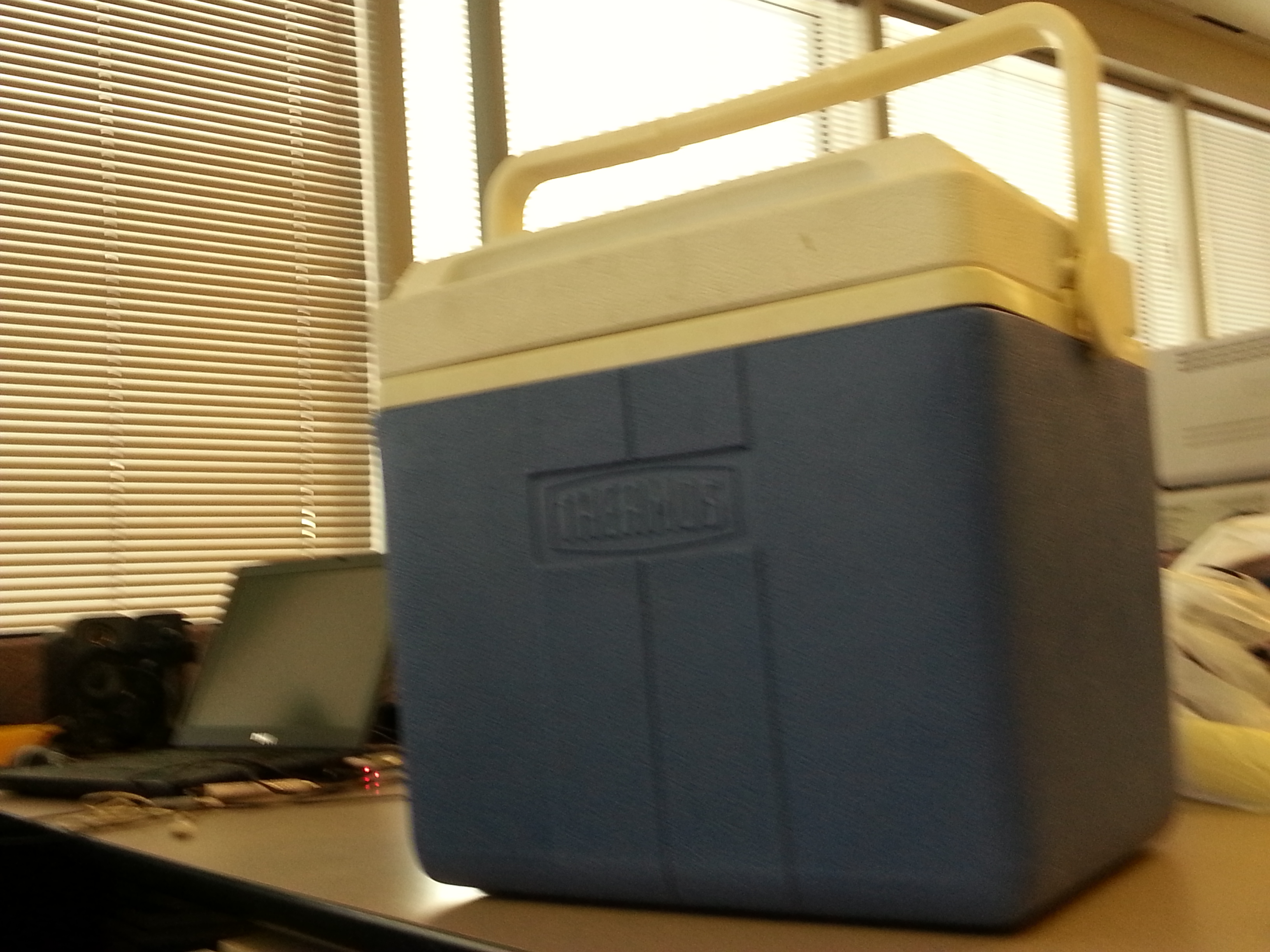
cooler pic

Hide-a-stench

For this, I look no further than my trusty Coleman cooler.  With its airtight seal, that baby can store up to 3 days worth of biological waste without emitting any foul smog.

Despite these precautions, I still get the occasional complaint from my neighbor at workstation 2G212.  I’m doing everything I can, but frankly, I think it’s time for our industry leaders to lend a hand.  If companies really want to attract health-conscious and carbon-neutral employees, they need to get ahead of the fitness curve.  I’m not talking about bike racks and shower rooms.  These days, those are the mere baseline.  I’m talking about lunch-hour massages, Gatorade and Clif shot energy gels in the vending machines, and most importantly, same-day dry cleaning service.

And would it really kill our bosses to keep an ironing board in the photocopy room?  I mean, c’mon!

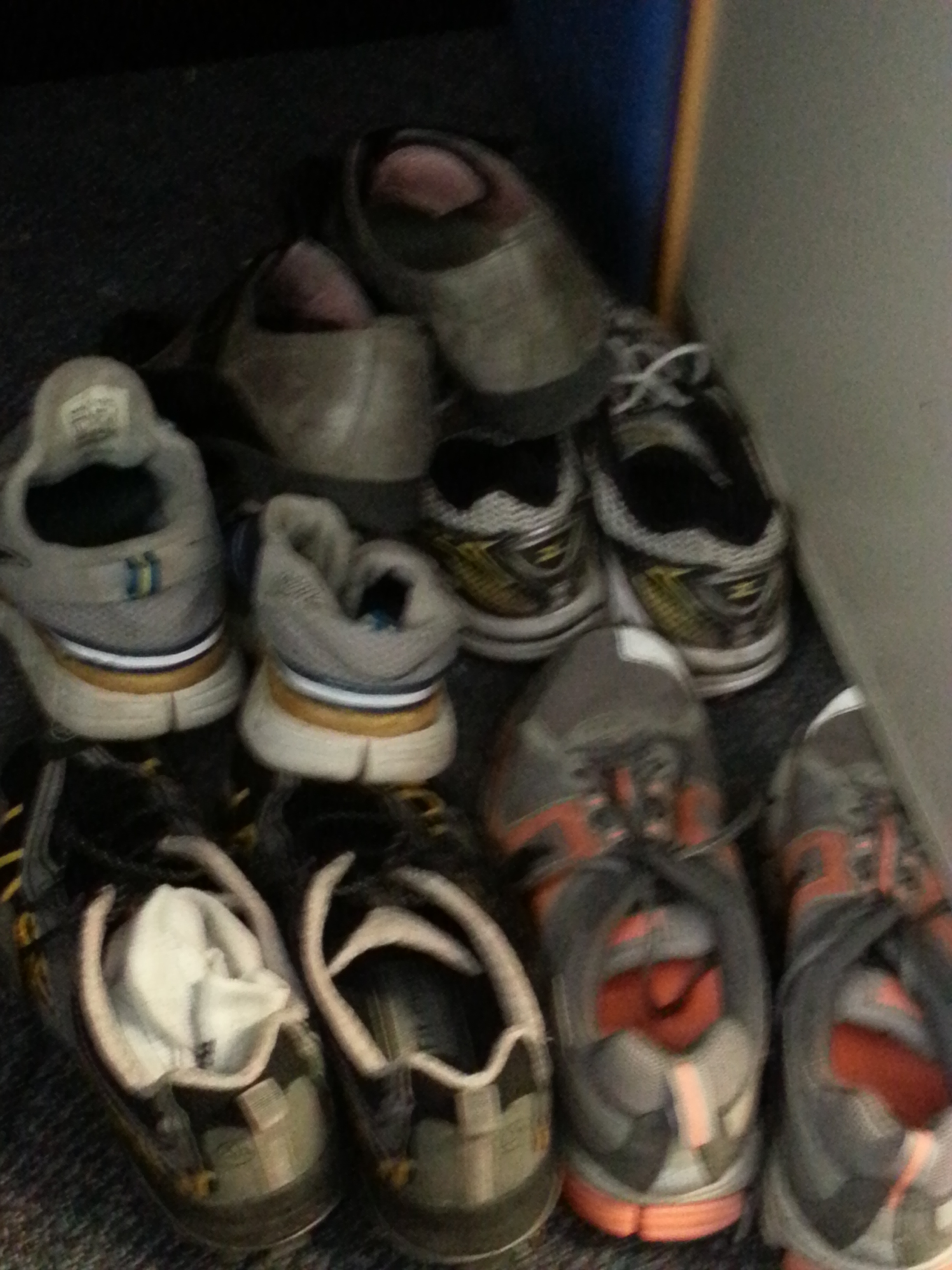
The evidence beneath my desk

The evidence beneath my desk

You’ll find a good article with tips on how to run-commute here.