20 Years of Ultra-Madness

Well, that was something!

The 20th edition of the Haliburton Forest Trail run was held this past weekend. For two decades and counting, race director Helen Malmberg and her crew of unimpeachable wits have put on the best trail race this side of the Rocky Mountains.

Here’s what the starting line looked like, Saturday at 5:59 a.m.

At the starting line

This is how it looked 90 seconds later:

6 AM, and they're off

One hundred miles. 160 kilometers. Half a million strides. Starting NOW.

We were about to burn 10,000 calories. Sweat 20 litres of water. Our hearts would beat 1.2 million times.

If you were to add up all the calories that runners have burned in this race over the last twenty years, it would be equivalent to a tower of butter that stretches all the way from here to, oh I don’t know, the moon.

Running, at the 8 mile mark

The weather held, despite the dire forecasts. A few brief showers fell throughout the day, but the raindrops stayed mostly in the canopy of trees, and the trails remained firm. Don did a brilliant job (as usual) of marking the route, and the aid stations were exploding with outrageously cheerful volunteers. You know, the kind of people who think nothing of baking a hundred dozen almond-rice bars, draining your blisters, and not even twitching at your repulsive Heed-breath.

David, at 8 miles

Can we talk about me for a second? Awesome. See, I couldn’t find my groove for the first thirty miles or so. The first fifty miles always get me down in this race. They strike me as a prelude; something you have to get out of the way before you can get on with the Real Race, which is miles 51-100. But something else felt off too. I was lonely. I barely saw anyone out there. Later, I’d learn this was because I was farther ahead of the pack than I thought. But at the time I thought it was just low enrollment.

Wrong, wrong, totally wrong.  Enrollment was UP. This race keeps getting more and more popular.

Anyway, back to me and my crappy mood. Every part of my body took its turn complaining, as usual. But then, at mile 46, something wonderful happened.  A volunteer at aid station 3 greeted me with a huge hug. “Oh my God!” she shouted. “You wrote a novel! And it’s about this race. When can I read it?”

This perked me up considerably. I stood there chatting awhile, basking in the adulation, until I suddenly remembered that I was running a race. I grabbed a couple of potatoes, and got on my way, promising to return with a copy of the book on my second lap. This little exchange turned my race around. Suddenly my legs were spinning like pinwheels. The knee pain I’d been feeling was GONE!

Running

I finished the first 50 miles in nine and a half hours, and met my family at the turnaround, which boosted my spirits even more. I sent a copy of my book out to the volunteer at the third aid station, and by the time I ran back there, she’d already read the first two chapters. Crazy! At aid station 2, I met a young kid who had his nose in the book as well. Double crazy! I wanted to sign his copy, but nobody had a pen.

Oh well, just keep the legs moving!  Down Poachers Trail and then on to The Pass.  Everywhere I looked, I saw little details that I’d stolen and woven into the book. The Nanaimo bars at aid station 4. The disco ball at aid station 7. The hilarious goings-on at Margaritaville. Even Troutspawn Lane, a gravel road near the entrance to Normac Trail, became the name of my protagonist’s favourite band. It was a surreal experience – like I was running through the pages of my novel. Mind you, I didn’t have any hallucinations, of which there are A LOT in the book.

Uphill

Of course I suffered the usual pain, and gobbled my fair share of Advil.  And I sank into the inevitable fits of depression whenever I foolishly contemplated the insane number of miles I had left to run. But I tried something new in this race. Excuse me if this sounds flaky. But whenever I felt that familiar depression coming on, I would say to myself, yes that’s true, you have a long way left to run, but how do you feel IN THIS EXACT MOMENT, RIGHT NOW? Every time I asked myself that question, I had to admit that I didn’t feel so bad. Once I stripped away my anxiety about the miles that remained, I was left with only the sensations in my body AT THAT MOMENT. My body hurt, of course. How could it not? But it never hurt enough to stop me from running. So I kept the legs moving. And the number on the odometer kept rising.

I crossed the finish line just before 3 a.m. The clouds blew away and the stars came out, and, later, the morning broke cold and clear.

Good morning

As usual, my favourite part of the race was hanging out at the finishing line campfire, eating Helen’s fried chicken and trading stories with the other runners. Stories about bear sightings and injuries and personal revelations on the trail.

A few people congratulated me on my run. I was thrilled with my time, but I felt awkward about claiming third place. I only got it because some better runners had bad days on the trail. But I guess that’s how it goes sometimes. And I must admit, it was a lark to squeeze onto the podium for once!

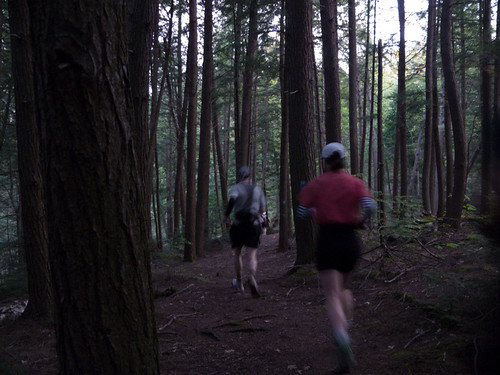
In the woods (2)

Many thanks to Helen, Don and Gary, and all the other volunteers, far too numerous to mention, who gave me and so many other runners such a precious gift. It’s a life-changing experience to run through a forest all night long, and it wouldn’t be possible without caring souls who are willing to watch out for us and cheer us on and put up with our B.O. and queasy stomachs and pain-induced crankiness. You all deserve a finisher’s medal!

Finally, a shout-out to my amazing parents, who gave me the genetic material that allows me to run these crazy races in the first place.  Let’s face it, it’s a privilege to have a body that can run for 100 miles straight. Yes, we train hard, and yes, we watch what we eat, and yes, we focus obsessively on our goals.  But we couldn’t do any of it if not for that duo who gave us the greatest gift of all.

This one’s for you, Mom and Dad!
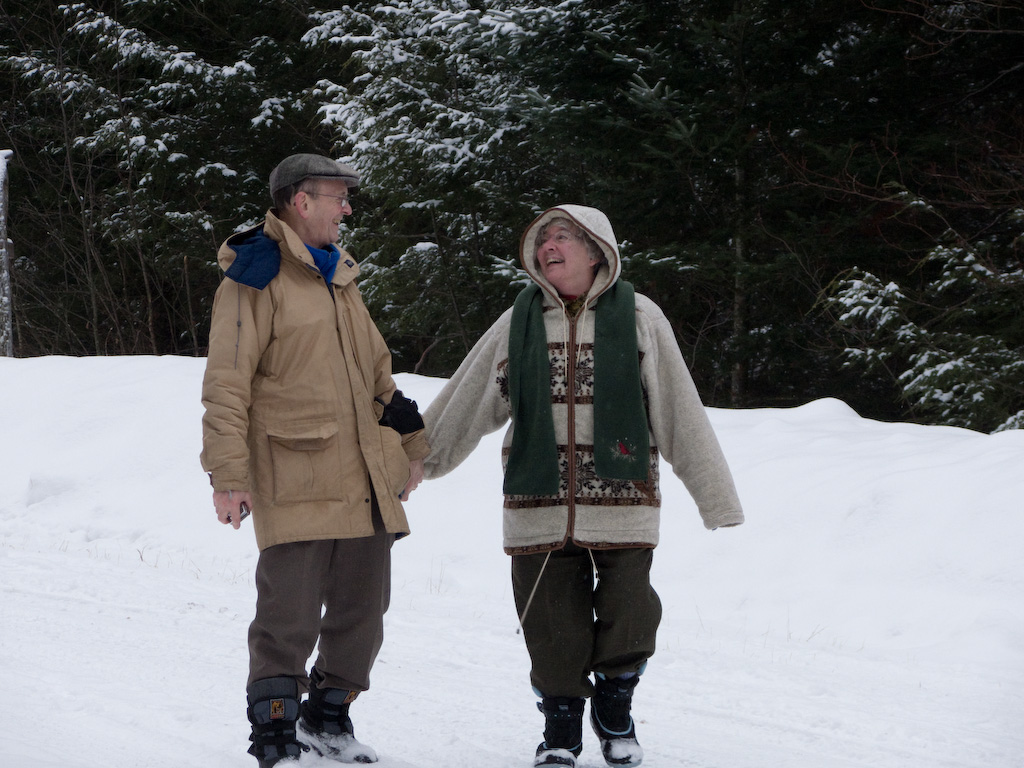
Dad and Mom - winter

Photo hat tip: my brilliant brother, at http://www.flickr.com/photos/andys_camera/
3 More Sleeps

Haliburton Forest race (5)

Pray for good weather. Three days out from a 100-mile race, that’s all you can do. At this stage, there’s no point doing any more training. Your body isn’t going to get any fitter over the next 72 hours. You might as well relax, eat well, sleep as much as you can, run to stay loose, but not so hard you deplete yourself. And above all, pray for clear skies.

rainy running

100 mile races are challenging enough when the sun is shining. Wet, muddy trails can make things hellish. Under those conditions, your goals have to change.  You’re not just trying to cross the finish line in one piece anymore.  You’re trying to keep your feet dry for as long as possible. Wet feet are susceptible to blisters, and blisters can end your race fast. Which is why runners usually bring 2 or three pair of runners and a half dozen pair of socks to each race. We store them in “drop bags” along the course.

The worst possible scenario?  Cold, pounding rain.  Last year I ran a 100-mile race in something close to a hurricane. All 50 runners were soaking wet from the very first mile. Blisters were the least of our problems. There was chafing and hypothermia to deal with too. Late at night, when the temperature dropped, I couldn’t stay warm enough.  Shivering uncontrollably, I dropped out at 3 am, after having run 92 miles.

20130902_214838

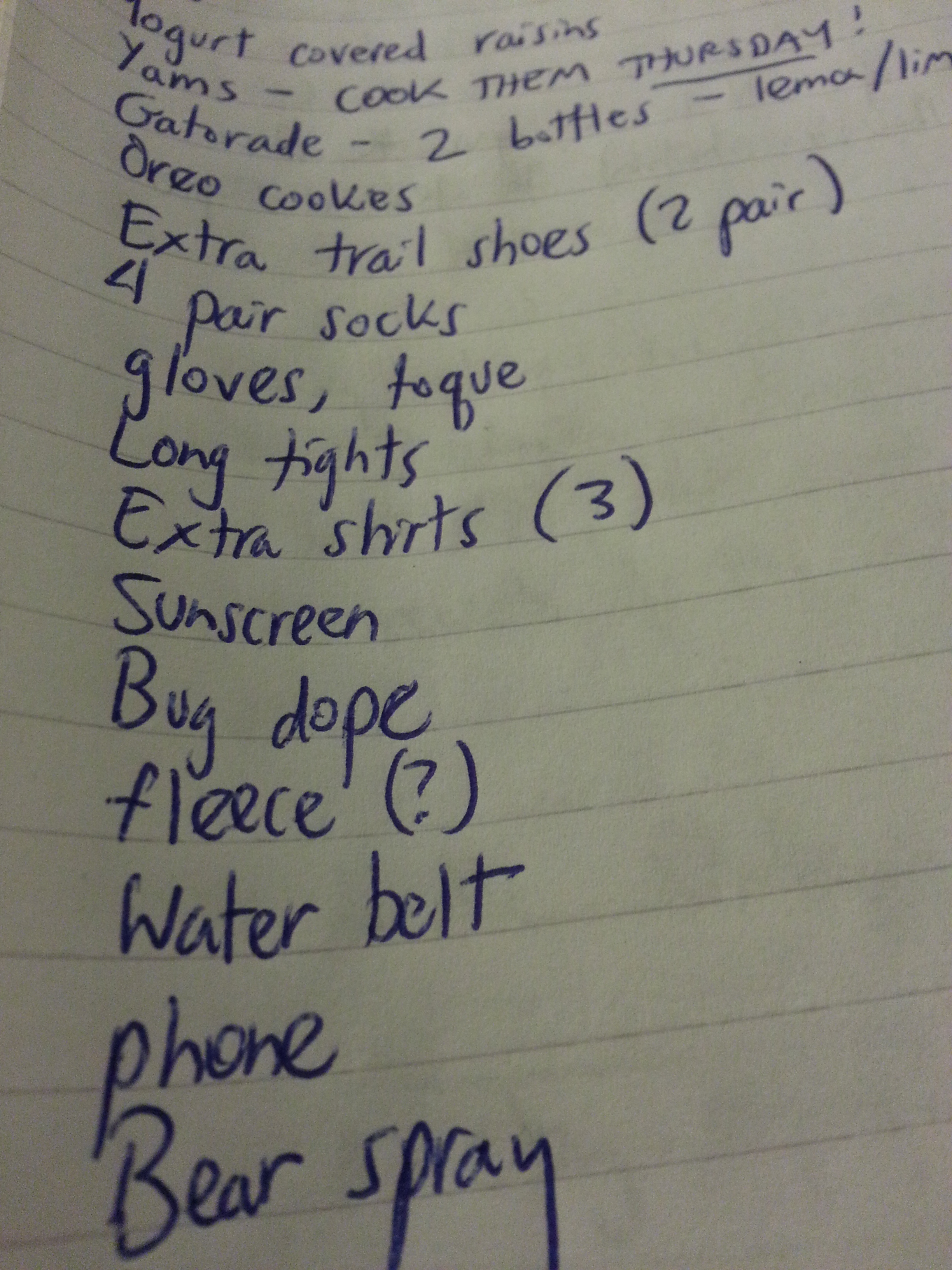
There’s my list.  You’ll notice Advil at the top.  A couple of years ago, after some exceedingly painful ultra marathons, I discovered the joy of ibuprufen.

I don’t take many. I’ll gobble a couple of those sweet little pills at mile 75, and another couple four hours later.

It’s not recommended, of course. Too much Ibuprufen could potentially damage your kidneys, which are already under serious strain, trying to keep your urine flowing despite a lack of available body fluids.

Still, they do such a good job of dulling the pain, especially when running downhill late in a race. You’d think that running uphill would be the hardest thing, but it’s not. Running downhill feels like your legs are being pressed through a cheese grater.

So hello Advil, old friend! I don’t care if you’re not recommended. Running 100 miles through a forest isn’t generally recommended either.

20130902_214810

This is What a Dream Comes True Looks Like:

first copy of Ultra

Yesssss!

My first novel. In my hands. For realsies.

It was the hardest thing I ever did.  Writing the thing was only half the battle. Getting it published was even harder.

But this feeling, this moment, makes it all worthwhile.

To those of you who are struggling to get your writing into print, please, don’t give up! It can be done. Hard work pays off.

Dave poster 2

And I must give a huge shout-out to my nieces and nephews – who inspired this story, lent their names to some of the characters, helped me with the jokes and dialogue, and even shared early versions of the book with their classmates.  You all deserve a finisher’s medal:

Aaron, Alex, Ali, Ben, Benjamin, Brody, Caelan, Caitlin, Caleb, Christopher, Daniel, Darcie, Grace S., Grace W., Jackson, Julia, Julian, Kara, Kelsey, Kiernan, Leonardo, Lucy-Claire, Luke, Monty, Madelaine, Maggie, Mateos, Nate, Oliver, Olivia, Parisinia, Quinn, Ray, Riley, River, Rowan, Rylee, Sacha, Skyler, Sofia, Sydney, Tahnee, Tobias, Zoe.

Re-writing is your Friend

SCAN0006

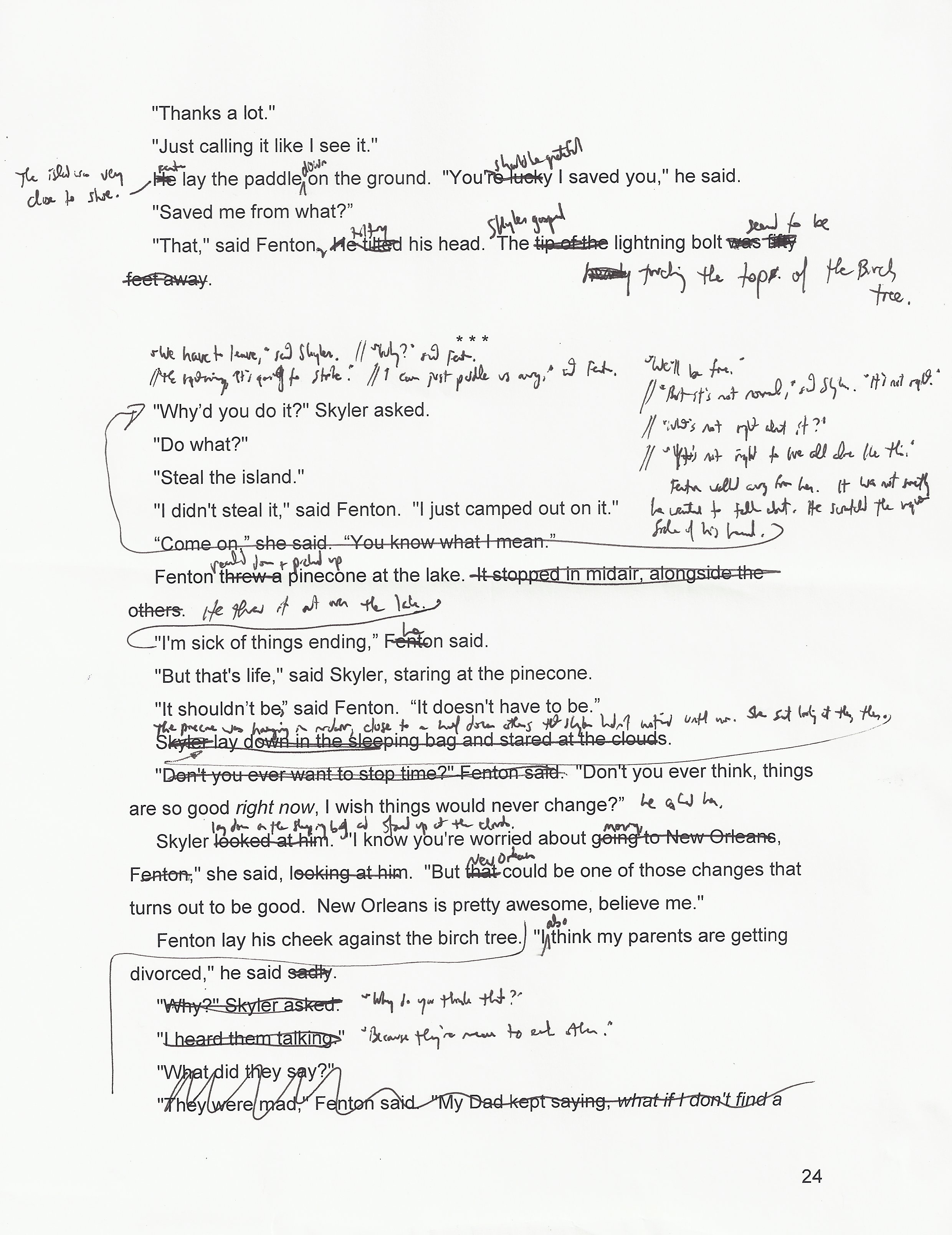
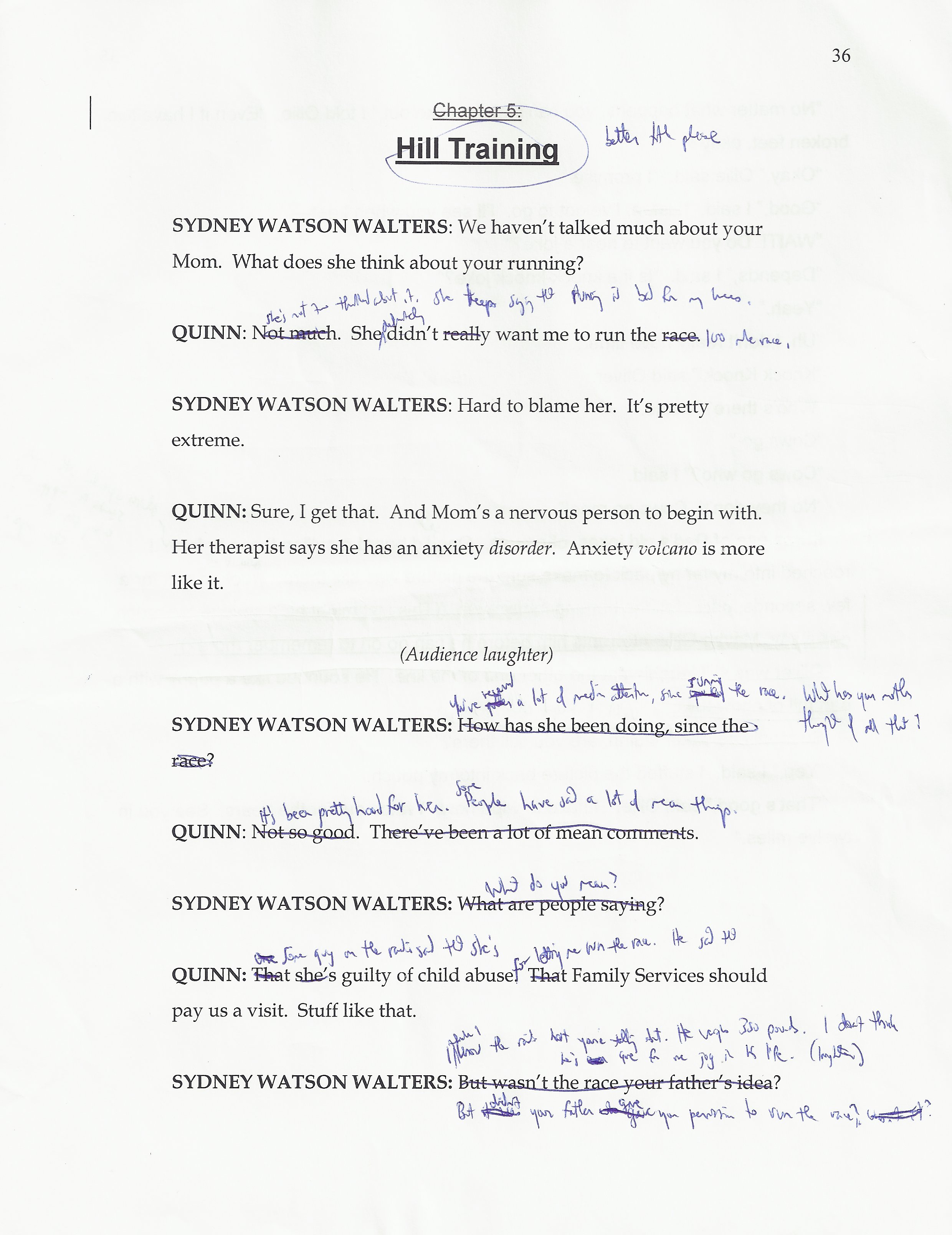
People often ask me how many times I re-wrote my first novel, Ultra.  Trust me when I say, YOU DON’T WANT TO KNOW.

Image

I wrote the first version waaaaaay back, in the summer of 2008.  It was 20,000 words long, and it swallowed two months of my life.  Back then, it was titled “Quinn and the 100 Mile Race.”

I finished the second draft a month later.  By Christmas I’d rewritten it a third time, and then I sent it out.

I sent it to an agent and also a publisher.  The publisher said some nice things about it.  She said the narration was lovely and warm; perhaps too lovely and warm.  She explained that the warm tone made it hard to believe that the central character was living on top of a calamity.  Which was why she was going to take a pass.

The agent didn’t reply.

I wasn’t too upset about it.  I’ve written lots of stuff over the years that never got published.   That’s the writer’s life.  I stuffed the manuscript in a drawer and forgot about it.

Two years later, I picked it up again.  I re-wrote it for…let’s see…the fourth time.

After 5 months of work, I pitched it 50 agents.  49 of them said, “Thanks but no thanks.”

The fiftieth agent (the brilliant Scott Waxman who represents some of the finest sports writers, including the legendary John L. Parker) called me on the phone.  When I saw the 212 area code on the display, I knew something was up.  Scott told me that he liked my story.  He said, however, that he wasn’t quite ready to offer representation just yet.  There were a few things I ought to think about – if, that is, I was “willing to re-write the manuscript.”   

I thought about the improvements that Scott suggested.  I thought about them for all of ten seconds.

Once again, I started re-writing.  When I finished that re-write I did another.

And then another.

And then another.

SCAN0007

After six months of re-writing, Scott Waxman accepted my novel.  I received an “Offer to Represent” in the mail.

Cue the champagne corks!  Cue the s’mores!

A couple of months later, the novel sold to Scholastic Canada.

MORE champagne!  MORE s’mores!

In the year or so since I signed with Scholastic, I’ve done three more rewrites.  The first took 3 months, the second took one month, the third took a week.

That makes eleven re-writes in all.

I know that sounds like a lot of work, but listen: with every single re-write the book got better!

Lesson learned:

Writing a book, and running 100 miles, are similar in two distinct ways.

(1) Both involve a TON of pain.

and (2) The finish line is incredibly sweet.

Thunder Running

Reasons not to run on the Bruce Trail during a thunderstorm:

  1. A tree could fall on you and you could die.
  2. You could get swallowed by the mud and die.
  3. Lightning could strike you and you could die.
  4. You could slip off the 500-foot scarp face and die.

Reasons to run on the Bruce Trail during a thunderstorm:

  1. It’s super fun.

mud running

At a certain point, when you’re soaking wet and freezing cold and lathered in mud, and the forest is as dark as night, and the rain is lashing you like a blizzard of molars, and you’ve still got 15 kilometers left to go before you get back to the car, well, at a certain point, you’ve just got to throw up your hands and laugh, don’t you?  After all, you checked the weather online.  You saw the probability of precipitation (75%) and the expected accumulation (20 – 40 mm), and you saw those clouds amassing on the horizon like an army of unwashed hoodies.  You knew what you were in for and you just laughed, didn’t you?  Well, now it’s time to laugh again.

As for all that mud, well, that can’t be a surprise either.  You do you know what happens to dirt trails when you add water to them, don’t you?  You did play in a sandbox as a child, right?  When water is added to dirt, that dirt turns into mud.  You know this.  If you add enough water, you get something worse than mud.  You get a slippery, shoe-sucking, toffee-like substance called glop. 

But it’s not all bad, is it?  There’s nothing like hypothermia and mud inhalation and blood loss and the threat of plunging into a crevasse cave fathoms deep to fire up the old endorphins, is there?  Especially when you arrive back at your car after three hours of slogging through rushing creek-beds, and stare at yourself in the rear-view mirror only to see a hollow-eyed, scabby-elbowed, tick-bitten runner; hair singed from stray lightning bolts, face besmirched with mosquito guts, and you swear you’ve never seen anything quite so idiotic!

An Ultra-Challenge for July

Of all the months, July is THE BEST.  July is like hitting a bunch of green lights in a row.  It’s better than the smell of crayons.  It’s the Justin Timberlake of months.

I usually take the whole month off, rent a cabin surrounded by hills and trails, and just run.  Last year, near Collingwood, I logged 347 miles on the Bruce Trail.  The July before that, I covered 316 miles in the Haliburton Forest. The July before that I managed, well, only 272 miles, but that’s because I was running up and down mountains in France.

Running up "The Canigou" - near Perpignan, France

Running up “The Canigou” – near Perpignan, France

This July, I’ve set an even BIGGER challenge.  In addition to running 12 miles per day, I’m determined to write my second novel.

WHAT???  In a month?  Who does he think he is – Stephen King?

Actually, I don’t have to write it from scratch.  I wrote a first draft a couple of years ago, but then I set it aside, so I could work on my other book, which is, you know, actually getting published.

This July is the first chance I’ve had to go back to work on that other writing project.  It’s a big, messy, 60,000-word turd right now, but I’m excited about polishing it into a diamond.

So every day this July, in addition to burning 1000 calories on the trail, I’m hoping to produce 2000 words.  Words that glitter like spun glass, words that gleam like dragonflies in sunshine, words that shimmer like cobwebbed trees in summery skies

Okay, I’ll stop now.

This July, I’m also planning to: eat 30 salads, drink 30 cups of coffee, watch 30 sunsets, take 30 naps, and watch zero television shows.

Wish me luck!

OK, So You’ve Run Into a Bear. Now What?

A few days ago I wrote about running into bears while on the trail.  It’s a daunting prospect, and there are lots of things you can do to prevent it from happening (like making lots of noise).

But suppose you do run into a bear.  What then?

No single strategy is guaranteed to work in all situations, but you can minimize your risk by doing the following:

First, keep your distance from the bear and remain calm.  Don’t run away.  In most cases, if you make some noise, the bear will leave.

Don’t be surprised if the bear rises up on its hind legs.  Bears are curious animals, and often stand up to get a better view, or to catch your scent.  Back away slowly and speak in a firm voice.

A bear that swats at the ground, swings its head from side to side, snorts or huffs, pops its jaw, or bares its teeth is likely stressed and is asking for more space.  Give it to him.  Bears may also bluff their way out of an encounter by charging, then turning away at the last second.  Stand your ground.

A bear that follows you, circles or cuts you off is likely displaying predatory behaviour.  This is more common in black bears.  Face the bear and act aggressively.  Throw rocks and sticks.

If a Bear Charges:

If it’s a Black Bear, stand and fight.  Grab the closest stick and bash him across the nose.  Throw things.  If you’re carrying bear spray, use it.  Any of these actions may convince the bear to leave you alone.

If it’s a Grizzly Bear, play dead.  Protect your face, and the back of your head and neck with your arms.  The typical grizzly attack happens as a result of surprise, so non-aggressive behavior generally works.

Here’s an easy way to remember: If it’s black, fight back.  If it’s brown, lie down.

Another Burden to BEAR

Patricia Sommers was having a great race.  Until she ran into the bear.

Sommers was running her first 100-miler, in the Haliburton Forest, back in 2000.  She was keeping a good pace, the weather was good, and her husband was waiting for her at the 75-mile turnaround.

One mile shy of that aid station, Sommers heard a noise.  It was eleven at night, and she could hear a large animal crashing down a hill towards her, on the left hand side of the trail.  “I hoped it was a moose, but it wasn’t,” she explained. “It burst onto the path 100 meters ahead of me.”

Sommers shone her headlamp at the animal.  It was an adult black bear.  It rose up on its hind legs and roared.

Black bear

I’ve run into a number of bears on the trail.  It’s gets your heart pumping, that’s for sure.   Given that these animals are large, with claws the size of steak knives, I’ll found myself wondering: am I crazy to be running in a forest?

The answer, according to Bart Hillhorst, is no.  Hillhorst is a Forestry Technician with Ontario’s Ministry of Natural Resources.  He deals with a lot of problem bears.  “There’s always a danger with animals of this size,” he explains, “but in general, black bears are programmed to be scared of humans.  Ninety percent of the black bear’s diet is vegetation – grass, berries, nuts.  The other ten percent is meat, but that’s mostly larvae and ants.  The reality is, bears don’t like dealing with people.  It’s not in their personality.”

Statistics back this up.  Since the early 1900’s, fewer than 70 deaths in North America have been attributed to black bears.

“When you see a bear on the trail, your first reaction is to be scared,” Hillhorst says.  “That’s perfectly natural, but fear is the wrong thing to show a bear.  You want to be calm.  You want to look at the bear and figure out her situation.  What’s the bear doing?  Is it aware you’re there?  Is it feeding on something?  Are there cubs nearby?  Then you can figure out your best response.”

“Once you know what the conditions are, then it’s just a matter of risk tolerance,” explains Dr. Stephen Herrero, Professor Emeritus of Environmental Science at the University of Calgary.  “There is risk associated with bears, so you have to decide if you’re comfortable with that.  I’m a runner myself, and I love running in nature.  But there are some places in North America where I wouldn’t dare run right now.”

If you do decide to lace up in bear country, you can take steps to increase your safety.

1) “Run at a more leisurely pace than you otherwise might.  Bears hate surprises, that’s a major cause of aggressive behaviour, especially with Grizzlies.

2) Keep an eye out for bear tracks, spoor, fresh diggings, torn up logs and scratched trees.  If you see any of those, find another place to run.

3) Above all, make lots of noise, particularly when you’re running in dense forest, or rounding blind corners.

Carrying a can of bear repellent doesn’t hurt either.  Just be sure you know how to use it.

“When you’re staring at that bear, and your heart is racing, and the wind is blowing, how good do you think your aim is going to be?” Hillhorst says.  “Bear spray is good because it gives you confidence, but practice using it a couple of times before you head out.”

Coming Soon – My New Novel About Running

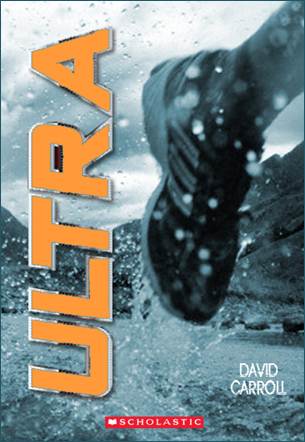
Ultra cover

The 100 mile race is a harsh and hostile immensity, and to take it on is to enter a war.

ULTRA is the story of Quinn’s war.  A war against fatigue, despair, dehydration, wild animals, hallucinations, and a dangerous family secret.

It’ll be published by Scholastic in September.

Ultra

The Running Shoes That Saved My Life

Muddy shoes

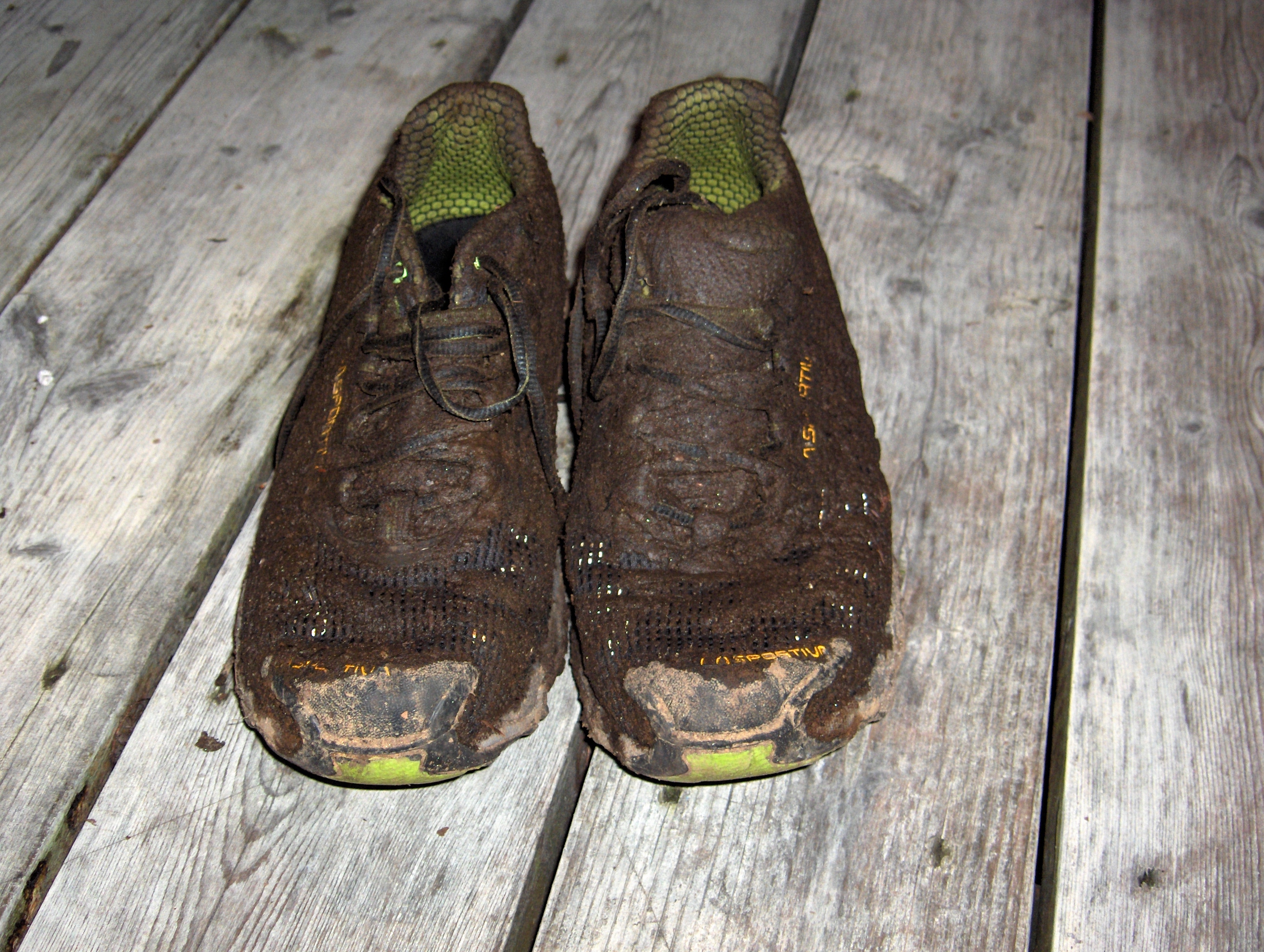
There they are.  My beloved Sportiva Wildcat Trail Runners.  Those shoes saved my life back in September 2011.

How did a pair of Sportiva Wildcat Trails save my life?

It’s an amazing story.  So amazing, I got invited onto CBC Radio to talk about it.

You can listen to the gory details here.