In Every Race There is a Surprise, Part 2

I love running 100 mile races.  And one of my favourites takes place this month.

The Sulphur Springs Trail Run is held in the Dundas Valley Conservation Area in Southern Ontario.  The race follows a series of hard-pack trails that weave in and out of steep gorges carved thousands of years ago by retreating glaciers. Over the course of the 20-kilometer loop (which you run 8 times), you pass through dense Carolinian forests and wildflower-strewn meadows.

Sulphur Springs 09

Gorgeous

To answer your question, yes, there’s a bit of hill-climbing.  Over the course of the 100 miles, you have to gut your way up 4600 metres of elevation.  That’s like 8 CN towers stacked on top of each other.

Sadly, I won’t be running the race this year.  Instead, I’ll be working this mind-blowingly awesome music festival.  It’s a decent trade-off, but I’ll still be thinking about Sulphur Springs while I’m rocking out.  I’ve said before that every 100-mile race holds a surprise of some sort, and I’ve had more than my share in that particular race…

For instance.  Five years ago I was toeing the starting line with a hundred or so other runners.  It was late May, and it was six in the morning, and most of us were wearing headlamps.

Most – but not all.

“3…2…1…GO!” shouted the race director.

“Yaaaaaaaaa!” we runners yelled, charging heroically into the darkness.

We ran for maybe 30 seconds, down a gravel road toward the trailhead. Everyone jostled for position as the road got narrower, and soon we were funneling into a straight line.

Did I mention that it was dark?  That we were moving fast?

Soddenly, right in front of me, someone shouted: “Look out!  Look out!  Look out!”

The offending posts!

The offending posts

Four metal posts were sticking out of the ground.  They were two-and-a-half feet high.  Castration height.

“Look out! Look out! Look out!”

The crowd parted, and I slipped safely between the posts. The guy beside me wasn’t so lucky, and went down with a horror-movie scream.

IN EVERY RACE THERE IS A SURPRISE.

Poor guy.  He’d run all of 200 metres.

Happily, the following year, the starting line was moved to a different area of the park.  I have no idea if that was coincidental or not.

* * *

Running a hundred miles is not like running shorter distances.  In the 100 mile race, you don’t compete with other people.  You compete against yourself.  More precisely, you compete against your own mind.  You would think that your mind would be on your side in an endurance event.  But it is not.  Your mind is your worst enemy.  Your mind is on the side of your body, and your body wants nothing more than to go home, lie down in a hammock, and eat a bag of barbecue chips.

Oh sure, every now and again, your mind will say something nice to you, like: “The bath you take after this race sure is going to feel good!”  Or, “It sure is nice, being outside in the fresh air!”  But most of the time your mind says nasty things like: “You’re stupid for trying this; you should drop out and go home.”

That’s what my mind was saying to me a couple of years ago, when I was once again running Sulphur Springs.  I’d been running for 80-odd miles and it was the middle of the night and my mind was saying: “You are a stupid bloody fool.  Why are you doing this to yourself?”

HPIM3533

I’ll never forget finishing my 7th loop. At the turnaround, the volunteer lady gave me a high five and offered me a slice of pizza.  I declined, since I still had one final 20-kilometer loop to do.  “No you don’t,” she said.  “You’ve already done your 8.  Just look at the clipboard.”

I stared at the clipboard, and counted the laps.  She was right, I’d done 8, not 7 like I thought.

Which meant –

I WAS DONE!!!

Believe me when I tell you – that was the happiest moment of my life.  

Of course, later that day, the pain really set in.  I had a burning Achilles tendon, and I lost all feeling in six of my toes.  My calves and left shin were…hmmm, let me see.  What were they exactly?  Ah yes, they were a blinding wall of pain.  That’s right, that’s what they were.

On the bright side, I was given permission to use the physical disability washroom at work.  That handle on the wall beside the toilet was a godsend. 
 

Repeat to Failure

I’ve been upping my mileage lately.  I’ve got a 50-mile race coming up in July, and my usual 100-mile “fun run” in September.  Let the training begin!

I love the extra hours outside, but I’m having trouble keeping my weight up. Yesterday, in the span of five minutes, three different people expressed concern about my evaporating waistline.  They looked startled by my appearance – as if I were a mangy stray who’d left an unwanted deposit on their front lawn.

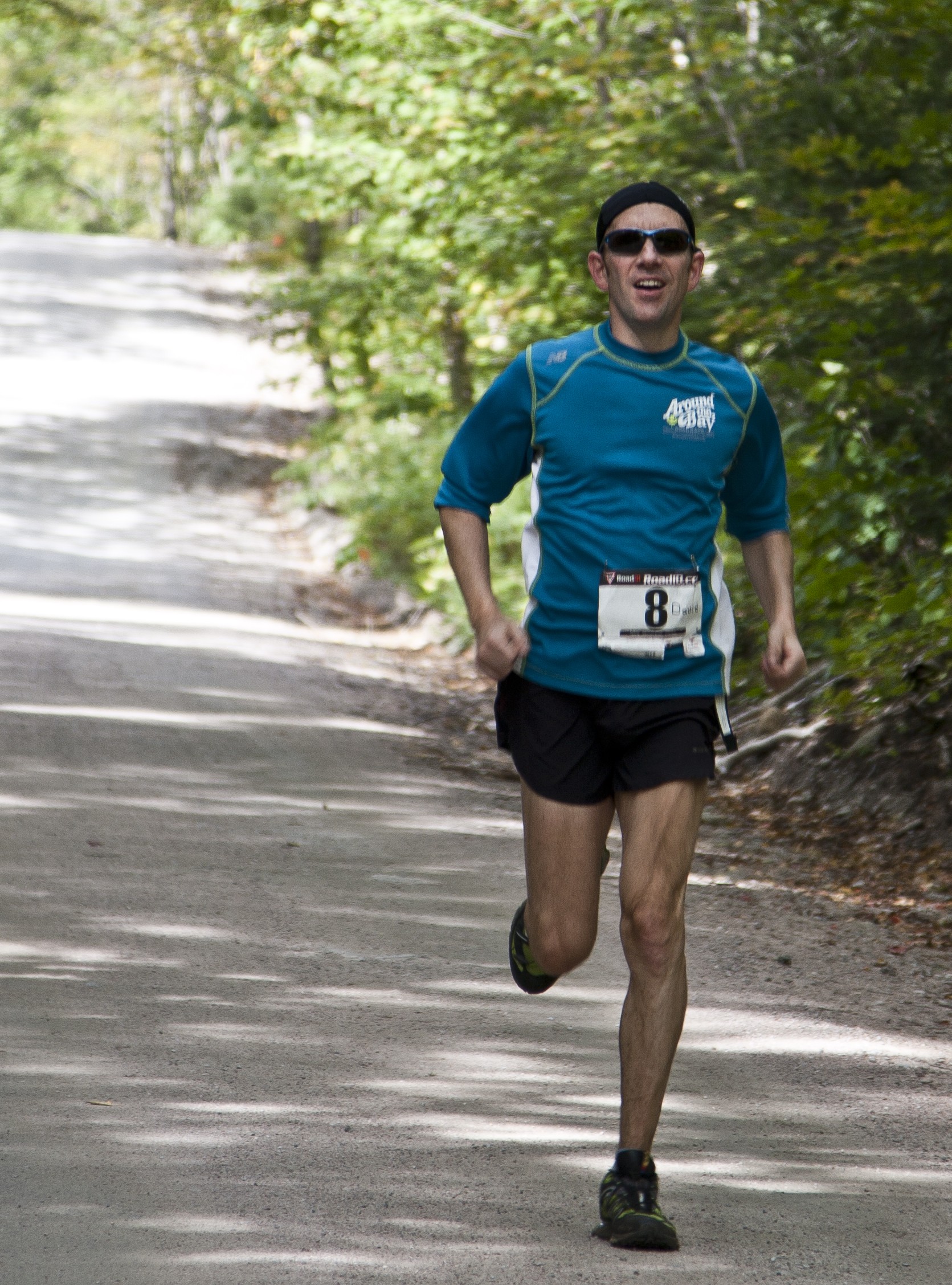
David Carroll running-3

The trouble is, I can’t eat enough food to keep pace with my caloric output.  60 miles per week = roughly 6000 extra calories burned.  That’s a lot of fettuccine alfredo.

My friend Paul tells me I should be cross training more.  Paul is a weight lifter, and he keeps promoting this thing called “repeat to failure.”

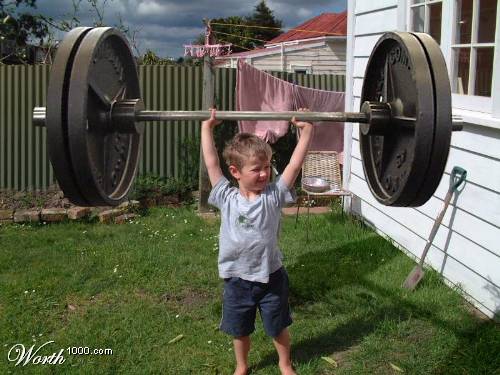
four-hour-body-weight-lifting

You wouldn’t think that weight-lifters are the smartest people.  Paul, for instance, spends most of his free time grunting and lifting impossibly heavy discs.  And yet, weight-lifters have somehow come up with one of the most brilliant concepts of all time.

Repeat to Failure basically means you lift the maximum amount of weight possible – for a limited number of repetitions.  Whereas you might normally lift a 20-pound weight fifteen times, with repeat to failure, you’d lift double the weight – but only for five or six reps.  The idea is to stress your muscles to the point of collapse while also – and this is the tricky part – avoiding injury.

Yes, there’s pain involved.  But, as my friend Paul points out, pain is how you grow.

“Every time I lift a massive weight over my head, I’m literally shredding my back and neck his muscles,” Paul told me. “But later on, scar tissue will grow on top of those damaged muscles.  And guess what that scar tissue will turn into?  Bigger muscles!”

Repeat to Failure strikes me as a wonderful metaphor for life.  Why tread on familiar ground, over and over?  We only grow by pushing ourselves beyond our comfort zones.  And the moment of our greatest failure can lead us to the threshold of our greatest success.

This is true whether you’re a weight-lifter, or a runner, or a writer, or a knitter, or a photographer, or a snake charmer or a Minecraft player.  We only get better by taking on bigger and heavier challenges.  And as much as the failures hurt, they almost always make us stronger.

Failures aren’t failures.  They’re stepping stones to success.

Coming Soon – My New Novel About Running

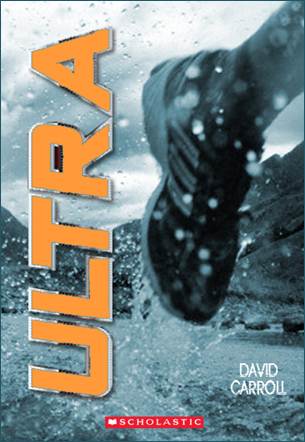
Ultra cover

The 100 mile race is a harsh and hostile immensity, and to take it on is to enter a war.

ULTRA is the story of Quinn’s war.  A war against fatigue, despair, dehydration, wild animals, hallucinations, and a dangerous family secret.

It’ll be published by Scholastic in September.

Ultra

Trading Diamonds for Stones

A few years ago, when I was stuck in an office job I didn’t like, I found myself staring out the window.  It was a gorgeous, sunny day, and I felt like a panther inside a cage.

A colleague came up beside me. “Today is a diamond,” he said.  “Workdays are stones.  You and me, we’re trading diamonds for stones.”

It was a depressing thought, and I determined to get out of that job and change my life for the better.  The trouble was, I didn’t know what I wanted to do.

A friend of mine came up with a good idea.  He sat me down with a piece of paper and a pen, and told me to write down the best experiences of my life.

ideas

In no particular order, here’s what I wrote:

  • Sailing with my brother on Lake Kennisis in the summer of 1986, when a hurricane blew in and we nearly shipwrecked.
  • Tobogganing in Edmonton, with my nieces and nephews, IN MINUS 50 DEGREE WEATHER!
  • Running my first 100 mile race.
  • Sitting on the dock with my mom one summer night, while the Northern Lights tarted up the skies.
  • Skiing down Whistler Mountain with my visually-impaired friend.
  • Hiking through a forest with Shawna and running into that big-ass BEAR.
  • Canoe tripping with my dad, in lakes so clean you could drink straight out of them.
  • Getting the phone call from my agent that my novel had sold.

HPIM3895

I handed the list to my friend.  His face lit up instantly.  “Good job,” he said.  “Now what do all of those things share in common?”

It took me a while to figure it out.  But eventually I saw the common thread.  All of those events, with the exception of that last one, took place OUT OF DOORS.  It sounds obvious, but it was an incredible revelation to me at the time.  If I really wanted to be happy in the future, I needed to find a way of getting outside more often.  And ideally, I’d do it with the people I love.

Years have passed since then, and while I still have a job that keeps me chained to a desk a lot of the time, it’s extremely creative, and I’m surrounded by zillions of smart, spunky people.

More importantly, I know what I need to do to keep myself sane.  A week spent behind a computer screen can gut me like a fish, but an hour on the running trail puts me right.

So if  you feel as though you’re trading diamonds for stones, don’t worry.  Most of us have to spend some time in the mine-shaft before we achieve the career we want and deserve.  The trick is to figure out how to get more sunlight into our lives in the meantime.  Figure that out, and the bars of your cage may well evaporate.

Running with Borscht

The symptoms are unmistakable.  You’ve forgotten your kids’ names.  The family dog hates your guts.  And you’re getting bad vibes from that person in the kitchen who you suspect you may have married at some point.

I hate to be the one to break the bad news, but you’ve got an advanced case of Runner’s Guilt.  It’s a common affliction at this time of year, what with 20-mile long runs pre-empting our family responsibilities.

Happily, there’s a simple treatment for this scourge.  It’s called THINKING ABOUT OTHER PEOPLE FOR A CHANGE!

Here’s what you do.  First, draw up a list of the people in your life who are suffering.  Any kind of ailment will do – a layoff, hip replacement, a bad break-up, etc.  Enter the addresses of these afflicted souls into Google Maps.  Plot a course that equals your training distance, then run!

Note: while it’s important to stop and say hello to each of these afflicted friends, try to avoid prolonged conversations.  Yes, you’re on a charitable mission, but it’s equally important to keep your heart rate elevated.  By all means, give your friends a supportive hug, but don’t stop running for more than two or three minutes.

One other thing – and this part is crucial – you must impart a small gift to each of your friends.

The ideal gift is small and light; something that’s easy to carry during your run.  Gift certificates are perfect.  So are thumb drives full of music.  Packets of heirloom seeds will delight the green thumbs among your friends.

Then again, if you’re feeling especially generous, you can always deliver jars of Russian Cabbage Borscht.

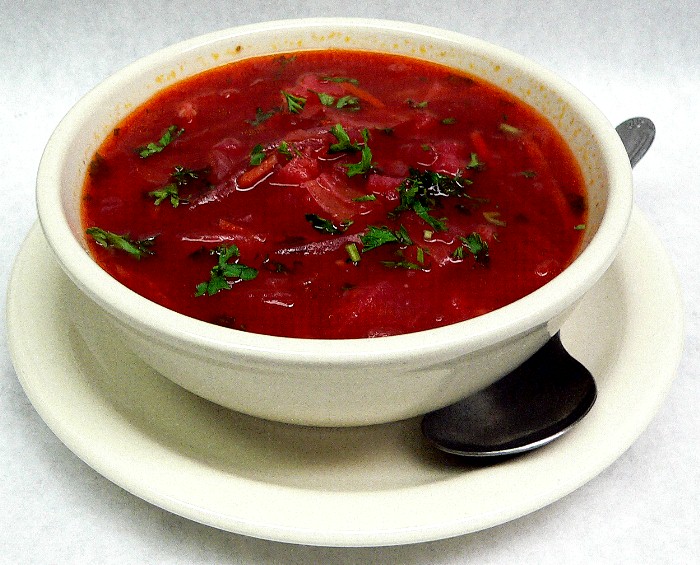
borscht

A cautionary note: 1500 millilitres of Russian Cabbage Borscht weighs just over six pounds.  Three Mason jars full, swaddled in a bath towel and crammed tightly into a running backpack, weigh roughly the same as 8 litres of milk.

How do I know this?  I know this because I delivered that precise volume to a number of friends during a recent 35-mile training run (I’m prepping for a 100-miler).  Sounds insane, I know.  But to my credit, I  planned the run so that I’d unload the first jar fairly early in the run.  That is to say, at mile 19.

“It smells a bit like armpit,” my friend Farhad said, unscrewing the lid and taking a sniff.  (Farhad’s recovering from a nasty case of Shingles.)

“It’s better when you heat it up,” I said.

I’m not really sure what I was thinking with the borscht.  Borscht is a healing food; full of every colourful vegetable known to humankind.  Vanity also played a role, no doubt.  For years, Russian Cabbage Borscht has been my “thing.”  I make it with lots of sour cream and dill.  Blend it until it’s velvet.

Farhad dipped in a finger and took a taste.  “It tastes like dirt.  Really good dirt.”

Yeah, but is it safe?

That’s Kaytlynn Welsch, age 12, center, and her little sister Heather, who is 10, just before they ran a half marathon in Utah last year.

Some people wonder how safe it is for kids to run that kind of distance.

Sometimes I even wonder if it’s safe for me!

Haliburton10-8308

A couple of years ago, while running a 100-mile race, I asked the following question of an on-site medic: “Is it healthy, running 100 miles at a stretch?”

It was 3 a.m. and the Doctor had been patching up battered runners for the better part of 24 hours.  “On the whole, I would have to say NO,” she said, looking at me over the waxy light of a Coleman lantern.

It had been a tough race.  The thermometer had risen to thirty degrees, and a bunch of runners had been evacuated to the local hospital with heat-related illness.  I’d been lucky.  I had some blisters, a nasty cut on my knee from a fall, and a strange rash I never really figured out (lyme disease?).  But that was all.

“Seriously?” I said.  “You think running long distances is unsafe?”

“For some people,” said the Doctor. “Absolutely.”

* * *

Distance running is not risk-free.  But the same can be said of virtually any activity worth doing. Playing hockey can be risky.  Same thing with riding a bicycle.  And as much as we try to convince ourselves otherwise, strapping fiberglass boards to our feet and launching ourselves down icy mountain slopes may not be the safest thing in the world.

And yet we still do it.  Because it’s FUN.

The trick is to use our common sense.  Check out what the Dad in this story says about the importance of getting checked out by a doctor.

As long as you’ve trained properly, and understand the importance of proper nutrition and hydration, and have the approval of your family doctor, and the support of friends and family members, and most important, if you really want to be out there, then why not run?  After all, there’s not much difference between running a marathon in 5 hours, and spending an afternoon playing soccer or Capture The Flag with your friends.

Real Life Superheroes, Part 4

Nikolas Toochek, age 9, is attempting to do something no kid has ever done before.  He wants to run 7 marathons on 7 continents.  He ran his first in Delaware, last December:

A few days ago, Nikolas completed his second marathon – in Antarctica.

Nikolas and penguin

The weather got pretty nasty during the run, and race organizers were forced to bundle everyone onto an airplane, and fly them back to Chile.  Nikolas ran the final 8 miles of his marathon there.

So why is Nikolas doing all this running?  To raise money for Operation Warm, a not-for-profit organization his grandfather founded.  The charity buys warm clothing for kids in need.

Nikolas isn’t sure when and where his next marathon will be.  You can follow his adventures here.

Real Life Superheroes, Part 2

Take a look at the runners in these pictures.  Can you tell what makes them all special?

First, there’s America’s Dick Beardsley (on the left):

Dick+Beardsley+and+Inge+Simonsen+finish+the+London+Marathon+together.+Horace+Culter+of+the+Greater+London+council+one+of+the+men+who+made+this+race+possible+watches+on+in+the+background

Up next, Spain’s Fernandez Anaya (in green):

o-FERNANDEZ-ANAYA-570

And finally, Ohio track star Meghan Vogel (blonde hair, on the right):

Meghan Vogel

Any guesses?  Yes, they’re all runners, and yes, they’re crazy fit.  They probably run 100+ miles a week and eat nothing but salads and nuts.  But these incredibly healthy human specimens have something much more interesting – and much more valuable – in common.

You’ve got fifteen seconds to figure it out.  Tick tick tick tick tick…TIME’S UP!

ANSWER: All of these runners are real-life superheroes.  They’re not only fast.  They’re also super kind.

Take Meghan Vogel.  She was competing in her third race of the day.  Ahead of her, a runner crumpled to the ground in the heat.  But instead of dashing past her, she lifted her up, helped her to the finish line, and literally pushed her across the finish line.

Fernandez Anaya (the guy in the green shirt) was equally generous.  He was running second in his race, a ways behind the race leader, Abel Mutai.  As he entered the finishing straight, Fernandez noticed Mutai pull up about 10 metres before the finish line.  Mutai thought he’d crossed the finish line, BUT HE HADN’T!  He still had 30 feet left to go!

Instead of racing past Mutai for the win, Fernandez slowed down and gestured at him to keep running.  He literally helped the OTHER guy win.

Which brings me to the black and white photo of Dick Beardsley at the top.  Dick was running the very first London marathon in 1981.  He and Norway’s Inge Simonsen spent the race battling for first place.  In the finishing stretch, instead of trying to prove who was better than the other, the athletes clasped hands and crossed the finish line together.

How awesome is that?  They acknowledged they were evenly matched, and split the first place prize two ways.

Someone should show these videos to Lance Armstrong.