Going Long. Too Long.

We runners love to set goals.  Drop a few pounds; shave a few minutes off a PR, improve our finishing kick.  We set expectations, and then we go out and exceed them.  Except for those rare occasions when we don’t.

A couple of years ago,  I decided to run 4000 kilometres.  Why 4000?  I’m not sure.  It felt like a big, braggable number.  And it was just slightly beyond my comfort zone.  Previously, the most I’d ever run in a year was 3500 kilometres.

A few facts about running 4000 kilometres:

In order to cover 4000 kilometres in a year, you must run 11k each and every day.

If you take a day off, you’ll need to run 22k on some subsequent day to make it up.

If you get sick, and miss a week of running, you’re on the hook for eighty clicks.

It quickly became clear that my whimsical little goal would require some careful planning.  I’d need to pay attention to diet, sleep, hydration, injury prevention, stretching, recovery, supplements, etc.  In short, I would need to become the most BORING person on the face of the planet.

I’m sorry to report, that’s exactly what happened.

I suffered injuries, I got sick, and I spent the entire year obsessively totaling my mileage.  As the months went by, I became more and more depressed.  I didn’t understand what was happening to me at the time, but I do now.  I spent the whole year staring at the odometer instead of the gorgeous scenery I was running past.

“You used to be a peddler of joy,” Shawna said towards the end of the year. “But you’ve turned into a fun vacuum.”

Haliburton10-8303

On the last day of the year, December 31st, I was 6 kilometer shy of my goal. I’d run 3994 kilometers in 364 days.  In the month of December alone, I’d run 600 kilometers.

It was a sunny and dry day, and there was no physical reason why I shouldn’t have pulled on my gear and dashed off the final 6 km to meet my goal.

And yet, I didn’t.

Why?

Years before, at a marathon, I’d seen a man cross the finish line, check his watch, and then yell – at the top of his lungs – the raunchiest  swear word known to humankind.  You know the one.  I pledged then and there that I would never become that guy; I would never put goals and numbers ahead of my love of the sport.

It was a tough decision to make, and I felt conflicted about it.  But later that night I went to a New Year’s party.  10 p.m. came and went, and not only was I still conscious; I was laughing and telling stories, and actually having fun for a change!  I was so bubbly, so full of spunk; I didn’t know what to make of myself.

“I can’t believe I’m awake,” I said to Shawna.

“Welcome back to the world,” she replied.

Repeat to Failure

I’ve been upping my mileage lately.  I’ve got a 50-mile race coming up in July, and my usual 100-mile “fun run” in September.  Let the training begin!

I love the extra hours outside, but I’m having trouble keeping my weight up. Yesterday, in the span of five minutes, three different people expressed concern about my evaporating waistline.  They looked startled by my appearance – as if I were a mangy stray who’d left an unwanted deposit on their front lawn.

David Carroll running-3

The trouble is, I can’t eat enough food to keep pace with my caloric output.  60 miles per week = roughly 6000 extra calories burned.  That’s a lot of fettuccine alfredo.

My friend Paul tells me I should be cross training more.  Paul is a weight lifter, and he keeps promoting this thing called “repeat to failure.”

four-hour-body-weight-lifting

You wouldn’t think that weight-lifters are the smartest people.  Paul, for instance, spends most of his free time grunting and lifting impossibly heavy discs.  And yet, weight-lifters have somehow come up with one of the most brilliant concepts of all time.

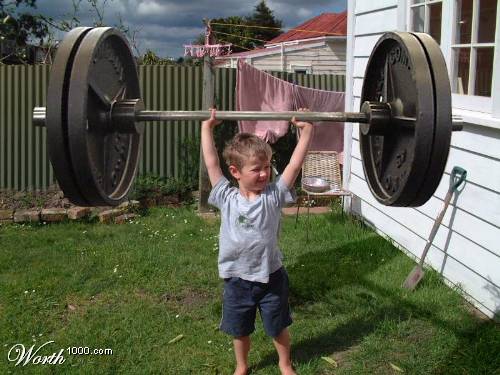
Repeat to Failure basically means you lift the maximum amount of weight possible – for a limited number of repetitions.  Whereas you might normally lift a 20-pound weight fifteen times, with repeat to failure, you’d lift double the weight – but only for five or six reps.  The idea is to stress your muscles to the point of collapse while also – and this is the tricky part – avoiding injury.

Yes, there’s pain involved.  But, as my friend Paul points out, pain is how you grow.

“Every time I lift a massive weight over my head, I’m literally shredding my back and neck his muscles,” Paul told me. “But later on, scar tissue will grow on top of those damaged muscles.  And guess what that scar tissue will turn into?  Bigger muscles!”

Repeat to Failure strikes me as a wonderful metaphor for life.  Why tread on familiar ground, over and over?  We only grow by pushing ourselves beyond our comfort zones.  And the moment of our greatest failure can lead us to the threshold of our greatest success.

This is true whether you’re a weight-lifter, or a runner, or a writer, or a knitter, or a photographer, or a snake charmer or a Minecraft player.  We only get better by taking on bigger and heavier challenges.  And as much as the failures hurt, they almost always make us stronger.

Failures aren’t failures.  They’re stepping stones to success.

Coming Soon – My New Novel About Running

Ultra cover

The 100 mile race is a harsh and hostile immensity, and to take it on is to enter a war.

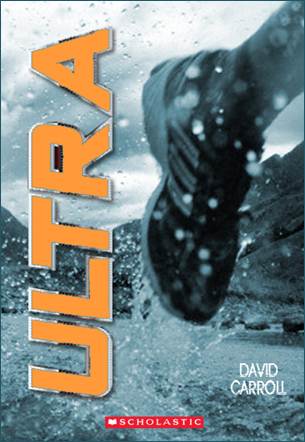
ULTRA is the story of Quinn’s war.  A war against fatigue, despair, dehydration, wild animals, hallucinations, and a dangerous family secret.

It’ll be published by Scholastic in September.

Ultra

Blindfolded in Boston

Did I mention that I’m not in Boston right now?  That I won’t be running the fabled marathon on Monday?

I know; a total drag.  But I do have some choice memories of the event.

Back in 2007, along with 30,000 other hardy souls, I ran from Hopkington to downtown Boston through a howling nor-easter.  The storm was so violent that they shut the airport down.  The downtown hotel where I stayed teetered back and forth in the wind.   When I got up in the night to take a pee, there were whitecaps in the toilet bowl!

We had better weather in 2008.  I ran that year with my buddy Kai, who is blind.  He’d asked me to be his “seeing-eye runner,” but I don’t think I did a very good job.  Thanks to me, he nearly did a face-plant on the infamous “Three Mile Island.”

“Buddy!” I shouted.  “Veer left!  Veer left!”

Three Mile Island is a cement protrusion in the middle of Route 135 near Ashland.  If you’re running in the middle of the pack, or drafting behind another competitor, it’s easy to miss the warning signs and pilons.  Half the runners go right and the other half go left.   If you’re not careful, you’ll smack into the cement wall.

“Kai!” I screamed.  “LOOK OUT!”

I grabbed his sleeve and yanked him out of harm’s way.

“What was that?” Kai asked.

“An early death,” I said.

When Kai was still a teenager, macular degeneration robbed him of ninety percent of his central vision.  Mercifully, the disease left his peripheral vision intact.  And it’s those twin curtains of sight that allow Kai to run with some degree of confidence – to deke left and right, and to find the gaps between other runners.

“I actually feel pretty comfortable running in a pack,” Kai told me.  “I can see the contours of people ahead of me.  So all I have to do is find my opening and keep up with the crowd.”

Although he chose me to be his guide, Kai had no particular interest in being tethered to me by a rope.  Nor was he interested in pinning a bright yellow BLIND RUNNER sign to the back of his jersey.  “Thousands of cute Wellesley girls, and you want me to advertise that I’ve got a disability?” he said.

So we ran side by side.  Kai was worried about slowing me down, but I assured him that I wasn’t looking for a PR.  “I’ve run lots of marathons for speed,” I told him.  “I’m looking forward to actually seeing this race.”

So there we were, two best friends, clipping along at a 3:50 pace.

“Who’s that singing?” Kai asked me at the 10-mile mark.  We could hear a karaoke version of Cracklin’ Rosie.

“There’s a Neil Diamond impersonator standing on the roof of his El Dorado,” I said.  “He’s dressed in leather pants, and he’s doing the Macarena.”

Ten minutes later we heard intoxicated screaming.

“What’s that?” said Kai.

“Hundreds of drunken dudes,” I said.  “Hot girls are lobbing beer cans to the runners.”

“Can you grab us some?”

“Too late,” I said.

As we ran, it occurred to me that this was my true role as Kai’s guide: to animate the lunacy of the race for him.  After all, running Boston is only half the fun.  Watching the crazy people on the sidelines is almost as good.

At Citgo Hill spectators yelled “One more mile!”

Before Boston, I’d run a hundred marathons for time, but in retrospect, I’d done those exclusively for myself.  This was the first race where my eyes were fully open.  Ironic that Kai would be the one to give me that gift.

There is a photograph of the two of us completing the race together.  Our arms are raised, and we appear to be laughing.

“Where’s the finish line?” Kai said.

“Right behind you,” I said.

Dave and Kai


Real-Life Superheroes, part 6

Whether you’re a runner looking for inspiration, or a writer looking for a story, this post may just help you out…

BHVlIirCMAATclw

The Boston Marathon takes place on Monday.  I won’t be running it this year, which breaks my heart.  That race is more fun than…jeez…a barrel of monkeys?  A trampoline of hamsters?  A terrarium of Bearded Dragons?

hopkintonIt’s crazy fun, that’s what it is.

My favourite Boston memory? Hmmm, let’s see…

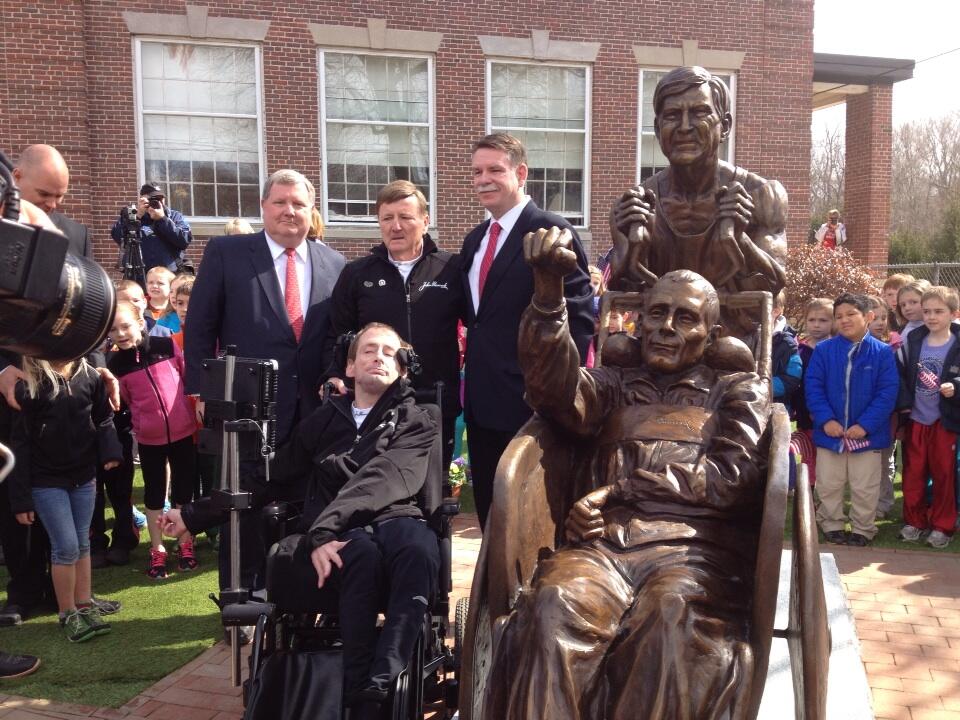
One time I found myself running alongside a heavyset man.  He was running at a fast clip, which was amazing, considering that he was pushing a weird wheelchair/stroller contraption.  A young man was reclined in the stroller, and he was grinning at the huge crowds that had gathered on both sides of the road. Everyone went ballistic as these two guys passed by.  It was like they were rock stars or something.

That was six years ago.  It’s one of the great regrets of my life that I HAD NO IDEA who Rick and Dick Hoyt were.  But I know who they are now.  As do millions and millions of others.

They aren’t rock stars, of course.  They’re something much better.  They’re a father and a son, and more importantly – A TEAM.  And they’re a reminder of the good that any of us can do in this world:

Believe me, it’s worth the plane fare to Boston – just to cheer these two heroes on.

Trading Diamonds for Stones

A few years ago, when I was stuck in an office job I didn’t like, I found myself staring out the window.  It was a gorgeous, sunny day, and I felt like a panther inside a cage.

A colleague came up beside me. “Today is a diamond,” he said.  “Workdays are stones.  You and me, we’re trading diamonds for stones.”

It was a depressing thought, and I determined to get out of that job and change my life for the better.  The trouble was, I didn’t know what I wanted to do.

A friend of mine came up with a good idea.  He sat me down with a piece of paper and a pen, and told me to write down the best experiences of my life.

ideas

In no particular order, here’s what I wrote:

  • Sailing with my brother on Lake Kennisis in the summer of 1986, when a hurricane blew in and we nearly shipwrecked.
  • Tobogganing in Edmonton, with my nieces and nephews, IN MINUS 50 DEGREE WEATHER!
  • Running my first 100 mile race.
  • Sitting on the dock with my mom one summer night, while the Northern Lights tarted up the skies.
  • Skiing down Whistler Mountain with my visually-impaired friend.
  • Hiking through a forest with Shawna and running into that big-ass BEAR.
  • Canoe tripping with my dad, in lakes so clean you could drink straight out of them.
  • Getting the phone call from my agent that my novel had sold.

HPIM3895

I handed the list to my friend.  His face lit up instantly.  “Good job,” he said.  “Now what do all of those things share in common?”

It took me a while to figure it out.  But eventually I saw the common thread.  All of those events, with the exception of that last one, took place OUT OF DOORS.  It sounds obvious, but it was an incredible revelation to me at the time.  If I really wanted to be happy in the future, I needed to find a way of getting outside more often.  And ideally, I’d do it with the people I love.

Years have passed since then, and while I still have a job that keeps me chained to a desk a lot of the time, it’s extremely creative, and I’m surrounded by zillions of smart, spunky people.

More importantly, I know what I need to do to keep myself sane.  A week spent behind a computer screen can gut me like a fish, but an hour on the running trail puts me right.

So if  you feel as though you’re trading diamonds for stones, don’t worry.  Most of us have to spend some time in the mine-shaft before we achieve the career we want and deserve.  The trick is to figure out how to get more sunlight into our lives in the meantime.  Figure that out, and the bars of your cage may well evaporate.

Running with Borscht

The symptoms are unmistakable.  You’ve forgotten your kids’ names.  The family dog hates your guts.  And you’re getting bad vibes from that person in the kitchen who you suspect you may have married at some point.

I hate to be the one to break the bad news, but you’ve got an advanced case of Runner’s Guilt.  It’s a common affliction at this time of year, what with 20-mile long runs pre-empting our family responsibilities.

Happily, there’s a simple treatment for this scourge.  It’s called THINKING ABOUT OTHER PEOPLE FOR A CHANGE!

Here’s what you do.  First, draw up a list of the people in your life who are suffering.  Any kind of ailment will do – a layoff, hip replacement, a bad break-up, etc.  Enter the addresses of these afflicted souls into Google Maps.  Plot a course that equals your training distance, then run!

Note: while it’s important to stop and say hello to each of these afflicted friends, try to avoid prolonged conversations.  Yes, you’re on a charitable mission, but it’s equally important to keep your heart rate elevated.  By all means, give your friends a supportive hug, but don’t stop running for more than two or three minutes.

One other thing – and this part is crucial – you must impart a small gift to each of your friends.

The ideal gift is small and light; something that’s easy to carry during your run.  Gift certificates are perfect.  So are thumb drives full of music.  Packets of heirloom seeds will delight the green thumbs among your friends.

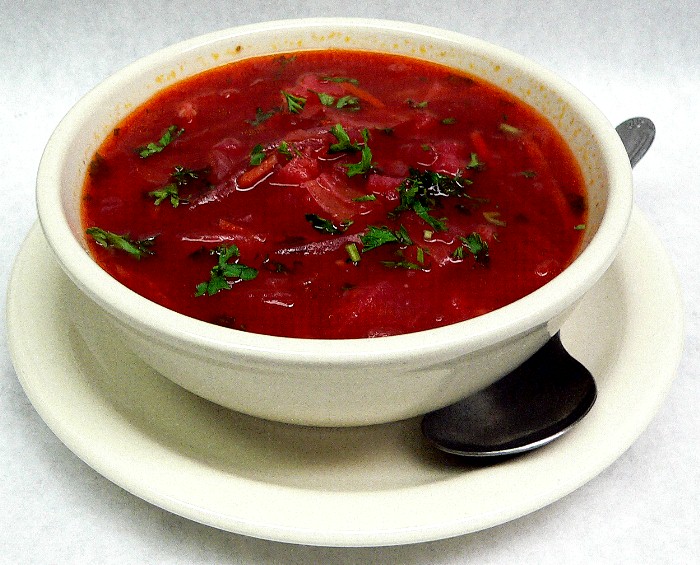
Then again, if you’re feeling especially generous, you can always deliver jars of Russian Cabbage Borscht.

borscht

A cautionary note: 1500 millilitres of Russian Cabbage Borscht weighs just over six pounds.  Three Mason jars full, swaddled in a bath towel and crammed tightly into a running backpack, weigh roughly the same as 8 litres of milk.

How do I know this?  I know this because I delivered that precise volume to a number of friends during a recent 35-mile training run (I’m prepping for a 100-miler).  Sounds insane, I know.  But to my credit, I  planned the run so that I’d unload the first jar fairly early in the run.  That is to say, at mile 19.

“It smells a bit like armpit,” my friend Farhad said, unscrewing the lid and taking a sniff.  (Farhad’s recovering from a nasty case of Shingles.)

“It’s better when you heat it up,” I said.

I’m not really sure what I was thinking with the borscht.  Borscht is a healing food; full of every colourful vegetable known to humankind.  Vanity also played a role, no doubt.  For years, Russian Cabbage Borscht has been my “thing.”  I make it with lots of sour cream and dill.  Blend it until it’s velvet.

Farhad dipped in a finger and took a taste.  “It tastes like dirt.  Really good dirt.”

Your Running Playlist, Part 2

I can’t write when music is playing in the background.   I need total silence to write.

On the other hand, when I want to run fast, I needs good tunes.  And nothing gets my legs pumping faster these days than Zedd:

If I had my own planet I’d make everyone write songs that catchy.

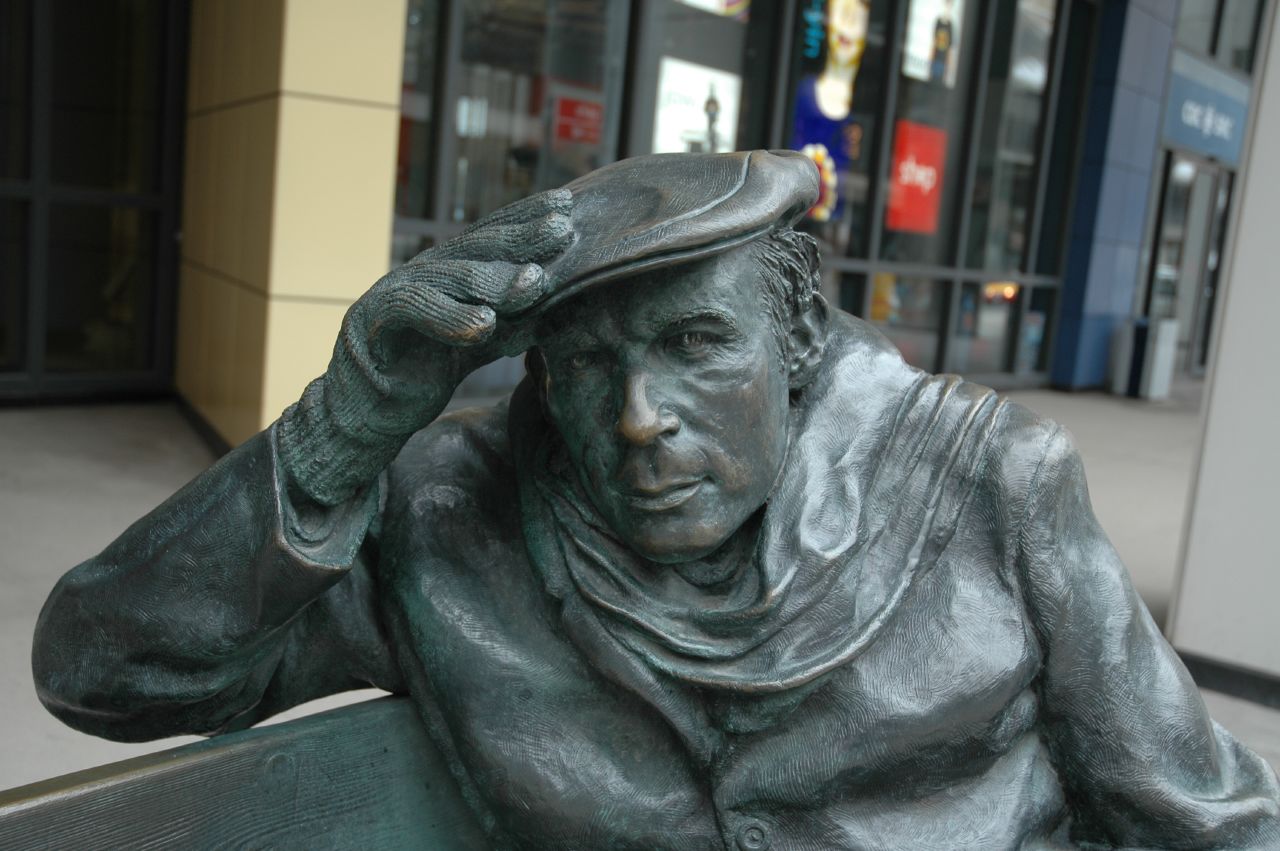
Seriously, when that song’s playing, I run faster than the internet.  If it was playing in his ear buds, I bet even the statue of Glenn Gould could win a marathon.

Glenn_gould_sitting_in_front_of_CBC_building

Zedd started playing piano at the age of four.  When he turned twelve, he learned to play the drums.  For a while there, he wrote a new song every day.

Zedd has done remixes for Lady Gaga, Black Eyed Peas, P. Diddy, Swedish House Mafia and Skrillex.  They’re good, but not nearly as good as his fist-pumping, slightly off-kilter originals:

The Running Shoes That Saved My Life

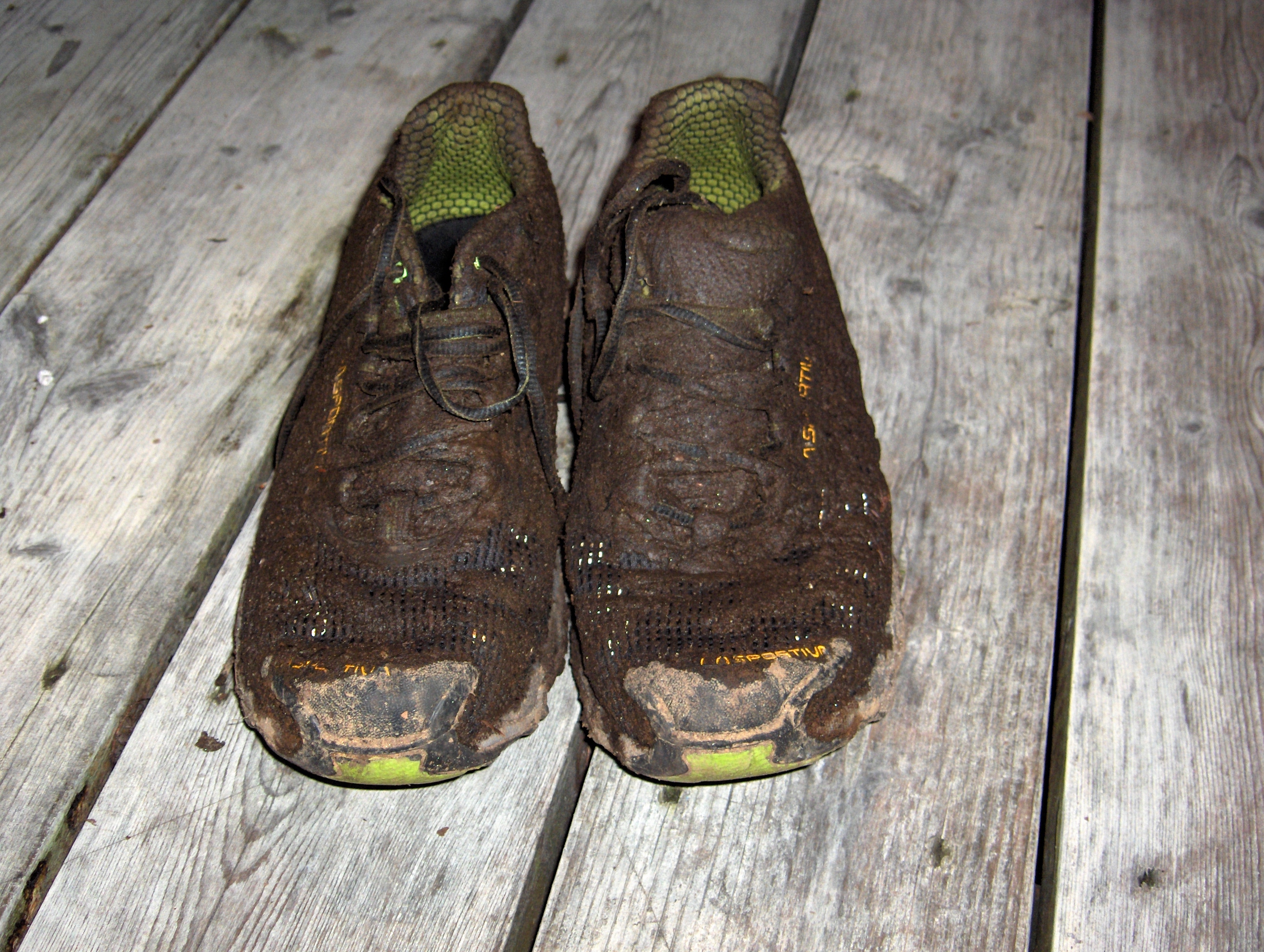
Muddy shoes

There they are.  My beloved Sportiva Wildcat Trail Runners.  Those shoes saved my life back in September 2011.

How did a pair of Sportiva Wildcat Trails save my life?

It’s an amazing story.  So amazing, I got invited onto CBC Radio to talk about it.

You can listen to the gory details here.

In Every Race There is a Surprise

Back in 2007, I met a hardcore trail-runner in Yellowknife.  He was as tough as the Canadian Shield, and skinnier than two toothpicks tied together.  He took me out for a run along the “highway to nowhere.”  As we ran, mile after mile, past the Giant Mine, where 9 men tragically lost their lives in an explosion 1992, he told about some of the running adventures he’d had over the years.  The animals he’d run into during long trail races (Grizzlies, wolverines), and the times he’d nearly broken ankles in the dark.  “You have to be prepared,” he said.  “In every race, there is a surprise.”

A couple of months later, I ran my first Ultra-marathon.  And he was right.  I got a BIG surprise.

The Niagara Ultra, at a mere 50 kilometers, is the Maggie Simpson of Ultra-marathons.  Still, it’s 8 kilometers longer than a conventional marathon, which seemed like a big leap to me at the time.

I drove down to Niagara-on-the-Lake at 4:30 a.m. on a June morning, got my BIB (#105) and sat in the Kinsmen Hall in my singlet and shorts, trying to stay warm until the race began.  The forecast was calling for clear, cool weather.  The sun rose over the Niagara River while Huey Lewis and the News sang about “The Power of Love” on the radio.

At 6:45 I went outside and joined the other runners.  There were maybe 100 of us standing about on a grassy field, rubbing our arms for warmth.  A stern man outlined the route and thanked the various local sponsors.  Then suddenly he said, “Is everyone ready?  Okay then, GO!”

There was no count-down clock and no pumping music.  Suddenly the hundred of us were running across the dewy meadow.

Things happened very fast.  The pack merged onto the Niagara Parkway path; a recreational trail that snakes alongside the Niagara River.  We were to run from Lake Ontario in the north to the great falls in the south, and then back again.  The crowd of runners quickly thinned out, and I got into a groove.

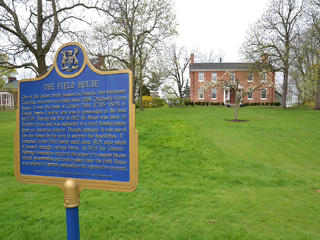
virtual-tour-79336-01-1335331793

The asphalt trail was shaded by mature oaks and elms.  Shortly after the first aid station, I ran past the Field House, the stately brick home General Brock used as his headquarters during the War of 1812.  More importantly, it was where my beloved Gran lived for many years, and where I spent many Christmases and Sunday dinners.

But there was no time for nostalgia – I had a race to run!  I climbed the Niagara Escarpment to the hamlet of Queenston, ran past the floral clock, the hydro electric plant where the Niagara river thins out, and the lush green golf courses.  I banked the first 10 kilometers in 46 minutes, which seemed a dangerously fast pace for me at the time.  At the 15k aid station a volunteer told me that I was in seventh place.  Seventh!  Never in my life had I ever been in seventh place for anything!

Unfortunately, this was not my only surprise in this race.  A much worse revelation was yet to come.

I ran into the city of Niagara Falls.  No roads had been closed for this race, and there weren’t any police officers to hold back traffic.  Runners were expected to follow the sidewalks, and obey traffic signals.  Since it was now 9 a.m. on a sunny June morning, I found myself dodging tourists with cameras, jumping over “Maid of the Mist” turnstiles, and waving at curious honeymooners.

Niagara Falls

And then, there it was.  Niagara Falls.  I’d grown up just down the road, and had visited the falls any number of times, and yet, on this morning it looked more beautiful than ever before.  I wanted to stop and stare at the falls.  But I didn’t.  My 7th place was on the line.

At the turnaround I downed a cup of Gatorade, and doubled back towards Niagara-on-the-Lake, passing the runners immediately in my wake.  The bulk of the pack was roughly 5 k behind me.

I swallowed one gel at the 25 k turnaround, and another at 35 k.  Hydration was not a problem.  But – SURPRISE – my bowels were.

Yes.  The B word.  I could feel the pressure starting to build.  It became quite a distraction, and I kept my eyes peeled for a porta-potty.

At the 40 kilometer mark I was still clinging to 7th place, but a guy named Doug kept catching up to me whenever I stopped to talk to the volunteers at the aid stations.  “Bathroom?” I’d say.  They’d shake their heads, no.  Doug would roll in behind me, and I’d sprint off again.

A couple of times, Doug got ahead of me.  Each time he came across a paper cup that someone had discarded on the road, he’d bend down, pick it up, and carry it to the garbage can at the next aid station.  He did this over and over again.  After a while, I started doing it too.  At big city races, there are hundreds of volunteers to clean up after the racers, but in a small race like this, it made sense to clean up after ourselves.

Of course, it wasn’t easy to bend down after having run 40k – especially now, when most of my strength was going into holding my butt cheeks clenched together.

At 46k, Doug passed me for good.  I was fighting off waves of gastric pain, and I could barely run anymore.  And so, with 4 kilometers left to run, and no relief in sight, I succumbed to the inevitable.  I jumped off the path, scrambled down the side of the gorge into the forest, and squatted.

While I took care of business in the gorge, I could hear runner after runner springing past me on the path above.  My 7th place was long gone.  But I didn’t care.  I was feeling fine. 

I’m sorry to tell you a story involving poop.  But there’s no way around it.  Bodily functions, and learning how to deal with them, is a big part of ultra-running.  You can’t expect to run for 6, 12, or 24 hours at a time, and not have to think about the food that goes in, or comes out of your body.  It’s life.

Happily, I learned a couple of things from that “surprise.”  For instance: don’t eat any dairy products in the 24 hours leading up to a race.  For me, that usually prevents unwanted bathroom breaks.

I also learned to always run with toilet paper.  And to never shake hands with an ultra-runner at the finish line – at least until you’ve both washed your hands.

The Niagara Ultra-marathon takes place Saturday, June 22nd.  You can find out more about it HERE.