Have I mentioned that I love running up mountains? It’s my favourite thing in the world – right next to maple syrup.
Only problem is, once you run to the top, you have to run all the way back down again.
Except in Austria:
Have I mentioned that I love running up mountains? It’s my favourite thing in the world – right next to maple syrup.
Only problem is, once you run to the top, you have to run all the way back down again.
Except in Austria:
So I wrote this YA novel called ULTRA. It’s about a 12 year-old boy who runs a 100-mile footrace in order to escape a terrible family secret.
Here’s the book in one sentence: “Why face your troubles when you can outrun them?”
Hoo boy! Sounds exciting, doesn’t it? You bet!
Anyway, while writing that book (to be published by Scholastic in September, 2013), I learned that the act of writing a novel and that of running 100 miles are similar in a lot of ways. For instance:
1) Runners don’t need much gear to do their thing. Just a pair of running shoes, a tee-shirt and shorts. Writers don’t need much either. A pen and some paper, a tee-shirt and shorts.
2) In running, there is a starting line, and then, some distance away, a finish line. In writing, there is a blank page, and then, some distance away, a published story.
3) Runners suffer from shinsplints, cramps and blistered toes. Writers suffer from writer’s block, writer’s cramp and blistered fingers.
4) Runners start out strong, and get weaker as they age. Writers are exactly the same, only in reverse.
But do you want to know the most important similarity? In both writing and running, the key to success is PRACTISE. Log enough miles, and you’ll eventually run faster. Fill enough pages, and you’ll eventually write better.
Just keep at it. Write, run, REPEAT.
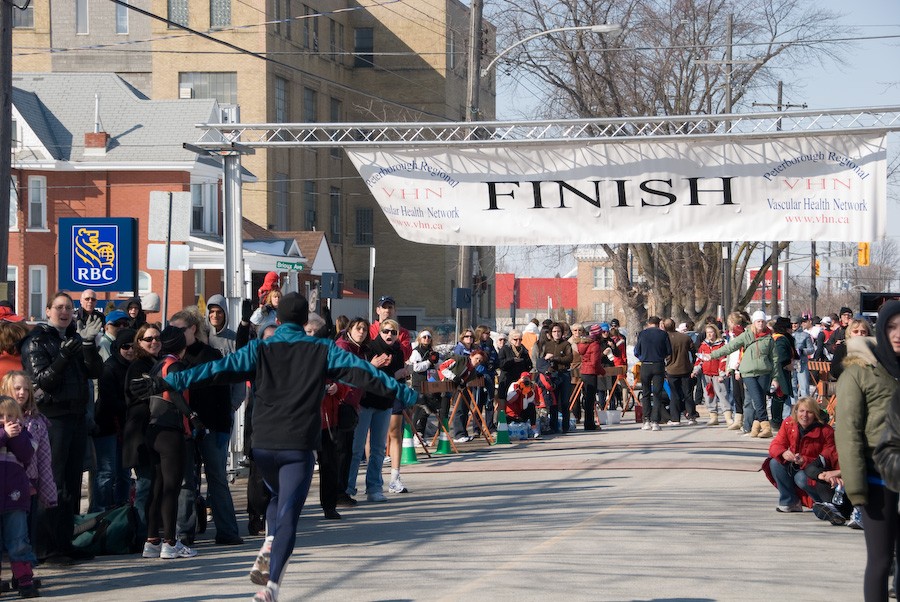

That’s Kaytlynn Welsch, age 12, center, and her little sister Heather, who is 10, just before they ran a half marathon in Utah last year.
Some people wonder how safe it is for kids to run that kind of distance.
Sometimes I even wonder if it’s safe for me!
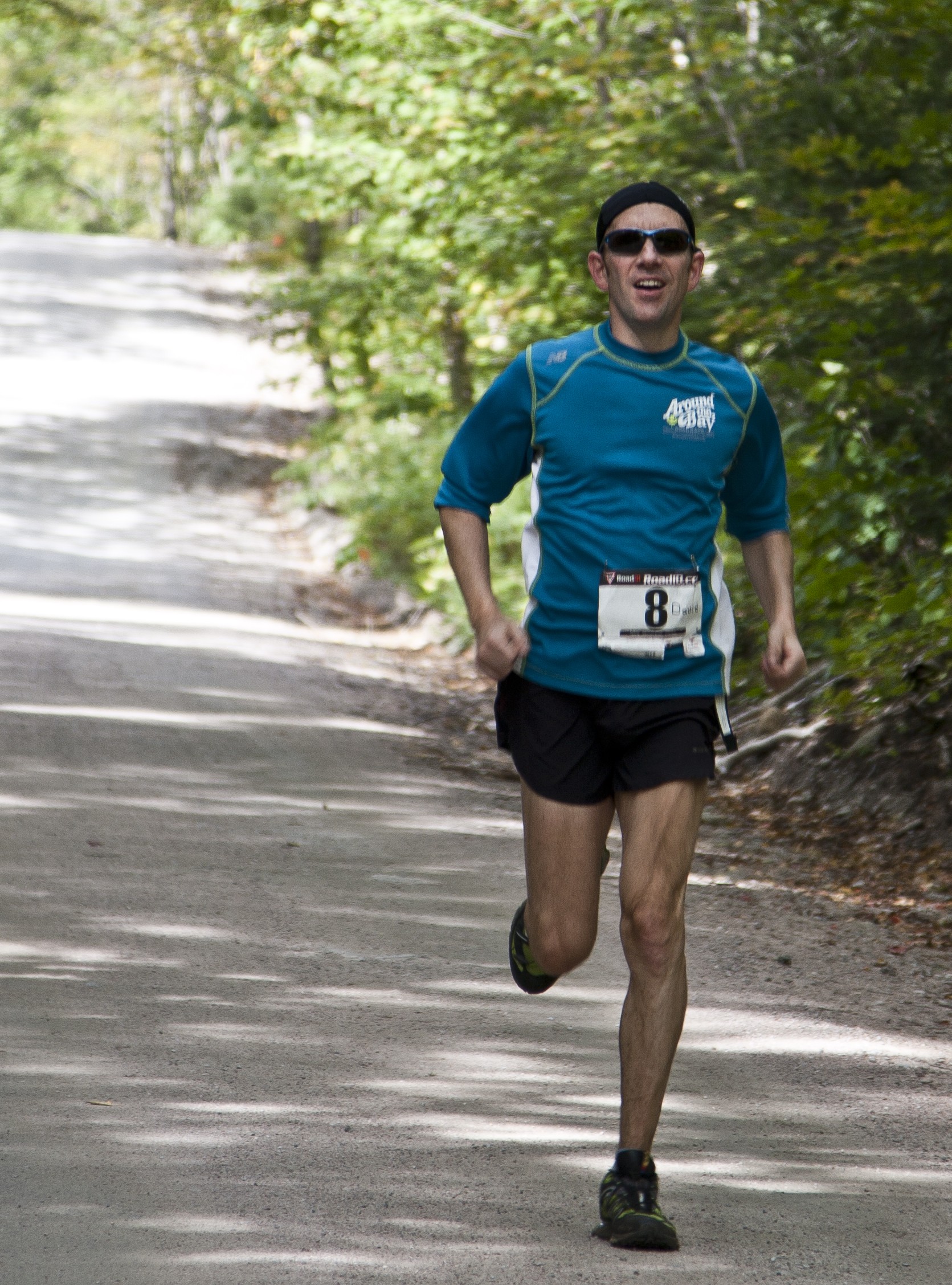
A couple of years ago, while running a 100-mile race, I asked the following question of an on-site medic: “Is it healthy, running 100 miles at a stretch?”
It was 3 a.m. and the Doctor had been patching up battered runners for the better part of 24 hours. “On the whole, I would have to say NO,” she said, looking at me over the waxy light of a Coleman lantern.
It had been a tough race. The thermometer had risen to thirty degrees, and a bunch of runners had been evacuated to the local hospital with heat-related illness. I’d been lucky. I had some blisters, a nasty cut on my knee from a fall, and a strange rash I never really figured out (lyme disease?). But that was all.
“Seriously?” I said. “You think running long distances is unsafe?”
“For some people,” said the Doctor. “Absolutely.”
* * *
Distance running is not risk-free. But the same can be said of virtually any activity worth doing. Playing hockey can be risky. Same thing with riding a bicycle. And as much as we try to convince ourselves otherwise, strapping fiberglass boards to our feet and launching ourselves down icy mountain slopes may not be the safest thing in the world.
And yet we still do it. Because it’s FUN.
The trick is to use our common sense. Check out what the Dad in this story says about the importance of getting checked out by a doctor.
As long as you’ve trained properly, and understand the importance of proper nutrition and hydration, and have the approval of your family doctor, and the support of friends and family members, and most important, if you really want to be out there, then why not run? After all, there’s not much difference between running a marathon in 5 hours, and spending an afternoon playing soccer or Capture The Flag with your friends.
Nikolas Toochek, age 9, is attempting to do something no kid has ever done before. He wants to run 7 marathons on 7 continents. He ran his first in Delaware, last December:
A few days ago, Nikolas completed his second marathon – in Antarctica.

The weather got pretty nasty during the run, and race organizers were forced to bundle everyone onto an airplane, and fly them back to Chile. Nikolas ran the final 8 miles of his marathon there.
So why is Nikolas doing all this running? To raise money for Operation Warm, a not-for-profit organization his grandfather founded. The charity buys warm clothing for kids in need.
Nikolas isn’t sure when and where his next marathon will be. You can follow his adventures here.
You never know what you’ll see when you’re out on a run.
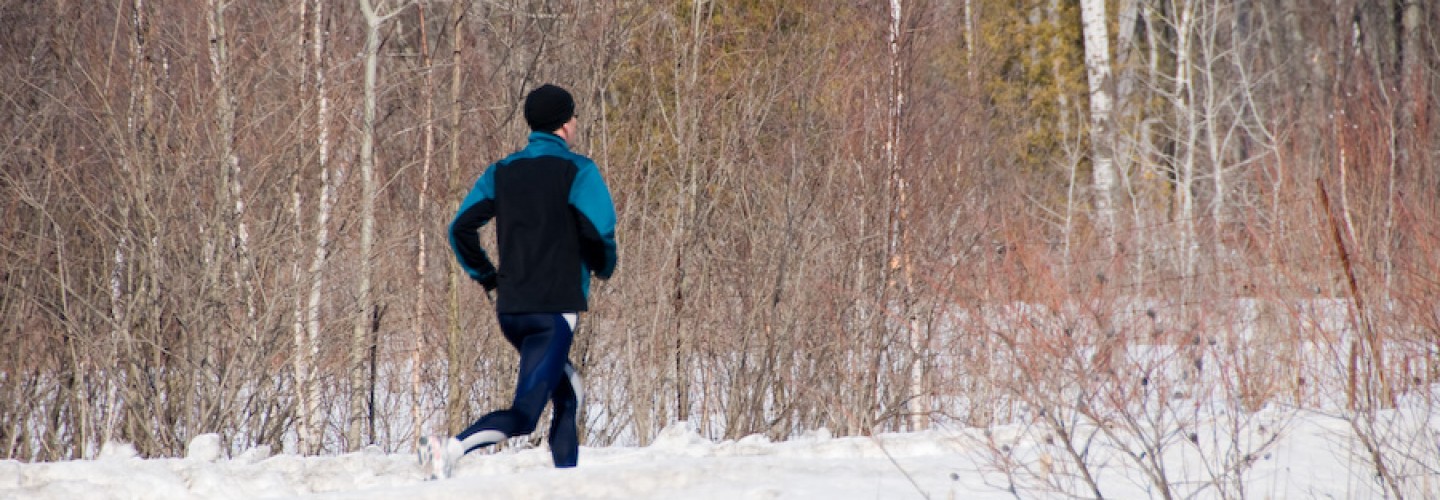
I was having the best run of the year so far, under a Jacuzzi-blue sky, and with golden sunshine slipping like loving arms between the reddening maples. The country roads were icy and hard, and flocks of little black birds darted from telephone line to telephone line as I passed beneath. Snow was melting on the fields, and you could see the stubble of the corn stalks poking through the white. In the middle of one field I saw a brown bump. I stopped and stared. The bump moved.
A cat? Raccoon? Maybe a groundhog?
An investigation was in order.
I waded through the snowdrift at the road’s edge, then picked my way through the treeline at the field’s edge. The snow was crunchy underfoot, and I was sure the animal would run away. But it didn’t. I crunched my way across the wind-swept field until I was 20 feet away from the animal.

The little porker turned to stare at me for a moment, and then went back to its work, which consisted of pulling up the dessicated stalks, and snuffling about in the frozen soil. I don’t know what it could have found to eat, but it was definitely chewing on something.
I knelt down. The porcupine noticed my movement, and stopped chewing. Then, to my surprise, it started waddling toward me.
15 feet lay between us. Then only 10. Then only 5.
It waddled so close, I could have reached out and touched its nose.
I was torn between wanting to cuddle the little guy, and wanting to run for the hills. The porcupine was incredibly cute, but as you probably know, porcupines have quills – quills that can hurt you.
Suddenly the porcupine made a clicking sound.
Tchick-Tchick-Tchick-Tchick-Tchick!
I smiled at the porcupine and made a clicking noise of my own:
Tchuck-Tchuck-Tchuck-Tchuck!
The porcupine blinked his eyes, turned his head, and then picked up the conversation. Tchick-Tchick-Tchick-Tchick-Tchick…
The two of us squatted there, two feet apart, clicking at each other for a good ten minutes. Though I was sorely tempted to scoop the little guy into my arms and give him a good tummy rub (which I don’t doubt he would have loved), I was too scared of those silver needles on his back. Eventually my knees got tired from crouching, so I regretfully stood up and said goodbye. My little friend went back to foraging for food.
It’s amazing, the things you see when you’re out running. If I’d been driving in a car, or even riding on a bike, none of this probably would have happened.
PHOTO CREDIT: Whitehorse photographer, David Cartier
No, I’ve never heard of Newtons either. But I love the ad. When the running’s going well, this is how it feels:
Hat tip: relentlessroadrunner.com/
When I tell people that I run 100-mile races, they often say, “Wow, that’s so extreme.”
I don’t actually think it’s all that extreme. Yes, it’s true, I once lost my sense of taste after running a 24-hour race. I tried drinking Coke, eating chocolate cake, but everything tasted like water. Like sand.
That’s the weirdest side-effect I’ve ever experienced. Hardly life-threatening.
Yes, we ultra-marathoners run for 100 (or more) miles without stopping. But what’s the worst that can happen when you’re traveling at 5 miles per hour?
It’s not like we’re racing down the side of a mountain on a bike:
This eye-popping urban bike race takes place every year on the ancient streets of Valparaiso, Chile. The riders have to deal with jumps, flights of stairs and, as you may have noticed at the 37 second mark, stray dogs.
THAT, my friends, is EXTREME.
And yet, as great as that POV video is, it isn’t my all-time favourite cycling film. Unlike running, cycling is romantic, so it really needs a shot of amour Montreal…
If I could be reincarnated as anything, I’d come back as a Francophone cyclist.
Michael Stipe, the lead singer of the rock band REM, once said this about the music of Arvo Part:
“It’s like a house burning down amid an infinite calm.”
That’s pretty much what running a 100-mile trail race feels like. The forest slumbers peacefully all around you, while your body immolates itself.

It’s not like I go around looking for pain, but I like to learn things, and I learn an awful lot about myself when things are really uncomfortable. Dostoyevsky had it right when he said: “Suffering is the sole origin of consciousness.”

I ran my first 100 miler way back in 2008. I thought I knew a thing or two about ultra marathons since I’d already run a handful of 50-milers and marathons.
I knew nothing.
“There’s a lot more going on in the 100 than in the 50,” a veteran runner told me at the pre-race spaghetti dinner. “The 50 is child’s play. The 100 is for grownups.”
I’d done a lot of physical training, but I wasn’t prepared for how surreal the run would be. I certainly didn’t realize that the race really only takes place during the daylight hours. Once night falls, most people slow down to a walk, and the “race” becomes little more than a night hike. For my part, I managed to travel all of 18 miles in the final 7 hours of my inaugural 100 miler. That’s a pace of roughly 2.5 miles per hour. Previously, I would have been disgusted by that pace. Now I can see only the victory in it, knowing the agony required to keep a battered body moving after 83 miles.
Neither was I prepared for the sheer beauty of the race. Running through a forest at night is like running through a Grimm’s fairy tale. There’s magic all around you, and danger too. And there’s no guarantee of a happy ending.

Night Running, somewhere around mile 75
Most memorable moment: coming into the 75 mile turnaround.
2 women were volunteering at this lonely outpost. They were watching over a small campfire and a Coleman stove. They offered me lasagne and chili, but I declined, knowing that I couldn’t possibly keep any solid food down.
“Nice night isn’t it?” one of the women said.
“A jolly good night!” I chirped, suddenly deciding, God knows why, that it was time to speak in a British accent.
“How about some chicken soup?”
This appealed. “Smashing!” I cried. “The absolute tops!”
The canopy of stars rotated above us. I sat down at a picnic table. It was the first time I’d sat down in 17 hours. Someone had hung a small disco ball from a tree branch, and a lantern was burning right above it, so that the fractured lights from the disco ball swirled across the backdrop of trees.
One of the women handed me a steaming Styrofoam cup full of chicken soup. The noodles were crunchy, and the broth was saltier than the Atlantic. It was like I was sucking on the keel of an ocean liner.
“You from the city?” the second woman asked.
“Yes, Parkdale.”
“Hey, me too!”
I decided that these two women were ghosts. It seemed impossible that they could be out here at the end of the world in the middle of the night, serving crunchy chicken noodle soup by the light of a disco ball.
“Are you having a good race?” the first ghost asked.
“It’s hard to tell,” I said. “I’m hurting quite a bit.”
“Everyone’s hurting out here,” said the second ghost. “I bet that a few days from now you’ll realize that you’re having an awesome time. I mean, how often do you get to run through a forest in all night long?”
I nodded and slurped my soup, unconvinced. “This really is incredible soup,” I told the ghosts. “You two really ought to set up a little restaurant out here. You probably wouldn’t get many clients out in the forest. But the people who do show up would probably be enormously grateful.”
The two women stared hard into my eyes. “Are you sure you’re okay to keep running?” they asked.
* * *
A couple of hours later, I stopped running to take a nature break. I turned out my headlamp and peed into the void. I had never seen such darkness, or heard such silence, in my life. After I finished I stood in the dark for a few moments longer, mindful of the great privilege it was to be there in that place, in that moment, in spite of all my pain. I was healthy, fit, upright, and enjoying nature. Tomorrow I’d be back in Parkdale, leading my dishwater life, checking Facebook and listening to Phil Collins on the radio.
A part of me wished I could stay in that moment forever. But I was also worried that some racer behind me was drawing ever closer, so I snapped my light back on and kept running. And running.
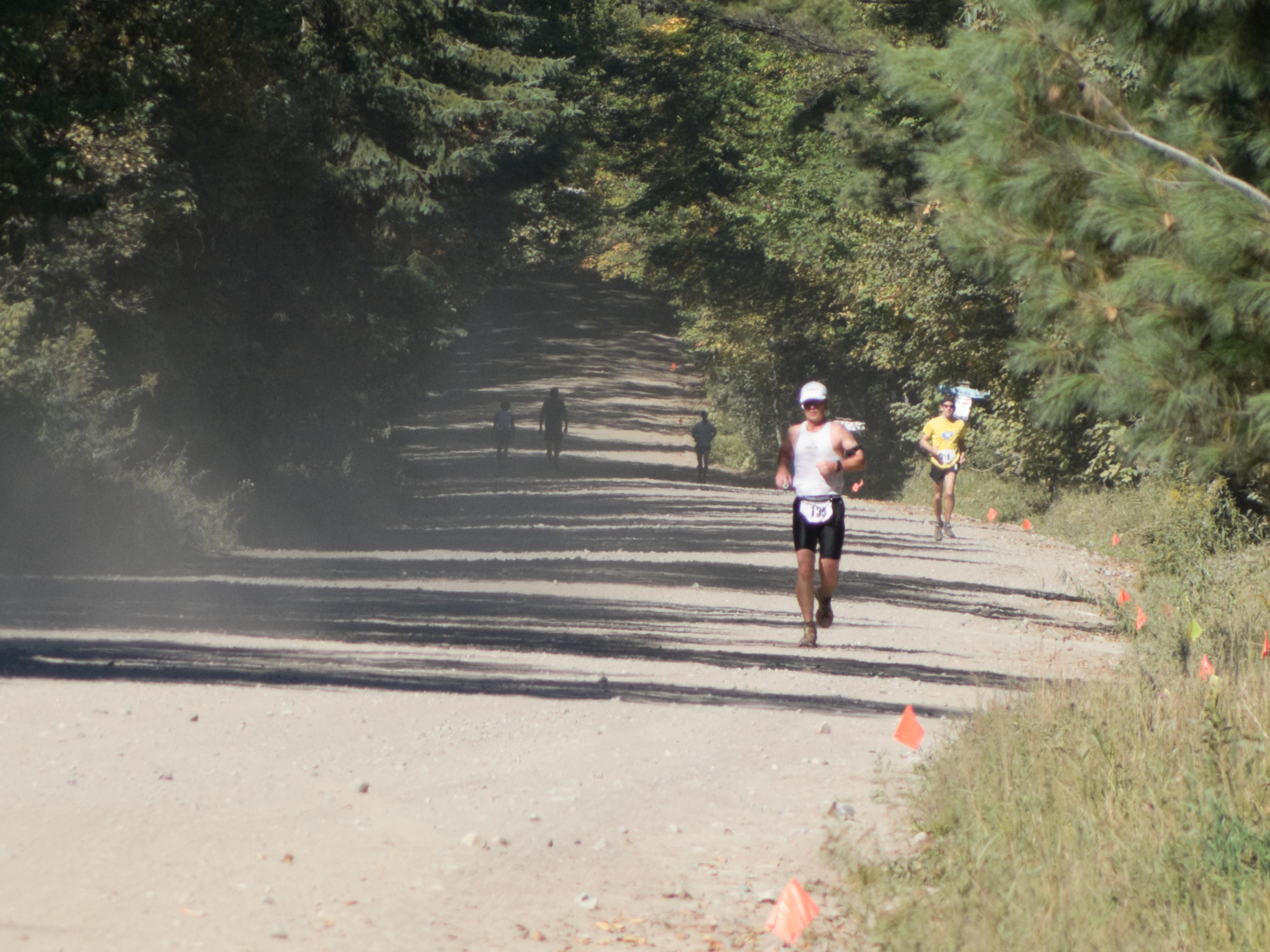
The Final Stretch
And then, far off in the distance, I saw the finish line.
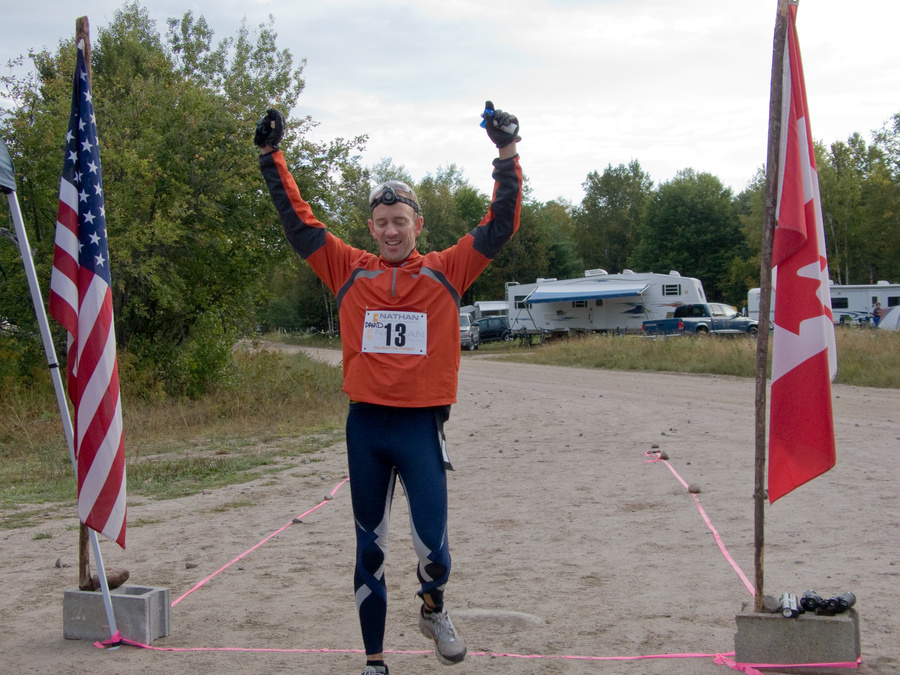
In the few seconds after I crossed that line, I nearly went unconscious. I could barely hold my head up straight, and my eyes refused to look in the direction I wanted them to look.
“Are you okay?” a woman asked. I said yes, because I didn’t want to scare her, and also because I was pretty sure that I would be okay in a second. Someone sat me down at a chair beside the fire and my consciousness slowly returned, and I became dimly aware that I wasn’t dying of a stroke after all.
* * *
What I told Shawna, immediately after the race: “That was really stupid, I can’t believe I did that. It’s too extreme and dangerous. I’m never doing that again.”
Phone message I left for my friend Kai, 3 hours after the race: “It was an interesting experience, and I’m glad I can scratch it off my bucket list. But there’s no way I’ll ever do that again.”
Phone message to my friend Mary, after I’d had a nap: “Hey Mary, I’m still alive. Not in a coma, so stop worrying. It was amazing. Totally amazing. I HAVE to do this again!”
Oh come on. this is too good.
Warning: a graphic picture of my feet appears in this post.
But first, a very pleasant image:

A bunch of baby bats, wrapped up in little blankets. I don’t know why they’re wrapped up like that. Maybe they were cold and wet. Just like me, last September…
***
I already mentioned that I run 100-mile races, right? That once or twice a year I go to some remote forest, line up with a bunch of crazy people, and run without sleeping for 24+ hours.
It’s a weird sport called ultra-running. I’ve run a dozen or so of these ultra-marathons in the last five years.
Every single time, I finished successfully. Until last September. When I ultra-failed.
The Haliburton Forest Trail Run is held at the Haliburton Wildlife Reserve; a sustainable forest tucked into the armpit of Algonquin Park. You run 25 miles out into the heart of the forest, then you turn around and run 25 miles back. And then you do the whole thing OVER AGAIN. The race took place last September 8, which, in case you’ve forgotten, was a rainy day.
Very rainy, come to think of it. It rained for eighteen hours before the race began, and then, for good measure, it rained another 12 hours while the race was happening. This created a lot of mud.
Here I am at the 50 mile turnaround:

I look happy, don’t I? Don’t be fooled. I’d been running for ten hours, and I was far from happy. I was…what’s the word….oh yeah – UNHAPPY!
Everyone was in pain out there. At mile 54, I caught up with a young guy named Pablo. Pablo was having trouble with his hip, and he squinted with every step he took. He wasn’t giving up, though. “Pain equals learning,” he told me. “If you aren’t feeling any pain, then you’re not learning anything.”
The rain finally stopped, and darkness fell. At the 68-mile checkpoint I pulled on my headlamp. I ran for two miles, then noticed that the light was flickering. Cheap Dollar Store batteries! I ran two miles back to the aid station and picked up my spares. These worked fine, but I’d had to run four miles out of my way.
(2nd warning – that picture of my feet is coming soon!)
I reached the 75-mile checkpoint by 11pm, which meant I still had a shot at finishing the race in 24 hours. Shawna surprised me at the aid station. She fed me yogurt-covered raisins and salted yams, and told me that I looked surprisingly good, considering the circumstances.
Luckily, she didn’t ask to see my feet.

Those are the tops of my feet. Believe me, you don’t want to see the bottoms.
Remember, I’d been running through muddy oil-slicks for 17 hours straight. I probably should have changed shoes and socks and greased my feet with Vaseline, but that would have taken an extra twenty minutes (it takes a lot of time to perform these seemingly simple manoeuvres when you’re wet and cold from 17 hours of running).
I ran on. I made it to the 85 mile checkpoint, but then things started to fall apart. At the top of a hill, I saw a two-storey marble sculpture of a rabbit. I ran closer and realized it wasn’t a marble sculpture at all, but a tree. I became dizzy. My feet were SCREAMING with pain. So was the chafing on my, er, undercarriage. I slowed down to a walk. And then, without the heat generated from the running, my body temperature plummeted.
I was wearing three layers of clothes, plus a running jacket and tights, but it wasn’t enough. The temperature dipped down to 5 degrees, and I began shivering uncontrollably. I could barely hike the hills I’d pranced up earlier in the day. A germ of an idea took root in my mind. You don’t have to finish if you don’t want to, it said.
It’s called a DNF, and it stands for Did Not Finish. I’d never DNF’d in my life.
But the pain in my feet was getting worse and it felt like my butt cheeks were being ripped to shreds with every step. The germ solidified in my mind.
And so, at 3 a.m., after running 89 miles (which was actually 93 if you count the extra miles I ran to get my spare batteries), I did something truly crazy. At the intersection of Ben’s Trail and Krista Trail, right near the makeshift Shrine which was the inspiration for a VERY IMPORTANT SCENE in my soon-to-be-published novel (“ULTRA,” Scholastic, Fall 2013), I intentionally walked off the trail.
“This is how it feels to DNF,” I told myself, stepping over the line of orange and pink flags.
And you know what?
It felt GREAT.
Mind you, after leaving the course, I still had to bushwhack two more miles through the forest before I stumbled upon a logging road. And then I had to wait until a car came along and mercifully picked me up. So in the end I figured I covered 95 miles.
Which wasn’t enough.
****
23 people finished that race. 31 DNF’d.
Pablo, that guy I’d chatted with during the race, was one of the successful ones. I cheered as he crossed the finish line. When he saw me, he beamed.
“How did you do?” he asked.
“I DNF’d,” I admitted. “I couldn’t handle the mud.”
“What? No! You were looking so good out there!”
It took a while to convince him that this was good, that this was my decision, and I was comfortable with it. I’ve had plenty of successful races before, and I wanted to see how failure played out. There is a cult around winning, around success, completion. But there is a wintry beauty in its opposite – in failure, chances lost.
“Pain equals learning,” I reminded Pablo.
He grinned, leaned down and rubbed his hip. “Then we must be geniuses now,” he said.
* * *
One last thought on pain and learning.

This is a standard rejection letter, from one of those highbrow literary journals that almost all writers dream of getting published in, but that very few people actually read. I’ve got millions of these forms lying around, from all the lousy short stories I sent out over the years.
Every one of those letters stung. But as Pablo pointed out in the race, pain can be instructive.
If you’re going to be a writer, you’ll have to deal with rejection at some point. But you can view these rejections in one of two ways:
1) You can see them as stop signs. As brick walls.
2) Or you can see them as an invitation to keep pushing.
If you’re suffering from hypothermia, or excruciating chafing, by all means, take some time off to recover. Otherwise, keep writing. The finish line is out there – somewhere.
where would-be writer works with words
A Brief History of Music
It's time to get hella serious about writing!
I like birds
A blog full of humorous and poignant observations.
Concussion, up close
A blog about books. Oh, and some other stuff too.
Run. Eat. Sleep. Repeat.
somewhere to share my experience related to gear, races, and training. Posts are mainly focused on sports such as road and trail running, ultramarathon racing, cycling, and multisport.
But Still Living The Life
A safe space for subversive comics.
Running with asthma and some other stuff.
Steve Vernon - Nova Scotia writer, storyteller and master of the booga-booga
It doesn't matter what you do, just move.
Ramblings of a busy person making the most of every moment
 Write...Run...Repeat...