In Every Race There is a Surprise

Back in 2007, I met a hardcore trail-runner in Yellowknife.  He was as tough as the Canadian Shield, and skinnier than two toothpicks tied together.  He took me out for a run along the “highway to nowhere.”  As we ran, mile after mile, past the Giant Mine, where 9 men tragically lost their lives in an explosion 1992, he told about some of the running adventures he’d had over the years.  The animals he’d run into during long trail races (Grizzlies, wolverines), and the times he’d nearly broken ankles in the dark.  “You have to be prepared,” he said.  “In every race, there is a surprise.”

A couple of months later, I ran my first Ultra-marathon.  And he was right.  I got a BIG surprise.

The Niagara Ultra, at a mere 50 kilometers, is the Maggie Simpson of Ultra-marathons.  Still, it’s 8 kilometers longer than a conventional marathon, which seemed like a big leap to me at the time.

I drove down to Niagara-on-the-Lake at 4:30 a.m. on a June morning, got my BIB (#105) and sat in the Kinsmen Hall in my singlet and shorts, trying to stay warm until the race began.  The forecast was calling for clear, cool weather.  The sun rose over the Niagara River while Huey Lewis and the News sang about “The Power of Love” on the radio.

At 6:45 I went outside and joined the other runners.  There were maybe 100 of us standing about on a grassy field, rubbing our arms for warmth.  A stern man outlined the route and thanked the various local sponsors.  Then suddenly he said, “Is everyone ready?  Okay then, GO!”

There was no count-down clock and no pumping music.  Suddenly the hundred of us were running across the dewy meadow.

Things happened very fast.  The pack merged onto the Niagara Parkway path; a recreational trail that snakes alongside the Niagara River.  We were to run from Lake Ontario in the north to the great falls in the south, and then back again.  The crowd of runners quickly thinned out, and I got into a groove.
virtual-tour-79336-01-1335331793

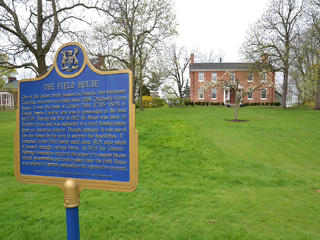
The asphalt trail was shaded by mature oaks and elms.  Shortly after the first aid station, I ran past the Field House, the stately brick home General Brock used as his headquarters during the War of 1812.  More importantly, it was where my beloved Gran lived for many years, and where I spent many Christmases and Sunday dinners.

But there was no time for nostalgia – I had a race to run!  I climbed the Niagara Escarpment to the hamlet of Queenston, ran past the floral clock, the hydro electric plant where the Niagara river thins out, and the lush green golf courses.  I banked the first 10 kilometers in 46 minutes, which seemed a dangerously fast pace for me at the time.  At the 15k aid station a volunteer told me that I was in seventh place.  Seventh!  Never in my life had I ever been in seventh place for anything!

Unfortunately, this was not my only surprise in this race.  A much worse revelation was yet to come.

I ran into the city of Niagara Falls.  No roads had been closed for this race, and there weren’t any police officers to hold back traffic.  Runners were expected to follow the sidewalks, and obey traffic signals.  Since it was now 9 a.m. on a sunny June morning, I found myself dodging tourists with cameras, jumping over “Maid of the Mist” turnstiles, and waving at curious honeymooners.

Niagara Falls

And then, there it was.  Niagara Falls.  I’d grown up just down the road, and had visited the falls any number of times, and yet, on this morning it looked more beautiful than ever before.  I wanted to stop and stare at the falls.  But I didn’t.  My 7th place was on the line.

At the turnaround I downed a cup of Gatorade, and doubled back towards Niagara-on-the-Lake, passing the runners immediately in my wake.  The bulk of the pack was roughly 5 k behind me.

I swallowed one gel at the 25 k turnaround, and another at 35 k.  Hydration was not a problem.  But – SURPRISE – my bowels were.

Yes.  The B word.  I could feel the pressure starting to build.  It became quite a distraction, and I kept my eyes peeled for a porta-potty.

At the 40 kilometer mark I was still clinging to 7th place, but a guy named Doug kept catching up to me whenever I stopped to talk to the volunteers at the aid stations.  “Bathroom?” I’d say.  They’d shake their heads, no.  Doug would roll in behind me, and I’d sprint off again.

A couple of times, Doug got ahead of me.  Each time he came across a paper cup that someone had discarded on the road, he’d bend down, pick it up, and carry it to the garbage can at the next aid station.  He did this over and over again.  After a while, I started doing it too.  At big city races, there are hundreds of volunteers to clean up after the racers, but in a small race like this, it made sense to clean up after ourselves.

Of course, it wasn’t easy to bend down after having run 40k – especially now, when most of my strength was going into holding my butt cheeks clenched together.

At 46k, Doug passed me for good.  I was fighting off waves of gastric pain, and I could barely run anymore.  And so, with 4 kilometers left to run, and no relief in sight, I succumbed to the inevitable.  I jumped off the path, scrambled down the side of the gorge into the forest, and squatted.

While I took care of business in the gorge, I could hear runner after runner springing past me on the path above.  My 7th place was long gone.  But I didn’t care.  I was feeling fine. 

I’m sorry to tell you a story involving poop.  But there’s no way around it.  Bodily functions, and learning how to deal with them, is a big part of ultra-running.  You can’t expect to run for 6, 12, or 24 hours at a time, and not have to think about the food that goes in, or comes out of your body.  It’s life.

Happily, I learned a couple of things from that “surprise.”  For instance: don’t eat any dairy products in the 24 hours leading up to a race.  For me, that usually prevents unwanted bathroom breaks.

I also learned to always run with toilet paper.  And to never shake hands with an ultra-runner at the finish line – at least until you’ve both washed your hands.

The Niagara Ultra-marathon takes place Saturday, June 22nd.  You can find out more about it HERE.
Why Do I Run? Why Do I Write?

010-funny-animal-gifs-running-duck

Why do I run?

Because running is my church.

Because running helps me figure out what I think about the world.

Because I love buying running shoes.

Because I like being alone sometimes.

Because running helps me sleep well.

Because I run past interesting things.  Bears, beaver dams, hidden valleys.

What to do, what to do... (1)

Why do I write?

Because writing is my church.

Because writing helps me figure out what I think about the world.

Because I love buying new journals.

Because I like being alone sometimes.

Because writing helps me sleep well.

Because I get to write about interesting things.  Talking bears, floating islands, secret valleys where time stands still.

Coffee

BONUS REASON I like to run:  I don’t need to worry about eating second helpings of dessert!

HAT TIP: above two photos taken by my talented brother, Andy.

Cool Running Shoe Ad Watch, part 2

Wondering what to buy me for my birthday?  Look no further than RIGHT HERE:


The comfort of a running shoes, paired with the exhilaration – and danger – of the trampoline.  Did you know that such an amazing product existed?  I didn’t!

I know, they’re probably crazy expensive.  Plus, it might look a bit goofy, running races in those things.  

Still…  My birthday is in July, just in case you were wondering.

Why Running = Writing

So I wrote this YA novel called ULTRA.  It’s about a 12 year-old boy who runs a 100-mile footrace in order to escape a terrible family secret.

Here’s the book in one sentence: “Why face your troubles when you can outrun them?”

Hoo boy!  Sounds exciting, doesn’t it?  You bet!

Anyway, while writing that book (to be published by Scholastic in September, 2013), I learned that the act of writing a novel and that of running 100 miles are similar in a lot of ways.  For instance:

1) Runners don’t need much gear to do their thing.  Just a pair of running shoes, a tee-shirt and shorts.  Writers don’t need much either.  A pen and some paper, a tee-shirt and shorts.

2) In running, there is a starting line, and then, some distance away, a finish line.  In writing, there is a blank page, and then, some distance away, a published story.

3) Runners suffer from shinsplints, cramps and blistered toes.  Writers suffer from writer’s block, writer’s cramp and blistered fingers.

4) Runners start out strong, and get weaker as they age.  Writers are exactly the same, only in reverse.

But do you want to know the most important similarity?  In both writing and running, the key to success is PRACTISE.  Log enough miles, and you’ll eventually run faster.  Fill enough pages, and you’ll eventually write better.

Just keep at it.  Write, run, REPEAT.

Peterborough Half marathon finish - Dave

The First Hundred Miles

Michael Stipe, the lead singer of the rock band REM, once said this about the music of Arvo Part:

“It’s like a house burning down amid an infinite calm.”

That’s pretty much what running a 100-mile trail race feels like.  The forest slumbers peacefully all around you, while your body immolates itself.

Dave's race (03)

It’s not like I go around looking for pain, but I like to learn things, and I learn an awful lot about myself when things are really uncomfortable.  Dostoyevsky had it right when he said: “Suffering is the sole origin of consciousness.”

50 down, 50 to go (1)

I ran my first 100 miler way back in 2008.  I thought I knew a thing or two about ultra marathons since I’d already run a handful of 50-milers and marathons.

I knew nothing.

“There’s a lot more going on in the 100 than in the 50,” a veteran runner told me at the pre-race spaghetti dinner.  “The 50 is child’s play.  The 100 is for grownups.”

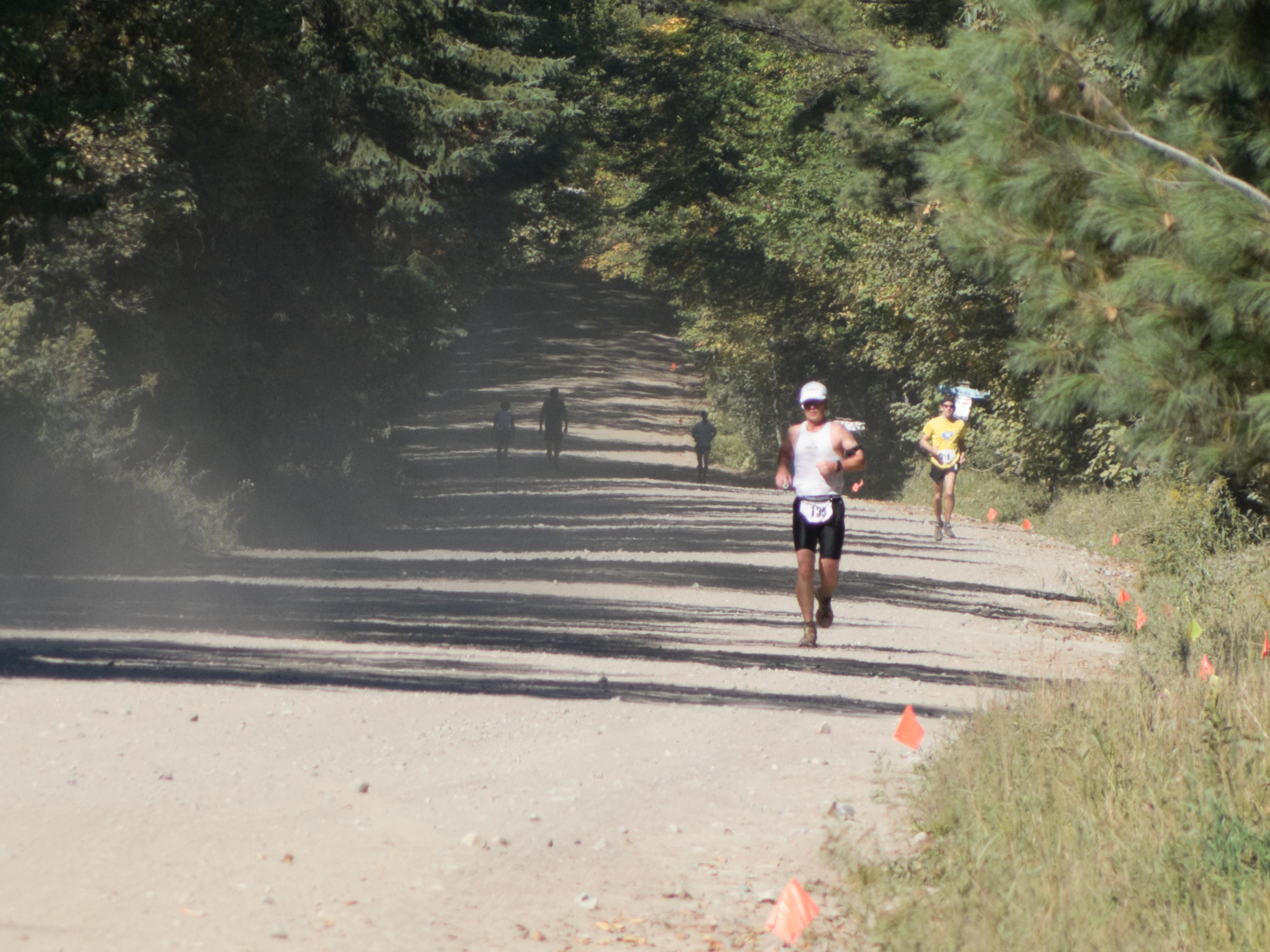
I’d done a lot of physical training, but I wasn’t prepared for how surreal the run would be.  I certainly didn’t realize that the race really only takes place during the daylight hours.  Once night falls, most people slow down to a walk, and the “race” becomes little more than a night hike.  For my part, I managed to travel all of 18 miles in the final 7 hours of my inaugural 100 miler.  That’s a pace of roughly 2.5 miles per hour.  Previously, I would have been disgusted by that pace.  Now I can see only the victory in it, knowing the agony required to keep a battered body moving after 83 miles.

Neither was I prepared for the sheer beauty of the race.  Running through a forest at night is like running through a Grimm’s fairy tale.  There’s magic all around you, and danger too.  And there’s no guarantee of a happy ending.

Night Running, somewhere around mile 75

Night Running, somewhere around mile 75

Most memorable moment: coming into the 75 mile turnaround.

2 women were volunteering at this lonely outpost.  They were watching over a small campfire and a Coleman stove.  They offered me lasagne and chili, but I declined, knowing that I couldn’t possibly keep any solid food down.

“Nice night isn’t it?” one of the women said.

“A jolly good night!” I chirped, suddenly deciding, God knows why, that it was time to speak in a British accent.

“How about some chicken soup?”

This appealed.  “Smashing!” I cried.  “The absolute tops!”

The canopy of stars rotated above us.  I sat down at a picnic table.  It was the first time I’d sat down in 17 hours.  Someone had hung a small disco ball from a tree branch, and a lantern was burning right above it, so that the fractured lights from the disco ball swirled across  the backdrop of trees.

One of the women handed me a steaming Styrofoam cup full of chicken soup.  The noodles were crunchy, and the broth was saltier than the Atlantic.  It was like I was sucking on the keel of an ocean liner.

“You from the city?” the second woman asked.

“Yes, Parkdale.”

“Hey, me too!”

I decided that these two women were ghosts.  It seemed impossible that they could be out here at the end of the world in the middle of the night, serving crunchy chicken noodle soup by the light of a disco ball.

“Are you having a good race?” the first ghost asked.

“It’s hard to tell,” I said.  “I’m hurting quite a bit.”

“Everyone’s hurting out here,” said the second ghost.  “I bet that a few days from now you’ll realize that you’re having an awesome time.  I mean, how often do you get to run through a forest in all night long?”

I nodded and slurped my soup, unconvinced.  “This really is incredible soup,” I told the ghosts.  “You two really ought to set up a little restaurant out here.  You probably wouldn’t get many clients out in the forest.  But the people who do show up would probably be enormously grateful.”

The two women stared hard into my eyes.  “Are you sure you’re okay to keep running?” they asked.

* * *

A couple of hours later, I stopped running to take a nature break.  I turned out my headlamp and peed into the void.  I had never seen such darkness, or heard such silence, in my life.  After I finished I stood in the dark for a few moments longer, mindful of the great privilege it was to be there in that place, in that moment, in spite of all my pain.  I was healthy, fit, upright, and enjoying nature.  Tomorrow I’d be back in Parkdale, leading my dishwater life, checking Facebook and listening to Phil Collins on the radio.

A part of me wished I could stay in that moment forever.  But I was also worried that some racer behind me was drawing ever closer, so I snapped my light back on and kept running.  And running.

The Final Stretch

The Final Stretch

The final few kilometers of the race were very hard.  Somewhere around 3 a.m., I realized that I wasn’t going to break the 24-hours barrier.  It was a crushing blow, and for the final 12 miles, I fell into a terrible despair.  For some reason, I was absolutely convinced that my friends and family would be deeply ashamed of my inability to run a hundred miles in anything less than 24 hours.  I actually wept on the trail, thinking of their disappointment.
I know – I’m insane.   I could have finished the race in 48 hours, 72 hours, A WEEK, and my family would have buried me in roses.  And yet, in those final miles, all I could see was failure.

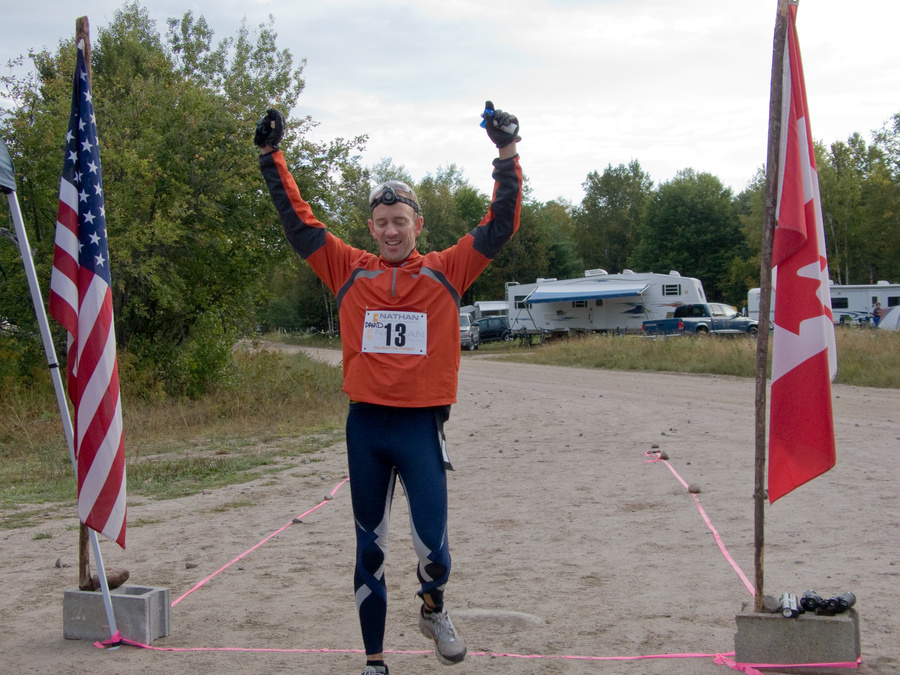
And then, far off in the distance, I saw the finish line.

David finishing 100 mile race

In the few seconds after I crossed that line, I nearly went unconscious.  I could barely hold my head up straight, and my eyes refused to look in the direction I wanted them to look.

“Are you okay?” a woman asked.  I said yes, because I didn’t want to scare her, and also because I was pretty sure that I would be okay in a second.  Someone sat me down at a chair beside the fire and my consciousness slowly returned, and I became dimly aware that I wasn’t dying of a stroke after all.

* * *

What I told Shawna, immediately after the race: “That was really stupid, I can’t believe I did that.  It’s too extreme and dangerous.  I’m never doing that again.”

Phone message I left for my friend Kai, 3 hours after the race: “It was an interesting experience, and I’m glad I can scratch it off my bucket list.  But there’s no way I’ll ever do that again.”

Phone message to my friend Mary, after I’d had a nap: “Hey Mary, I’m still alive.  Not in a coma, so stop worrying.  It was amazing.  Totally amazing.  I HAVE to do this again!”

Hating on Running

2008 Track - Payton Jordan Cardinal Invitational - May 4, 2008

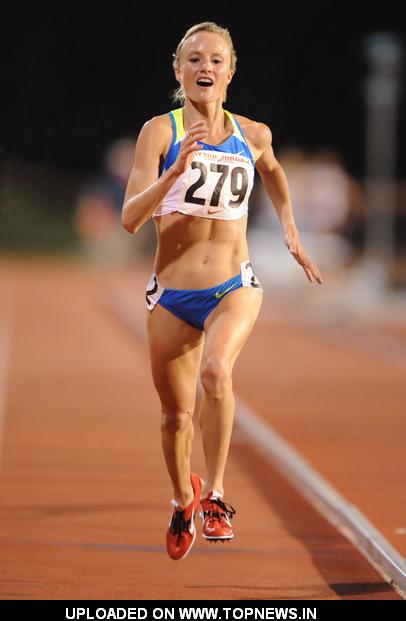
Shalane Flanagan is this crazyfast American distance runner.  She ran the marathon at the 2012 London Olympics, finishing in 10th place, with a time of 2:25.

In other words, she can run 26 miles in less time than it takes you to watch Wreck it Ralph.  

In order to run that fast, Shalane has to train A LOT.   Running is her full time job.  And like all full-time jobs, it sometimes drives her a little bit crazy CRAZY.

It’s a good list.  But she left out my biggest complaint.  Sometimes, when you wear tear-away pants on a run, you can accidentally snag them on the front bumper of a car stopped at an intersection, and find yourself pants-less in downtown Toronto…

Hot Crossed Buns + Parents = Speed!

Peterborough half-marathon

Peterborough half-marathon

“Did you know that you can only buy hot crossed buns during Lent?” Dad asked me.

I shook my head, no.

“It’s true,” he said.  “That’s why the cross is there.  It’s an ancient tradition.”

I asked Mom and Dad what they’re giving up for Lent.  “Nothing,” said Dad.  “Nothing,” said Mom.  We all laughed.  When I was a kid, giving up something for Lent around our house was…well, it was gospel.

“Nowadays the focus isn’t so much on what you give up,” said Dad, “but on what you take on.  What you do to lighten your neighbour’s load.”

I”d taken a bus to Peterborough for the annual half-marathon.  My parents live a couple of miles from the starting line, so I was staying with them.  Dad was in a hurry, getting ready for church.  He was on Sidesperson’s duty, which meant he had to put on a tie and a sports-jacket, and get to church early to greet the parishoners, and help them into their pews.  Mom was also on Sidesperson duty, but she played hooky to drive me to the starting line.

“I can always take a cab,” I told her.

“No,” she grinned.  “I’m glad for the excuse.”

The roads were dry, and it was one degree above zero, which meant I didn’t need to wear long underwear.  Mom dropped me at the YMCA, where I picked up my racing bib and traded stories with the other runners.  At noon I went outside and bounced around in the starting corral, trying to stay warm.  I thought to myself: I LOVE THIS!  I LOVE RUNNING!  THIS IS WHAT I LIVE FOR!

45 minutes later, I was no longer happy.  I was unhappy.   Ultra unhappy.

I’d run 12 kilometers, and my lungs were on fire.  It took all my strength to keep from throwing myself into a snowbank and bursting into tears.

I HATE RUNNING, I thought!   THIS SPORT SUCKS!  WHY DO I DO THIS TO MYSELF?

In that moment I hated absolutely everyone and everything in the world.

The volunteer handing me a cup of Gatorade?  HATED HER!

The barefoot runner dude?  HATED HIM!

The kindly-looking folks at the side of the road?   HATED THEM TOO.

“You can do it!” they shouted.

I nearly yelled right back at them: “YOU’RE WRONG!  I CAN’T DO IT!  YOU HAVE NO IDEA HOW MUCH THIS HURTS!  GET OUT HERE AND START RUNNING IF YOU THINK IT’S SO EASY!”

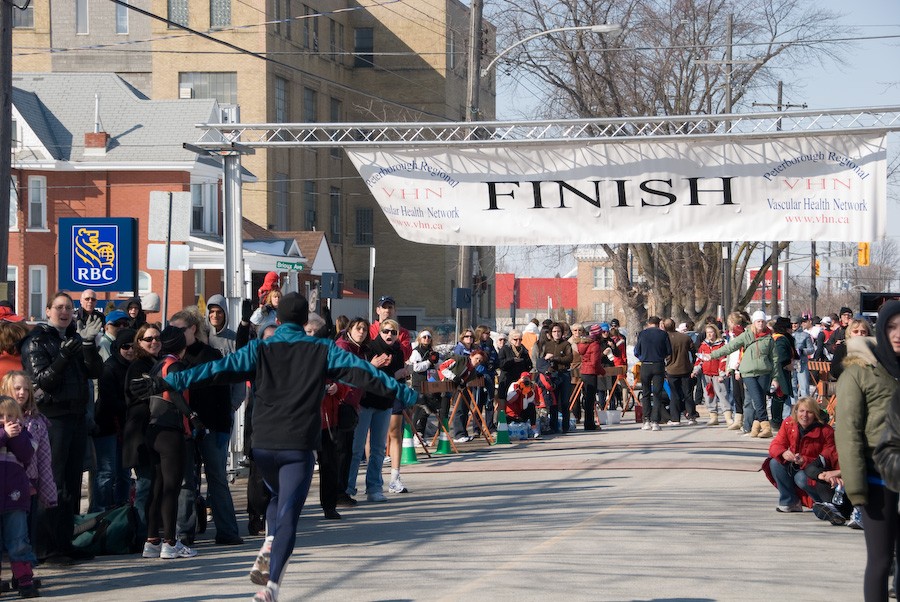
Suddenly I realized who they were.  Broke into a grin and stretched my arms wide:

peterboro2016km16

I was SO happy to see my parents, I did a little tap-dance there on the road.  Mom and Dad had been standing outside in the freezing cold for an hour, just so they could cheer me on.

“Nowadays the focus isn’t so much on what you give up,” Dad had said earlier, “but on what you take on.  What you do to lighten your neighbour’s load.”

In a flash, I thought about all the stuff my parents had done for me over the years.  All the diapers they’d changed.  All the meals they’d cooked.  That time Dad picked me up at the Pen Centre after I crashed his van.  The time Mom nursed me through a 105 degree fever.

They’d done so much to lighten my load.  And what did I do for them in return?

I tossed them my sweaty neck-warmer.

“What the heck is that?” Dad shouted after me.

“It’s his underwear!” another runner joked.

And then a strange thing happened.  As I ran away from my parents, I noticed that my pain was gone.  I sped up and got back into the zone, and finished 2 seconds faster than my goal.  (1:29:58)

peterboro2013postrun

It’s a good reminder.  Next time you’re having a rough time on the road, stop dwelling on your own pain, and shift your thoughts to someone else.  Think about what you can do to lighten their load.

And while you’re at it, eat some hot crossed buns too.

Re-Writing is Your Friend

SCAN0006

People often ask me how many times I re-wrote my first novel.  Trust me when I say, YOU DON’T WANT TO KNOW.

Image

I wrote the first version in the summer of 2008.  It was 20,000 words long, and it swallowed two months of my life.

I finished the second draft a month later.  By Christmas I’d rewritten it a third time, and then I sent it out.

I sent it to an agent and also a publisher.  The publisher said some nice things about it.  She said the narration was lovely and warm; perhaps too lovely and warm.  She explained that the warm tone made it hard to believe that the central character was living on top of a calamity.  Which was why she was going to take a pass.

The agent didn’t bother to reply.

I wasn’t dejected.  I’ve written lots of stuff over the years that never got published.   That’s the writer’s life.  I stuffed the manuscript in a drawer and forgot about it.

Two years later, I picked it up again.  I re-wrote it for…let’s see…the fourth time.

After 5 months of work, I pitched it 50 agents.  49 of them said, “Thanks but no thanks.”

The fiftieth agent (the brilliant Scott Waxman who represents some of the finest sports writers, including the legendary John L. Parker) called me on the phone.  When I saw the 212 area code on the display, I knew something was up.  Scott told me that he liked my story; that he’d read it to his kids and they liked it too.  He said, however, that he wasn’t quite ready to offer representation just yet.  There were a few things I ought to think about – if, that is, I was “willing to re-write the manuscript.”  

I thought about the improvements that Scott suggested.  I thought about them for all of ten seconds.

Once again, I started re-writing.  When I finished that re-write I did another.

And then another.

And then another.

SCAN0007

After six months of re-writing, Scott Waxman accepted my novel.  I received an “Offer to Represent” in the mail.

Cue the champagne corks!  Cue the s’mores!

A couple of months later, the novel sold to Scholastic Canada.

MORE champagne!  MORE s’mores!

IN the year or so since I signed with Scholastic, I’ve done three more rewrites.  The first took 3 months, the second took one month, the third took a week.

That makes eleven re-writes in all.

I know that sounds like a lot of work, but listen: with every single re-write the book got better!

Lesson learned:

Writing a book, and running 100 miles, are similar in two distinct ways.

(1) Both involve a TON of pain.

and (2) The finish line is incredibly sweet.

Real Life Superheroes, Part 2

Take a look at the runners in these pictures.  Can you tell what makes them all special?

First, there’s America’s Dick Beardsley (on the left):

Dick+Beardsley+and+Inge+Simonsen+finish+the+London+Marathon+together.+Horace+Culter+of+the+Greater+London+council+one+of+the+men+who+made+this+race+possible+watches+on+in+the+background

Up next, Spain’s Fernandez Anaya (in green):

o-FERNANDEZ-ANAYA-570

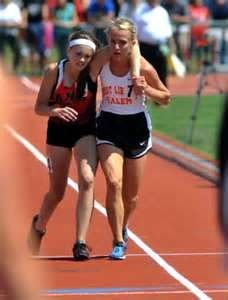
And finally, Ohio track star Meghan Vogel (blonde hair, on the right):

Meghan Vogel

Any guesses?  Yes, they’re all runners, and yes, they’re crazy fit.  They probably run 100+ miles a week and eat nothing but salads and nuts.  But these incredibly healthy human specimens have something much more interesting – and much more valuable – in common.

You’ve got fifteen seconds to figure it out.  Tick tick tick tick tick…TIME’S UP!

ANSWER: All of these runners are real-life superheroes.  They’re not only fast.  They’re also super kind.

Take Meghan Vogel.  She was competing in her third race of the day.  Ahead of her, a runner crumpled to the ground in the heat.  But instead of dashing past her, she lifted her up, helped her to the finish line, and literally pushed her across the finish line.

Fernandez Anaya (the guy in the green shirt) was equally generous.  He was running second in his race, a ways behind the race leader, Abel Mutai.  As he entered the finishing straight, Fernandez noticed Mutai pull up about 10 metres before the finish line.  Mutai thought he’d crossed the finish line, BUT HE HADN’T!  He still had 30 feet left to go!

Instead of racing past Mutai for the win, Fernandez slowed down and gestured at him to keep running.  He literally helped the OTHER guy win.

Which brings me to the black and white photo of Dick Beardsley at the top.  Dick was running the very first London marathon in 1981.  He and Norway’s Inge Simonsen spent the race battling for first place.  In the finishing stretch, instead of trying to prove who was better than the other, the athletes clasped hands and crossed the finish line together.

How awesome is that?  They acknowledged they were evenly matched, and split the first place prize two ways.

Someone should show these videos to Lance Armstrong.