Going Long. Too Long.

We runners love to set goals.  Drop a few pounds; shave a few minutes off a PR, improve our finishing kick.  We set expectations, and then we go out and exceed them.  Except for those rare occasions when we don’t.

A couple of years ago,  I decided to run 4000 kilometres.  Why 4000?  I’m not sure.  It felt like a big, braggable number.  And it was just slightly beyond my comfort zone.  Previously, the most I’d ever run in a year was 3500 kilometres.

A few facts about running 4000 kilometres:

In order to cover 4000 kilometres in a year, you must run 11k each and every day.

If you take a day off, you’ll need to run 22k on some subsequent day to make it up.

If you get sick, and miss a week of running, you’re on the hook for eighty clicks.

It quickly became clear that my whimsical little goal would require some careful planning.  I’d need to pay attention to diet, sleep, hydration, injury prevention, stretching, recovery, supplements, etc.  In short, I would need to become the most BORING person on the face of the planet.

I’m sorry to report, that’s exactly what happened.

I suffered injuries, I got sick, and I spent the entire year obsessively totaling my mileage.  As the months went by, I became more and more depressed.  I didn’t understand what was happening to me at the time, but I do now.  I spent the whole year staring at the odometer instead of the gorgeous scenery I was running past.

“You used to be a peddler of joy,” Shawna said towards the end of the year. “But you’ve turned into a fun vacuum.”

Haliburton10-8303

On the last day of the year, December 31st, I was 6 kilometer shy of my goal. I’d run 3994 kilometers in 364 days.  In the month of December alone, I’d run 600 kilometers.

It was a sunny and dry day, and there was no physical reason why I shouldn’t have pulled on my gear and dashed off the final 6 km to meet my goal.

And yet, I didn’t.

Why?

Years before, at a marathon, I’d seen a man cross the finish line, check his watch, and then yell – at the top of his lungs – the raunchiest  swear word known to humankind.  You know the one.  I pledged then and there that I would never become that guy; I would never put goals and numbers ahead of my love of the sport.

It was a tough decision to make, and I felt conflicted about it.  But later that night I went to a New Year’s party.  10 p.m. came and went, and not only was I still conscious; I was laughing and telling stories, and actually having fun for a change!  I was so bubbly, so full of spunk; I didn’t know what to make of myself.

“I can’t believe I’m awake,” I said to Shawna.

“Welcome back to the world,” she replied.

Repeat to Failure

I’ve been upping my mileage lately.  I’ve got a 50-mile race coming up in July, and my usual 100-mile “fun run” in September.  Let the training begin!

I love the extra hours outside, but I’m having trouble keeping my weight up. Yesterday, in the span of five minutes, three different people expressed concern about my evaporating waistline.  They looked startled by my appearance – as if I were a mangy stray who’d left an unwanted deposit on their front lawn.

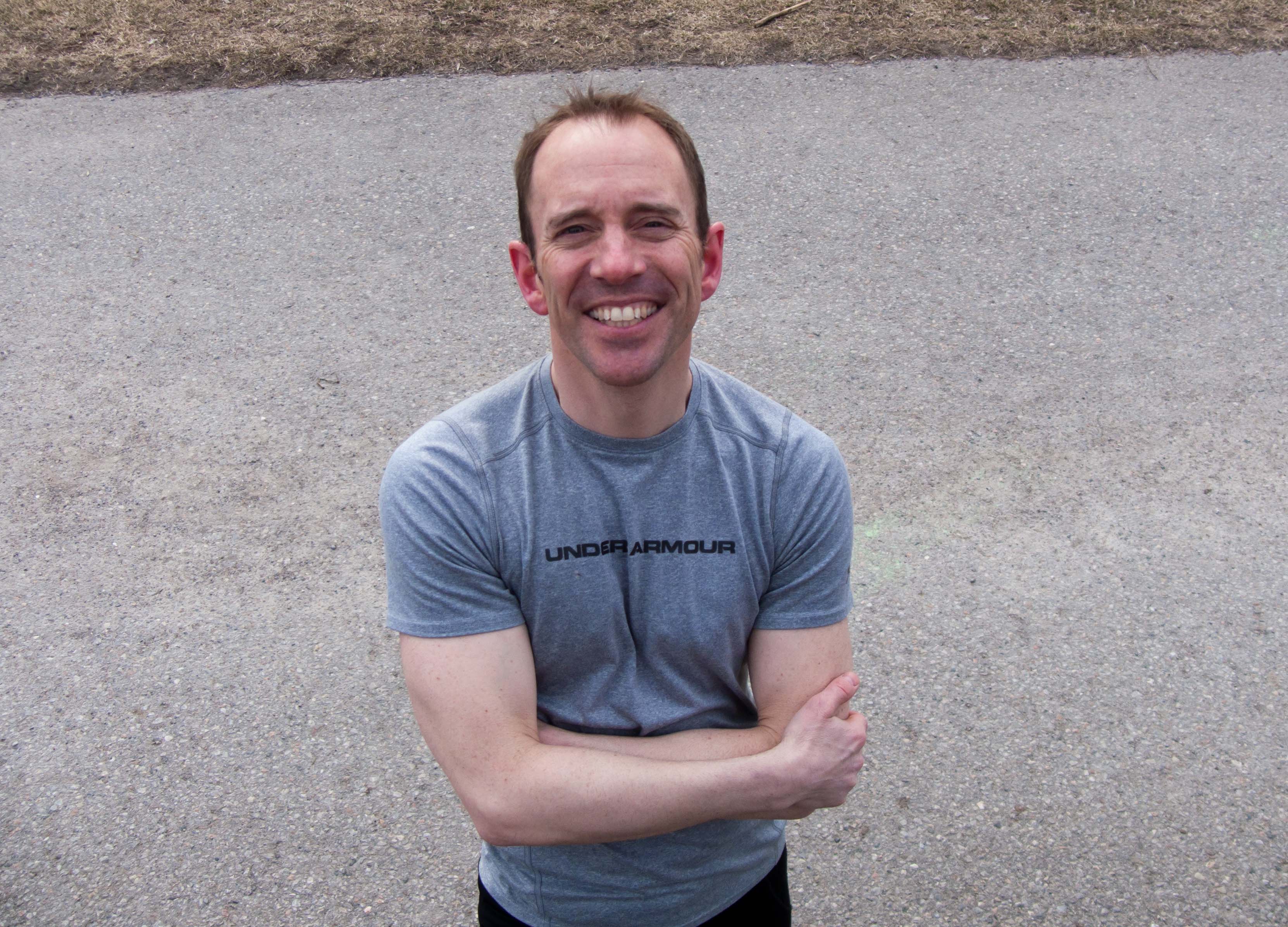
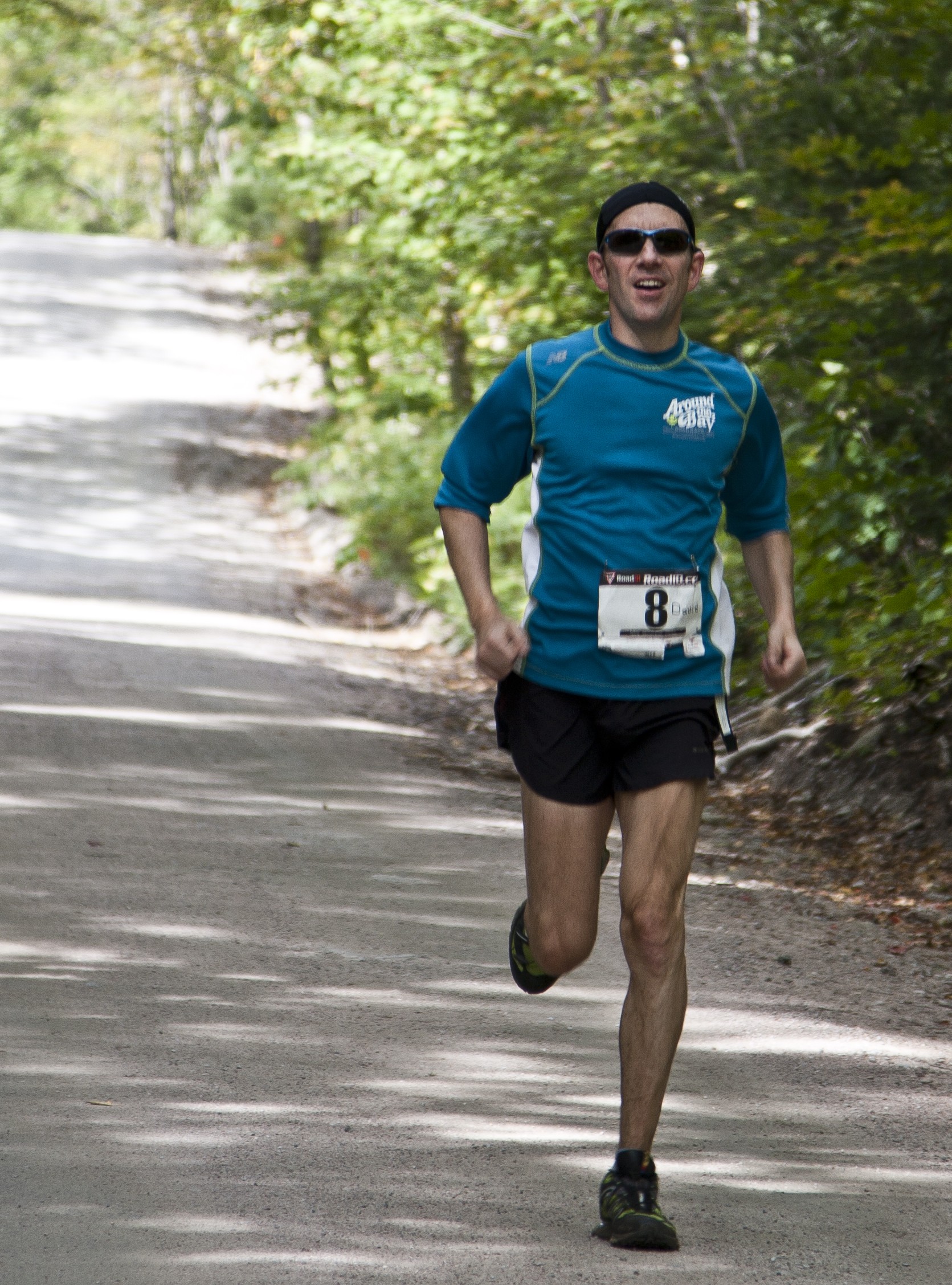
David Carroll running-3

The trouble is, I can’t eat enough food to keep pace with my caloric output.  60 miles per week = roughly 6000 extra calories burned.  That’s a lot of fettuccine alfredo.

My friend Paul tells me I should be cross training more.  Paul is a weight lifter, and he keeps promoting this thing called “repeat to failure.”

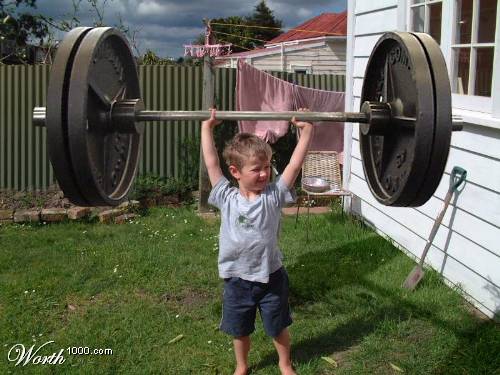
four-hour-body-weight-lifting

You wouldn’t think that weight-lifters are the smartest people.  Paul, for instance, spends most of his free time grunting and lifting impossibly heavy discs.  And yet, weight-lifters have somehow come up with one of the most brilliant concepts of all time.

Repeat to Failure basically means you lift the maximum amount of weight possible – for a limited number of repetitions.  Whereas you might normally lift a 20-pound weight fifteen times, with repeat to failure, you’d lift double the weight – but only for five or six reps.  The idea is to stress your muscles to the point of collapse while also – and this is the tricky part – avoiding injury.

Yes, there’s pain involved.  But, as my friend Paul points out, pain is how you grow.

“Every time I lift a massive weight over my head, I’m literally shredding my back and neck his muscles,” Paul told me. “But later on, scar tissue will grow on top of those damaged muscles.  And guess what that scar tissue will turn into?  Bigger muscles!”

Repeat to Failure strikes me as a wonderful metaphor for life.  Why tread on familiar ground, over and over?  We only grow by pushing ourselves beyond our comfort zones.  And the moment of our greatest failure can lead us to the threshold of our greatest success.

This is true whether you’re a weight-lifter, or a runner, or a writer, or a knitter, or a photographer, or a snake charmer or a Minecraft player.  We only get better by taking on bigger and heavier challenges.  And as much as the failures hurt, they almost always make us stronger.

Failures aren’t failures.  They’re stepping stones to success.

Coming Soon – My New Novel About Running

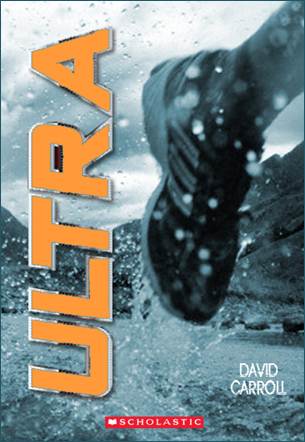
Ultra cover

The 100 mile race is a harsh and hostile immensity, and to take it on is to enter a war.

ULTRA is the story of Quinn’s war.  A war against fatigue, despair, dehydration, wild animals, hallucinations, and a dangerous family secret.

It’ll be published by Scholastic in September.

Ultra

Boredom is Good for You

It’s a dream come true, having a novel published.  Ever since I was a kid, I knew that I wanted to write.

But listen: It never would have happened if I hadn’t spent years being bored.

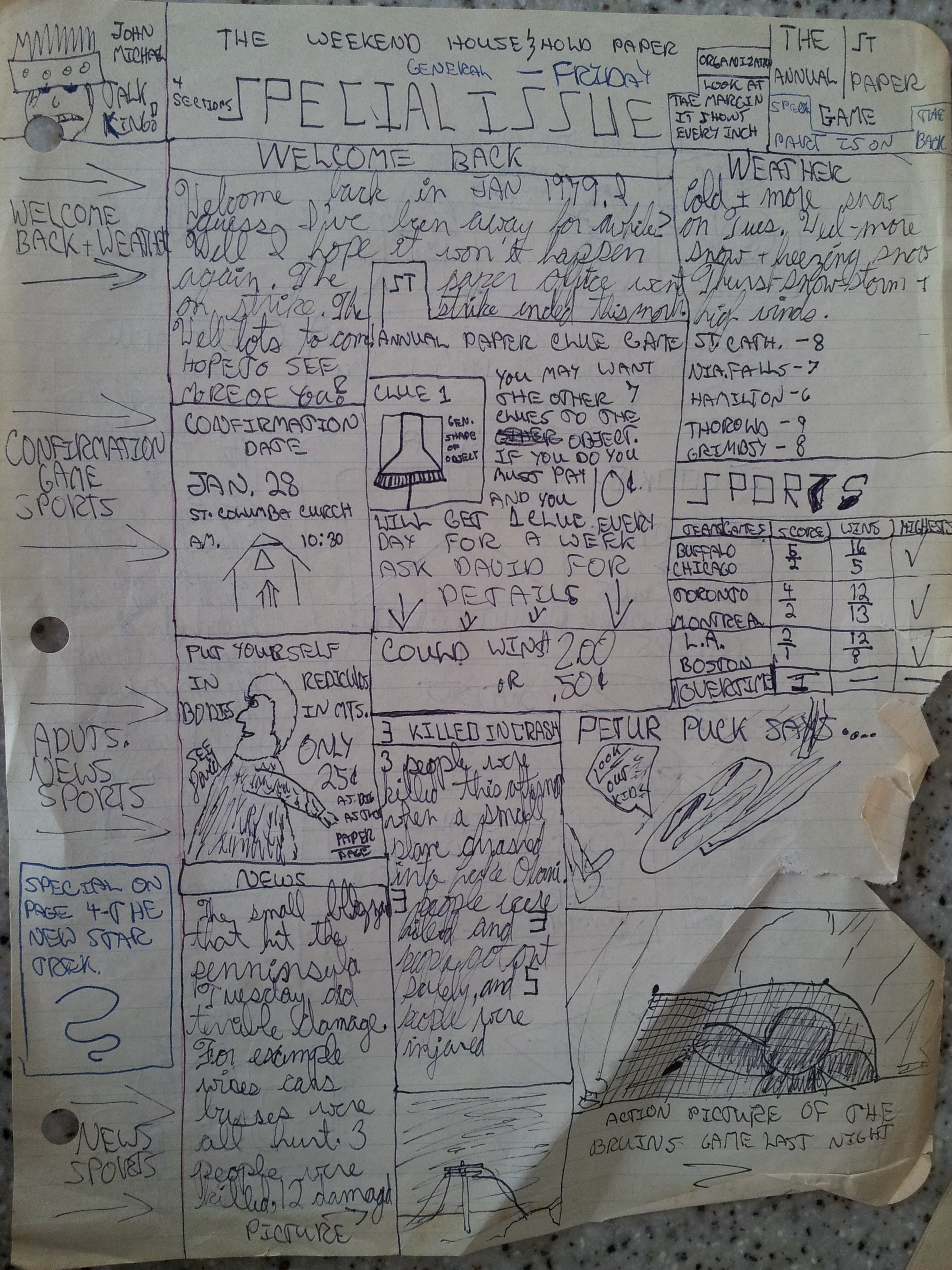
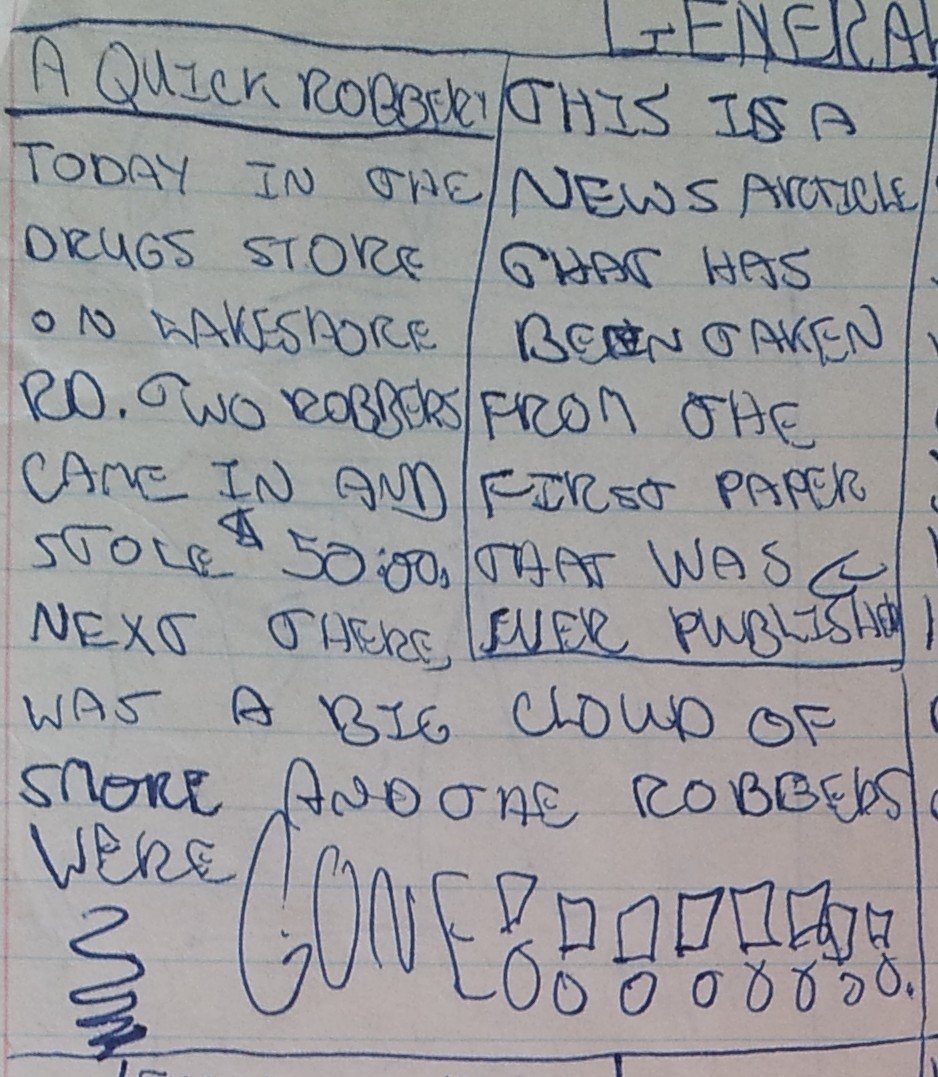
For instance.  When I was nine years old, I started cranking out a weekly newspaper.  It had a circulation of 5: my mom, my dad, my two brothers and me.  It looked like this:

weekend household paper 1

Why did I write this weekly rag?  Because I was bored!  We didn’t have a computer or the internet back then, so I had to write the whole thing out by hand.

Not many news stories happened inside our house, so I had to make most of them up.

weekend household paper 3

There was a big cloud of smoke and the robbers were gone!!!!!

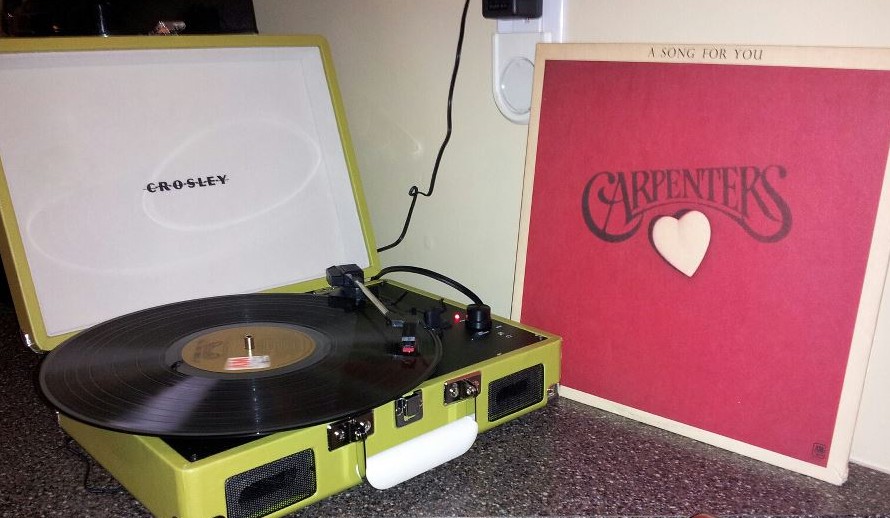
In addition to being a budding journalist, I also wanted to work in radio.  One Christmas, Santa Claus brought me a toy record player.  I immediately constructed a make-believe radio station in our basement.  I named the station C.H.O.W., and to my family’s immense pleasure I spun a lot of records by Supertramp, the Bee Gees, the Electric Light Orchestra, and yes, the Carpenters.

64683_10151384523493488_1789612412_n

I set the radio station up beneath the hot air vent, so that the music would carry all through the house.  I had to yell so everyone could hear me introducing the songs.

That changed when I got another present for my birthday:

Mr. Microphone turned me into a REAL broadcaster.  The signal carried ten metres in all directions, so you could hear me as far away as Mom and Dad’s bedroom (if you tuned your radio to 90.1 FM)!  I hosted a weekly chart show, and semi-regular newscasts in which I read the made-up news stories I’d written in the Weekend Household Paper.

Why am I telling you this?  Because sometimes you may feel bored.  I hope you do, because BOREDOM IS THE BEST THING EVER!  If I hadn’t been bored as a kid, I never would have written that newspaper, or set up that radio station.  And if I hadn’t done that, I might not be an author or a radio producer today.

So don’t be afraid of getting bored.  Instead, use that boredom to figure out what it is you love to do.  If you’re lucky, later on, you won’t have to chase after your dream career.  Instead, maybe it’ll come chasing after you.

Running with Borscht

The symptoms are unmistakable.  You’ve forgotten your kids’ names.  The family dog hates your guts.  And you’re getting bad vibes from that person in the kitchen who you suspect you may have married at some point.

I hate to be the one to break the bad news, but you’ve got an advanced case of Runner’s Guilt.  It’s a common affliction at this time of year, what with 20-mile long runs pre-empting our family responsibilities.

Happily, there’s a simple treatment for this scourge.  It’s called THINKING ABOUT OTHER PEOPLE FOR A CHANGE!

Here’s what you do.  First, draw up a list of the people in your life who are suffering.  Any kind of ailment will do – a layoff, hip replacement, a bad break-up, etc.  Enter the addresses of these afflicted souls into Google Maps.  Plot a course that equals your training distance, then run!

Note: while it’s important to stop and say hello to each of these afflicted friends, try to avoid prolonged conversations.  Yes, you’re on a charitable mission, but it’s equally important to keep your heart rate elevated.  By all means, give your friends a supportive hug, but don’t stop running for more than two or three minutes.

One other thing – and this part is crucial – you must impart a small gift to each of your friends.

The ideal gift is small and light; something that’s easy to carry during your run.  Gift certificates are perfect.  So are thumb drives full of music.  Packets of heirloom seeds will delight the green thumbs among your friends.

Then again, if you’re feeling especially generous, you can always deliver jars of Russian Cabbage Borscht.

borscht

A cautionary note: 1500 millilitres of Russian Cabbage Borscht weighs just over six pounds.  Three Mason jars full, swaddled in a bath towel and crammed tightly into a running backpack, weigh roughly the same as 8 litres of milk.

How do I know this?  I know this because I delivered that precise volume to a number of friends during a recent 35-mile training run (I’m prepping for a 100-miler).  Sounds insane, I know.  But to my credit, I  planned the run so that I’d unload the first jar fairly early in the run.  That is to say, at mile 19.

“It smells a bit like armpit,” my friend Farhad said, unscrewing the lid and taking a sniff.  (Farhad’s recovering from a nasty case of Shingles.)

“It’s better when you heat it up,” I said.

I’m not really sure what I was thinking with the borscht.  Borscht is a healing food; full of every colourful vegetable known to humankind.  Vanity also played a role, no doubt.  For years, Russian Cabbage Borscht has been my “thing.”  I make it with lots of sour cream and dill.  Blend it until it’s velvet.

Farhad dipped in a finger and took a taste.  “It tastes like dirt.  Really good dirt.”

The Running Shoes That Saved My Life

Muddy shoes

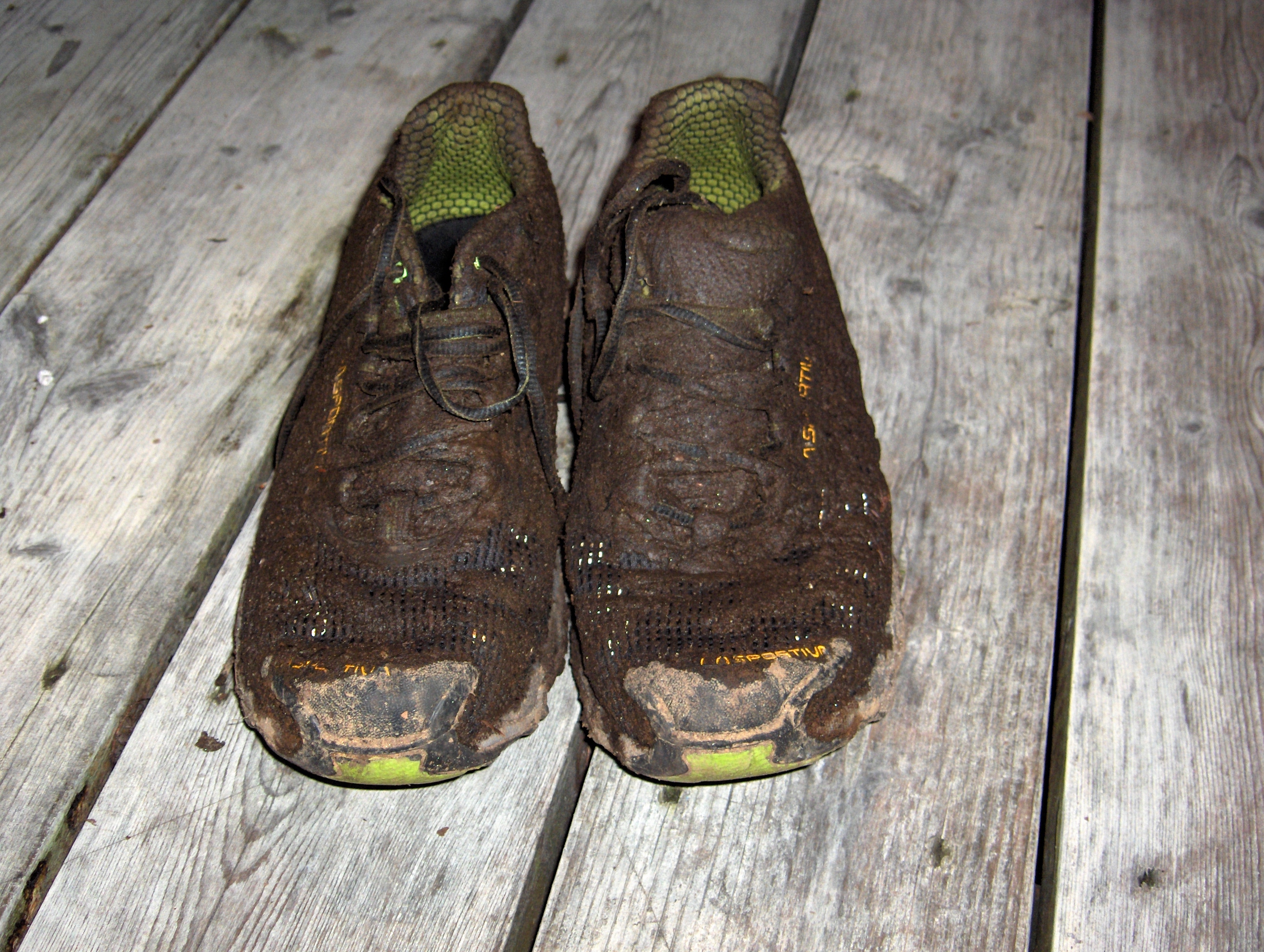
There they are.  My beloved Sportiva Wildcat Trail Runners.  Those shoes saved my life back in September 2011.

How did a pair of Sportiva Wildcat Trails save my life?

It’s an amazing story.  So amazing, I got invited onto CBC Radio to talk about it.

You can listen to the gory details here.

Yeah, but is it safe?

That’s Kaytlynn Welsch, age 12, center, and her little sister Heather, who is 10, just before they ran a half marathon in Utah last year.

Some people wonder how safe it is for kids to run that kind of distance.

Sometimes I even wonder if it’s safe for me!

Haliburton10-8308

A couple of years ago, while running a 100-mile race, I asked the following question of an on-site medic: “Is it healthy, running 100 miles at a stretch?”

It was 3 a.m. and the Doctor had been patching up battered runners for the better part of 24 hours.  “On the whole, I would have to say NO,” she said, looking at me over the waxy light of a Coleman lantern.

It had been a tough race.  The thermometer had risen to thirty degrees, and a bunch of runners had been evacuated to the local hospital with heat-related illness.  I’d been lucky.  I had some blisters, a nasty cut on my knee from a fall, and a strange rash I never really figured out (lyme disease?).  But that was all.

“Seriously?” I said.  “You think running long distances is unsafe?”

“For some people,” said the Doctor. “Absolutely.”

* * *

Distance running is not risk-free.  But the same can be said of virtually any activity worth doing. Playing hockey can be risky.  Same thing with riding a bicycle.  And as much as we try to convince ourselves otherwise, strapping fiberglass boards to our feet and launching ourselves down icy mountain slopes may not be the safest thing in the world.

And yet we still do it.  Because it’s FUN.

The trick is to use our common sense.  Check out what the Dad in this story says about the importance of getting checked out by a doctor.

As long as you’ve trained properly, and understand the importance of proper nutrition and hydration, and have the approval of your family doctor, and the support of friends and family members, and most important, if you really want to be out there, then why not run?  After all, there’s not much difference between running a marathon in 5 hours, and spending an afternoon playing soccer or Capture The Flag with your friends.

You Think I’m Extreme?

When I tell people that I run 100-mile races, they often say, “Wow, that’s so extreme.”

I don’t actually think it’s all that extreme.  Yes, it’s true, I once lost my sense of taste after running a 24-hour race.  I tried drinking Coke, eating chocolate cake, but everything tasted like water.  Like sand.

That’s the weirdest side-effect I’ve ever experienced.  Hardly life-threatening.

Yes, we ultra-marathoners run for 100 (or more) miles without stopping.  But what’s the worst that can happen when you’re traveling at 5 miles per hour?

It’s not like we’re racing down the side of a mountain on a bike:

http://youtu.be/zr_pO9DTJpM

This eye-popping urban bike race takes place every year on the ancient streets of Valparaiso, Chile.   The riders have to deal with jumps, flights of stairs and, as you may have noticed at the 37 second mark, stray dogs.

THAT, my friends, is EXTREME.

And yet, as great as that POV video is, it isn’t my all-time favourite cycling film.   Unlike running, cycling is romantic, so it really needs a shot of  amour Montreal…

If I could be reincarnated as anything, I’d come back as a Francophone cyclist.

The First Hundred Miles

Michael Stipe, the lead singer of the rock band REM, once said this about the music of Arvo Part:

“It’s like a house burning down amid an infinite calm.”

That’s pretty much what running a 100-mile trail race feels like.  The forest slumbers peacefully all around you, while your body immolates itself.

Dave's race (03)

It’s not like I go around looking for pain, but I like to learn things, and I learn an awful lot about myself when things are really uncomfortable.  Dostoyevsky had it right when he said: “Suffering is the sole origin of consciousness.”

50 down, 50 to go (1)

I ran my first 100 miler way back in 2008.  I thought I knew a thing or two about ultra marathons since I’d already run a handful of 50-milers and marathons.

I knew nothing.

“There’s a lot more going on in the 100 than in the 50,” a veteran runner told me at the pre-race spaghetti dinner.  “The 50 is child’s play.  The 100 is for grownups.”

I’d done a lot of physical training, but I wasn’t prepared for how surreal the run would be.  I certainly didn’t realize that the race really only takes place during the daylight hours.  Once night falls, most people slow down to a walk, and the “race” becomes little more than a night hike.  For my part, I managed to travel all of 18 miles in the final 7 hours of my inaugural 100 miler.  That’s a pace of roughly 2.5 miles per hour.  Previously, I would have been disgusted by that pace.  Now I can see only the victory in it, knowing the agony required to keep a battered body moving after 83 miles.

Neither was I prepared for the sheer beauty of the race.  Running through a forest at night is like running through a Grimm’s fairy tale.  There’s magic all around you, and danger too.  And there’s no guarantee of a happy ending.

Night Running, somewhere around mile 75

Night Running, somewhere around mile 75

Most memorable moment: coming into the 75 mile turnaround.

2 women were volunteering at this lonely outpost.  They were watching over a small campfire and a Coleman stove.  They offered me lasagne and chili, but I declined, knowing that I couldn’t possibly keep any solid food down.

“Nice night isn’t it?” one of the women said.

“A jolly good night!” I chirped, suddenly deciding, God knows why, that it was time to speak in a British accent.

“How about some chicken soup?”

This appealed.  “Smashing!” I cried.  “The absolute tops!”

The canopy of stars rotated above us.  I sat down at a picnic table.  It was the first time I’d sat down in 17 hours.  Someone had hung a small disco ball from a tree branch, and a lantern was burning right above it, so that the fractured lights from the disco ball swirled across  the backdrop of trees.

One of the women handed me a steaming Styrofoam cup full of chicken soup.  The noodles were crunchy, and the broth was saltier than the Atlantic.  It was like I was sucking on the keel of an ocean liner.

“You from the city?” the second woman asked.

“Yes, Parkdale.”

“Hey, me too!”

I decided that these two women were ghosts.  It seemed impossible that they could be out here at the end of the world in the middle of the night, serving crunchy chicken noodle soup by the light of a disco ball.

“Are you having a good race?” the first ghost asked.

“It’s hard to tell,” I said.  “I’m hurting quite a bit.”

“Everyone’s hurting out here,” said the second ghost.  “I bet that a few days from now you’ll realize that you’re having an awesome time.  I mean, how often do you get to run through a forest in all night long?”

I nodded and slurped my soup, unconvinced.  “This really is incredible soup,” I told the ghosts.  “You two really ought to set up a little restaurant out here.  You probably wouldn’t get many clients out in the forest.  But the people who do show up would probably be enormously grateful.”

The two women stared hard into my eyes.  “Are you sure you’re okay to keep running?” they asked.

* * *

A couple of hours later, I stopped running to take a nature break.  I turned out my headlamp and peed into the void.  I had never seen such darkness, or heard such silence, in my life.  After I finished I stood in the dark for a few moments longer, mindful of the great privilege it was to be there in that place, in that moment, in spite of all my pain.  I was healthy, fit, upright, and enjoying nature.  Tomorrow I’d be back in Parkdale, leading my dishwater life, checking Facebook and listening to Phil Collins on the radio.

A part of me wished I could stay in that moment forever.  But I was also worried that some racer behind me was drawing ever closer, so I snapped my light back on and kept running.  And running.

The Final Stretch

The Final Stretch

The final few kilometers of the race were very hard.  Somewhere around 3 a.m., I realized that I wasn’t going to break the 24-hours barrier.  It was a crushing blow, and for the final 12 miles, I fell into a terrible despair.  For some reason, I was absolutely convinced that my friends and family would be deeply ashamed of my inability to run a hundred miles in anything less than 24 hours.  I actually wept on the trail, thinking of their disappointment.
I know – I’m insane.   I could have finished the race in 48 hours, 72 hours, A WEEK, and my family would have buried me in roses.  And yet, in those final miles, all I could see was failure.

And then, far off in the distance, I saw the finish line.

David finishing 100 mile race

In the few seconds after I crossed that line, I nearly went unconscious.  I could barely hold my head up straight, and my eyes refused to look in the direction I wanted them to look.

“Are you okay?” a woman asked.  I said yes, because I didn’t want to scare her, and also because I was pretty sure that I would be okay in a second.  Someone sat me down at a chair beside the fire and my consciousness slowly returned, and I became dimly aware that I wasn’t dying of a stroke after all.

* * *

What I told Shawna, immediately after the race: “That was really stupid, I can’t believe I did that.  It’s too extreme and dangerous.  I’m never doing that again.”

Phone message I left for my friend Kai, 3 hours after the race: “It was an interesting experience, and I’m glad I can scratch it off my bucket list.  But there’s no way I’ll ever do that again.”

Phone message to my friend Mary, after I’d had a nap: “Hey Mary, I’m still alive.  Not in a coma, so stop worrying.  It was amazing.  Totally amazing.  I HAVE to do this again!”

DNF, or How Pain = Learning

Warning: a graphic picture of my feet appears in this post.

But first, a very pleasant image:

r-BABY-BATS-large570

A bunch of baby bats, wrapped up in little blankets.  I don’t know why they’re wrapped up like that.  Maybe they were cold and wet.  Just like me, last September…

***

I already mentioned that I run 100-mile races, right?  That once or twice a year I go to some remote forest, line up with a bunch of crazy people, and run without sleeping for 24+ hours.

It’s a weird sport called ultra-running.  I’ve run a dozen or so of these ultra-marathons in the last five years.

Every single time, I finished successfully.  Until last September.  When I ultra-failed.

The Haliburton Forest Trail Run is held at the Haliburton Wildlife Reserve; a sustainable forest tucked into the armpit of Algonquin Park.  You run 25 miles out into the heart of the forest, then you turn around and run 25 miles back.  And then you do the whole thing OVER AGAIN.  The race took place last September 8, which, in case you’ve forgotten, was a rainy day.

Very rainy, come to think of it.  It rained for eighteen hours before the race began, and then, for good measure, it rained another 12 hours while the race was happening.  This created a lot of mud.

Here I am at the 50 mile turnaround:
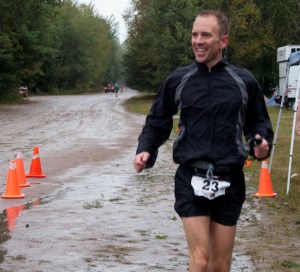
David Haliburton 2012

I look happy, don’t I?  Don’t be fooled.  I’d been running for ten hours, and I was far from happy.  I was…what’s the word….oh yeah – UNHAPPY!

Everyone was in pain out there.  At mile 54, I caught up with a young guy named Pablo.  Pablo was having trouble with his hip, and he squinted with every step he took.  He wasn’t giving up, though.   “Pain equals learning,” he told me.  “If you aren’t feeling any pain, then you’re not learning anything.”

The rain finally stopped, and darkness fell.  At the 68-mile checkpoint I pulled on my headlamp.  I ran for two miles, then noticed that the light was flickering.  Cheap Dollar Store batteries!  I ran two miles back to the aid station and picked up my spares.  These worked fine, but I’d had to run four miles out of my way.

(2nd warning – that picture of my feet is coming soon!)

I reached the 75-mile checkpoint by 11pm, which meant I still had a shot at finishing the race in 24 hours.  Shawna surprised me at the aid station.  She fed me yogurt-covered raisins and salted yams, and told me that I looked surprisingly good, considering the circumstances.

Luckily, she didn’t ask to see my feet.
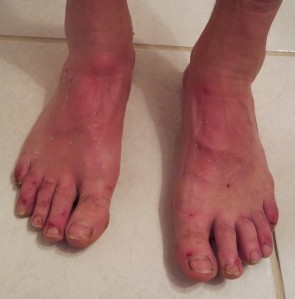
Dave's gnarly feet 1

Those are the tops of my feet.  Believe me, you don’t want to see the bottoms.

Remember, I’d been running through muddy oil-slicks for 17 hours straight.  I probably should have changed shoes and socks and greased my feet with Vaseline, but that would have taken an extra twenty minutes (it takes a lot of time to perform these seemingly simple manoeuvres when you’re wet and cold from 17 hours of running).

I ran on.  I made it to the 85 mile checkpoint, but then things started to fall apart.  At the top of a hill, I saw a two-storey marble sculpture of a rabbit.  I ran closer and realized it wasn’t a marble sculpture at all, but a tree.  I became dizzy.  My feet were SCREAMING with pain.  So was the chafing on my, er, undercarriage.  I slowed down to a walk.  And then, without the heat generated from the running, my body temperature plummeted.

I was wearing three layers of clothes, plus a running jacket and tights, but it wasn’t enough.  The temperature dipped down to 5 degrees, and I began shivering uncontrollably.  I could barely hike the hills I’d pranced up earlier in the day.  A germ of an idea took root in my mind.  You don’t have to finish if you don’t want to, it said.

It’s called a DNF, and it stands for Did Not Finish.  I’d never DNF’d in my life.

But the pain in my feet was getting worse and it felt like my butt cheeks were being ripped to shreds with every step.  The germ solidified in my mind.

And so, at 3 a.m., after running 89 miles (which was actually 93 if you count the extra miles I ran to get my spare batteries), I did something truly crazy.  At the intersection of Ben’s Trail and Krista Trail, right near the makeshift Shrine which was the inspiration for a VERY IMPORTANT SCENE in my soon-to-be-published novel (“ULTRA,” Scholastic, Fall 2013), I intentionally walked off the trail.

“This is how it feels to DNF,” I told myself, stepping over the line of orange and pink flags.

And you know what?

It felt GREAT.

Mind you, after leaving the course, I still had to bushwhack two more miles through the forest before I stumbled upon a logging road.  And then I had to wait until a car came along and mercifully picked me up.  So in the end I figured I covered 95 miles.

Which wasn’t enough.

****

23 people finished that race.  31 DNF’d.

Pablo, that guy I’d chatted with during the race, was one of the successful ones.  I cheered as he crossed the finish line.  When he saw me, he beamed.

“How did you do?” he asked.

“I DNF’d,” I admitted.  “I couldn’t handle the mud.”

“What?  No!  You were looking so good out there!”

It took a while to convince him that this was good, that this was my decision, and I was comfortable with it.  I’ve had plenty of successful races before, and I wanted to see how failure played out.  There is a cult around winning, around success, completion.  But there is a wintry beauty in its opposite – in failure, chances lost.

“Pain equals learning,” I reminded Pablo.

He grinned, leaned down and rubbed his hip.  “Then we must be geniuses now,” he said.

* * *

One last thought on pain and learning.

rejection letter

This is a standard rejection letter, from one of those highbrow literary journals that almost all writers dream of getting published in, but that very few people actually read.  I’ve got millions of these forms lying around, from all the lousy short stories I sent out over the years.

Every one of those letters stung.   But as Pablo pointed out in the race, pain can be instructive.

If you’re going to be a writer, you’ll have to deal with rejection at some point.  But you can view these rejections in one of two ways:

1) You can see them as stop signs.  As brick walls.

2) Or you can see them as an invitation to keep pushing.

If you’re suffering from hypothermia, or excruciating chafing, by all means, take some time off to recover.  Otherwise, keep writing.  The finish line is out there – somewhere.