Back in 2007, I met a hardcore trail-runner in Yellowknife. He was as tough as the Canadian Shield, and skinnier than two toothpicks tied together. He took me out for a run along the “highway to nowhere.” As we ran, mile after mile, past the Giant Mine, where 9 men tragically lost their lives in an explosion 1992, he told about some of the running adventures he’d had over the years. The animals he’d run into during long trail races (Grizzlies, wolverines), and the times he’d nearly broken ankles in the dark. “You have to be prepared,” he said. “In every race, there is a surprise.”
A couple of months later, I ran my first Ultra-marathon. And he was right. I got a BIG surprise.
The Niagara Ultra, at a mere 50 kilometers, is the Maggie Simpson of Ultra-marathons. Still, it’s 8 kilometers longer than a conventional marathon, which seemed like a big leap to me at the time.
I drove down to Niagara-on-the-Lake at 4:30 a.m. on a June morning, got my BIB (#105) and sat in the Kinsmen Hall in my singlet and shorts, trying to stay warm until the race began. The forecast was calling for clear, cool weather. The sun rose over the Niagara River while Huey Lewis and the News sang about “The Power of Love” on the radio.
At 6:45 I went outside and joined the other runners. There were maybe 100 of us standing about on a grassy field, rubbing our arms for warmth. A stern man outlined the route and thanked the various local sponsors. Then suddenly he said, “Is everyone ready? Okay then, GO!”
There was no count-down clock and no pumping music. Suddenly the hundred of us were running across the dewy meadow.
Things happened very fast. The pack merged onto the Niagara Parkway path; a recreational trail that snakes alongside the Niagara River. We were to run from Lake Ontario in the north to the great falls in the south, and then back again. The crowd of runners quickly thinned out, and I got into a groove.

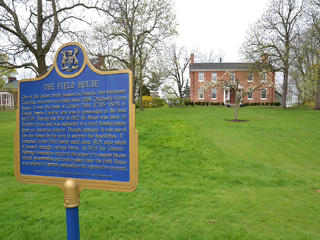
The asphalt trail was shaded by mature oaks and elms. Shortly after the first aid station, I ran past the Field House, the stately brick home General Brock used as his headquarters during the War of 1812. More importantly, it was where my beloved Gran lived for many years, and where I spent many Christmases and Sunday dinners.
But there was no time for nostalgia – I had a race to run! I climbed the Niagara Escarpment to the hamlet of Queenston, ran past the floral clock, the hydro electric plant where the Niagara river thins out, and the lush green golf courses. I banked the first 10 kilometers in 46 minutes, which seemed a dangerously fast pace for me at the time. At the 15k aid station a volunteer told me that I was in seventh place. Seventh! Never in my life had I ever been in seventh place for anything!
Unfortunately, this was not my only surprise in this race. A much worse revelation was yet to come.
I ran into the city of Niagara Falls. No roads had been closed for this race, and there weren’t any police officers to hold back traffic. Runners were expected to follow the sidewalks, and obey traffic signals. Since it was now 9 a.m. on a sunny June morning, I found myself dodging tourists with cameras, jumping over “Maid of the Mist” turnstiles, and waving at curious honeymooners.

And then, there it was. Niagara Falls. I’d grown up just down the road, and had visited the falls any number of times, and yet, on this morning it looked more beautiful than ever before. I wanted to stop and stare at the falls. But I didn’t. My 7th place was on the line.
At the turnaround I downed a cup of Gatorade, and doubled back towards Niagara-on-the-Lake, passing the runners immediately in my wake. The bulk of the pack was roughly 5 k behind me.
I swallowed one gel at the 25 k turnaround, and another at 35 k. Hydration was not a problem. But – SURPRISE – my bowels were.
Yes. The B word. I could feel the pressure starting to build. It became quite a distraction, and I kept my eyes peeled for a porta-potty.
At the 40 kilometer mark I was still clinging to 7th place, but a guy named Doug kept catching up to me whenever I stopped to talk to the volunteers at the aid stations. “Bathroom?” I’d say. They’d shake their heads, no. Doug would roll in behind me, and I’d sprint off again.
A couple of times, Doug got ahead of me. Each time he came across a paper cup that someone had discarded on the road, he’d bend down, pick it up, and carry it to the garbage can at the next aid station. He did this over and over again. After a while, I started doing it too. At big city races, there are hundreds of volunteers to clean up after the racers, but in a small race like this, it made sense to clean up after ourselves.
Of course, it wasn’t easy to bend down after having run 40k – especially now, when most of my strength was going into holding my butt cheeks clenched together.
At 46k, Doug passed me for good. I was fighting off waves of gastric pain, and I could barely run anymore. And so, with 4 kilometers left to run, and no relief in sight, I succumbed to the inevitable. I jumped off the path, scrambled down the side of the gorge into the forest, and squatted.
While I took care of business in the gorge, I could hear runner after runner springing past me on the path above. My 7th place was long gone. But I didn’t care. I was feeling fine.
I’m sorry to tell you a story involving poop. But there’s no way around it. Bodily functions, and learning how to deal with them, is a big part of ultra-running. You can’t expect to run for 6, 12, or 24 hours at a time, and not have to think about the food that goes in, or comes out of your body. It’s life.
Happily, I learned a couple of things from that “surprise.” For instance: don’t eat any dairy products in the 24 hours leading up to a race. For me, that usually prevents unwanted bathroom breaks.
I also learned to always run with toilet paper. And to never shake hands with an ultra-runner at the finish line – at least until you’ve both washed your hands.
The Niagara Ultra-marathon takes place Saturday, June 22nd. You can find out more about it HERE.


 Write...Run...Repeat...